 MineArchive
Anhydrite
| Also known as | Anhydrous Gypsum (Older descriptive name emphasising its relationship to gypsum) |
|---|---|
| Category | Commodities |
| Commodity page | Anhydrite → |
Anhydrous calcium sulphate — gypsum's drier chemical twin, formed the same way but without the water locked into gypsum's crystal structure — worked in Britain not as a building material but as the raw material for making sulphuric acid.
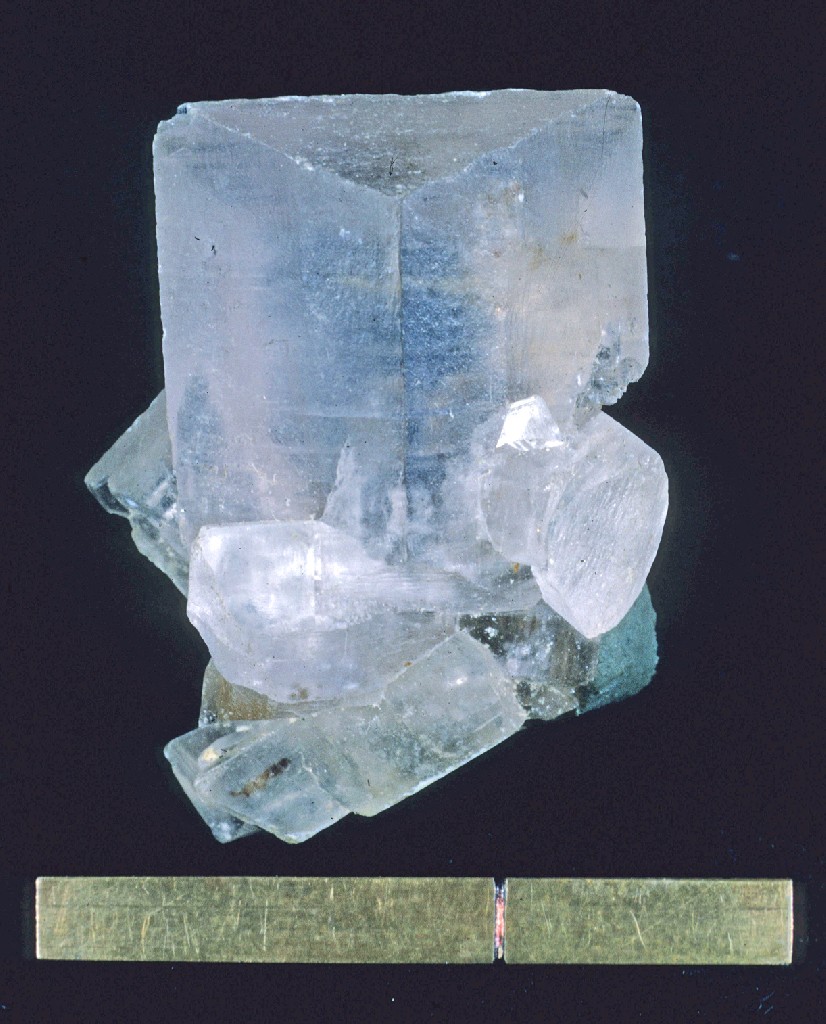
Historical usage
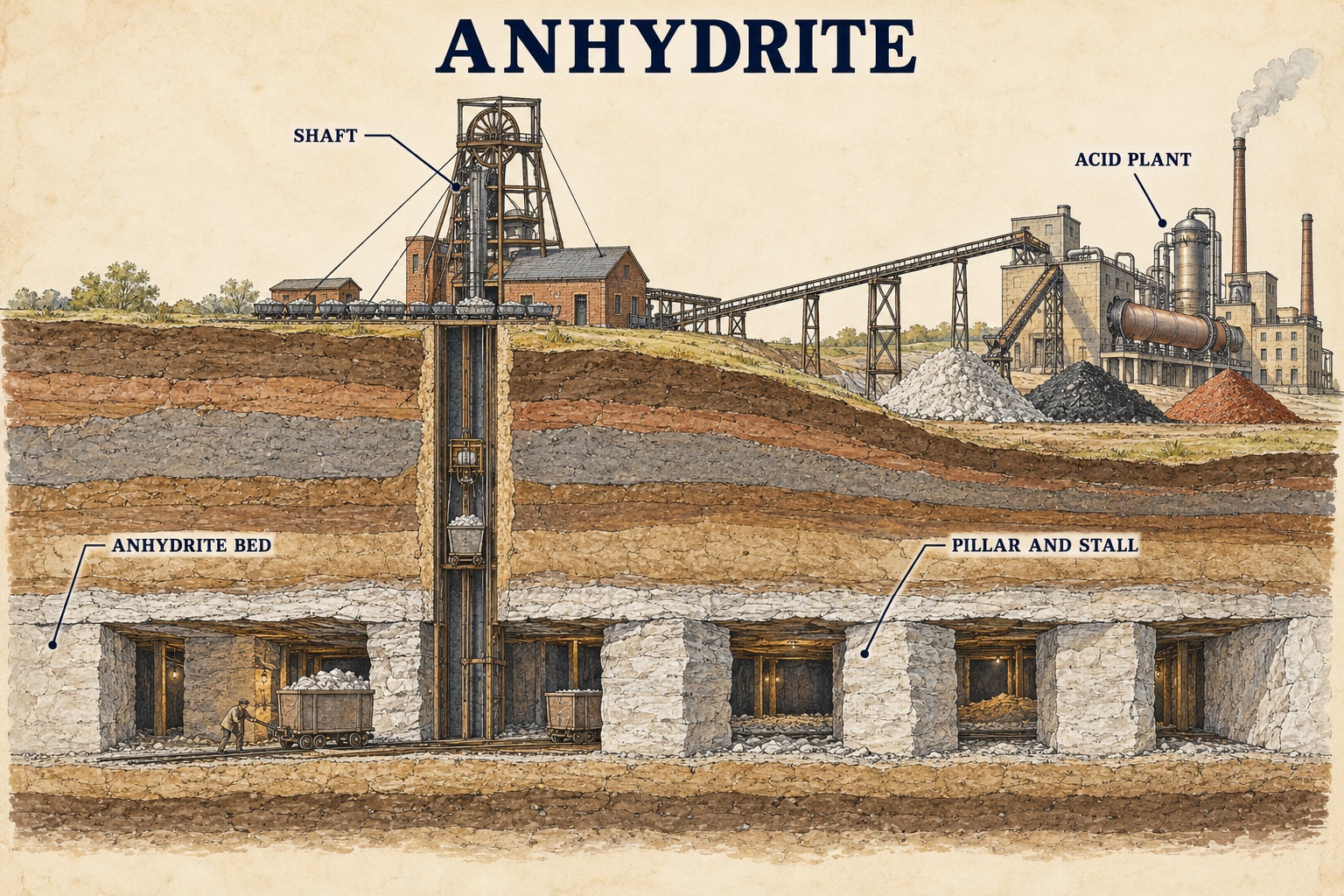
Anhydrite was proved beneath Billingham by drilling from 1924, and ICI launched a project to make sulphuric acid from it in 1926; the shaft that reached it was sunk that September, bottoming fourteen months later, and the mine went into production in November 1927. Over the following forty-four years the mine yielded more than thirty-three million tons, feeding the ICI Billingham works — at its 1960s peak the second largest chemical factory in the world. Production ended in 1971 and the shaft was capped in 1978.
How it worked
At Billingham the anhydrite bed, five to six metres thick, was worked by pillar-and-stall mining beneath the chemical works, brought up a single shaft and taken to the plant by conveyor. There it was roasted with coke and clay in the Müller-Kühne process, which produced sulphuric acid and a calcium silicate clinker together — the clinker suitable for grinding into Portland cement, so that one raw material and one process yielded two saleable products at once.
Why it was used
Anhydrite offered a way to make sulphuric acid, and the ammonium sulphate fertiliser that depended on it, without importing sulphur — of real strategic value to a nation that otherwise had to bring virtually all its sulphur in from overseas. That the same process also yielded cement clinker as a saleable by-product made the economics still more attractive while the chemistry of the wider industry favoured it.
Value over time
Anhydrite had essentially no market value until ICI's 1920s process gave it one, and its whole economic life was tied to that single use: making sulphuric acid and cement clinker together for a captive, adjoining chemical works rather than for open sale. That value collapsed not because the mineral ran out but because the wider industry changed around it — post-war Billingham progressively switched its feedstock and fuel from coal to natural gas, adopted elemental sulphur instead of anhydrite as its acid-making raw material, and phased out ammonium sulphate fertiliser altogether, leaving the mine with nothing left to supply by 1971.
Hazards & challenges
No hazard specific to the mineral itself is documented beyond the generic risks of pillar-and-stall hard-rock mining at depth — roof and pillar stability, and the usual dust of drilling and blasting anhydrite rock.
Risks & limitations
The process depended on a specific and fairly narrow chemical route — roasting calcium sulphate with coke and clay — which could not easily adapt when cheaper sulphur sources became available elsewhere in the industry; the mine's viability was tied to that one process remaining the most economic way to make acid, not to the size of the reserve, which by closure was still far from exhausted.
Regional variation
Anhydrite occurs in the same broad Permian Zechstein evaporite sequence that gives Britain the potash of Boulby and the salt of Cheshire, differing from those neighbours chemically rather than geologically — anhydrite is calcium sulphate, potash is potassium salts, and rock salt is sodium chloride, three distinct evaporite minerals laid down from the same drying Permian sea. It also differs from gypsum, the hydrated form of the identical compound calcium sulphate, worked instead at Kirkby Thore and at Brightling and Mountfield.
Related terminology
Mines associated with this term
Included only where MineArchive's own research gives a reasonable evidential basis — not every mine where this might plausibly apply.
- Long Meg Mine — Cumbria (well documented example)
Named 10 times in this record, first in the summary: “Long Meg was a gypsum and later anhydrite mine in Cave Wood Valley just north of Little Salkeld in the Eden…” - Billingham Anhydrite Mine — Stockton-on-Tees (well documented example)
The only anhydrite mine in the archive, and the reason the mineral has any economic history in Britain at all — documented in full on its own record. - Brightling and Mountfield Gypsum Mines — East Sussex (well documented example)
Named in this record’s closure notes: “…than out of the ground; what Brightling raises goes mainly as an anhydrite and gypsum blend to the cement industry.” - Cocklakes Mine — Cumbria (well documented example)
Named 9 times in this record, first in the summary: “Cocklakes worked the gypsum and anhydrite of the Eden valley a few miles south of Carlisle, beginning as a…”
See every mine that worked anhydrite →
Sources
- (primary) Billingham — Cement Plants and Kilns in Britain and Ireland — cementkilns.co.uk
- (secondary) The Anhydrite Process for Sulfuric Acid and Cement — cementkilns.co.uk
Record created: 24 August 2026 · Last researched: 24 August 2026