 MineArchive
Long Meg Mine
| Also known as | Long Meg Drift, Long Meg Gypsum and Anhydrite Mine |
|---|---|
| Location | Cave Wood Valley, north of Little Salkeld, Cumbria — 54.7327, -2.6790 (exact) |
| Commodities | Gypsum, Anhydrite |
| Type | Mineral |
| Worked | 1880–January 1976 |
| Maximum depth | Unknown. The mine was worked from a drift, not a shaft. |
| Operators | Long Meg Plaster Company Ltd. (1880–?), Carlisle Plaster and Cement Company Ltd. (?–1915), Long Meg Plaster and Mineral Company Ltd. (1922–1939), British Plaster Board Limited (1939–1976) |
Overview
Long Meg was a gypsum and later anhydrite mine in Cave Wood Valley just north of Little Salkeld in the Eden valley, worked from a drift rather than a shaft and served by its own standard-gauge branch off the Settle–Carlisle railway. It ran in two distinct lives — gypsum from 1885 until abandonment in 1914 or 1915, then anhydrite from 1922 until January 1976 — and shipped over five million tonnes before it closed. It takes its name from the Long Meg and Her Daughters stone circle nearby.
History
The Long Meg Plaster Company Ltd. was established in 1880 and drove an underground drift on which operations began in 1885. In 1886 a standard-gauge extension line was run in from the Settle–Carlisle railway, a distance of about 350 metres. The return for that year records a workforce of twelve, all of them at surface, gives the mine's name as Long Meg Drift, and names A. K. Busby as agent.
By 1902 the workforce had grown to 26, twelve underground and fourteen at surface. Then it collapsed: by 1914 only six were employed, four below ground and two above, and the mine was abandoned at some unrecorded date in 1914 or 1915. The operator at that point was the Carlisle Plaster and Cement Company Ltd.
It reopened in 1922, and for a different mineral. The Long Meg Plaster and Mineral Company Ltd. worked it for anhydrite, the anhydrous form of calcium sulphate, and in 1939 the concern was bought by British Plaster Board Ltd., now British Gypsum. Through this second life the workforce moved between twelve and twenty-nine — as few as four and as many as twenty-two underground. The 1930 return records the mine under Vincent Bramall of Riverdale, with L. Graham as agent and eight men underground, working gypsum.
The millionth tonne of anhydrite was shipped to the works at Widnes on 20 May 1959, and more than five million tonnes were extracted before the mine closed in January 1976. Long Meg kept its own locomotives to shunt wagons between the mine, the plaster mill and the junction with the Settle–Carlisle. One of them, an 0-4-0 Barclay named W.S.T. after the plaster company's deputy chairman William Steuart Trimble, arrived on 10 June 1954, was transferred away in 1969, and survives at the Bowes Railway in Tyne and Wear.
Geology
Long Meg worked the evaporite beds of the Eden valley, where gypsum and anhydrite occur in the Permian and Triassic sequence. Both are calcium sulphate: gypsum is the hydrated form and anhydrite the anhydrous one, and which of them a bed contains depends chiefly on how deeply it has been buried, since gypsum dehydrates to anhydrite at depth and anhydrite rehydrates back to gypsum where groundwater reaches it near the surface. That is why the mine changed mineral without changing ground: the shallower, hydrated gypsum was taken first, and the deeper anhydrite afterwards for a different market. Evaporites of this kind are laid down where an enclosed body of salt water evaporates faster than it is replenished, leaving its dissolved salts behind in beds.
Geological setting: Evaporite Deposits (well documented example)
Workings
An underground drift mine — the 1886 return calls it Long Meg Drift — rather than a shaft mine, driven into the valley side in Cave Wood. From 1886 it had its own standard-gauge branch running about 350 metres to the Settle–Carlisle railway, with its own locomotives shunting between the mine, the plaster mill and the junction, and its own signal box on the main line. Surface plant included a large concrete loading platform, apparently of the mid twentieth century, and loading gear beside the sidings.
Closure
The mine closed in January 1976, after more than five million tonnes had been taken out. This was the second closure: the gypsum working had already been abandoned once, at an unrecorded date in 1914 or 1915, before the site was reopened for anhydrite in 1922. No source gives a reason for the 1976 closure.
What remains
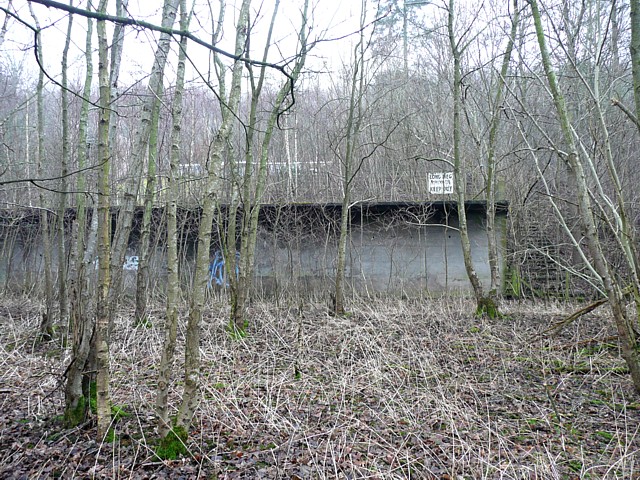
Derelict and decaying, but open to view. Much of the site can be seen from the public footpath along the banks of the River Eden between Little Salkeld and Lacy's Caves. The rail tracks have not been lifted in many places and the footpath follows their line, with metalwork and sleepers exposed; the branch signal box still stands, left to decay like the mine buildings. What appears to be the entrance to the drift has been filled in. Objects including wagons have been left about the site. The newer buildings carry danger notices, while the older ones stand unfenced beside the footpath, and the site has clearly been visited: several buildings are covered in graffiti.
Mine buildings in poor repair, a large concrete loading platform of apparently mid-twentieth-century date, the sidings and the site of the loading gear, exposed rails and sleepers along the footpath, abandoned wagons, and the branch line's signal box on the Settle–Carlisle. The drift entrance appears to have been filled in.
Related mines
- Brightling and Mountfield Gypsum Mines — Both were worked by British Plaster Board Limited, which bought the Long Meg concern in 1939 and held the Sussex gypsum mines as well — the same company working calcium sulphate at opposite ends of the country, from the Permo-Triassic evaporites of the Eden valley and from the Purbeck beds of the Weald.
- Cocklakes Mine — Both Eden valley calcium sulphate mines, and connected twice over: the Long Meg Plaster Company and John Howe and Company of Cocklakes were among the concerns amalgamated into the Carlisle Plaster and Cement Company in 1911, and in later years the two mines shared a locomotive fleet moved between them and Kirkby Thore as required — the saddle tank WST of 1954 among them.
Nearby mines
- Hartside Mine — 5.8 miles (9.4 km) NE
- New Stamphill Mine, Kirkby Thore — 8.1 miles (13.1 km) SE
- Kirkby Thore Gypsum Mines — 8.5 miles (13.7 km) SE
- Rodderup Fell Mine — 8.7 miles (14.0 km) E
- Upper Slatesike Mine — 9.0 miles (14.5 km) E
Straight-line distance, within 9 miles (15 km). Show on the map.
What's uncertain
Points where sources disagree or the record could not be settled; both accounts are kept. All open questions in the archive.
- The BGS mine-plans catalogue holds a Mining Remediation Authority abandonment plan titled 'Long Meg' (catalogue OM6294, Gypsum Or Alabaster, dated 1914); the catalogue gives no location and the plan's details do not clearly tie it to this working, so it may belong to another of the same name. (uncertain) 4
Recorded claims
Individual factual claims, each attached to the source(s) that support it below. Where sources disagree, both are kept.
- The Long Meg Plaster Company Ltd. was established in 1880 and drove an underground drift upon which operations commenced in 1885. 1
- In 1886 a standard gauge extension line was connected to the site from the Settle-Carlisle Railway, a distance of around 0.35 km; the workforce that year was 12, all at surface, the mine was named Long Meg Drift and the agent was A. K. Busby. 1
- The workforce was 26 in 1902 (12 underground, 14 surface) but only 6 by 1914 (4 underground, 2 surface), and the mine was abandoned on an unknown date in 1914/1915 under the Carlisle Plaster and Cement Company Ltd. 1
- The mine was re-opened in 1922 for the extraction of anhydrite by the Long Meg Plaster and Mineral Company Ltd., which was purchased in 1939 by British Plaster Board Ltd., now British Gypsum. 1
- The 1930 List of Mines records Long Meg at Langwathby under Vincent Bramall of Riverdale, with L. Graham as agent, eight men underground and gypsum as the mineral worked. 2
- The one millionth tonne of anhydrite was shipped to the plant in Widnes on 20 May 1959, and before closure over 5 million tonnes were extracted. 1
- An 0-4-0 Barclay locomotive named W.S.T., after the plaster company's deputy chairman William Steuart Trimble, was delivered to the site on 10 June 1954, transferred in 1969, and now resides at the Bowes Railway in Tyne and Wear. 1
- The mine closed in January 1976. 1
- The mine is in a poor state of repair; the rail tracks have not been lifted in many places, the signal box for the branch line still exists but has been left to decay, what appears to be an entrance to the drift has been filled in, and various buildings are adorned with graffiti. 1,3
- The BGS mine-plans catalogue holds a Mining Remediation Authority abandonment plan titled 'Long Meg' (catalogue OM6294, Gypsum Or Alabaster, dated 1914); the catalogue gives no location and the plan's details do not clearly tie it to this working, so it may belong to another of the same name. (uncertain) 4
Photographs & further reading
The fullest account of the mine's two working lives, with the workforce figures from the statutory returns, the anhydrite tonnages and the history of its locomotives and branch line.
View sourceSources
- (secondary) Long Meg Mine — Wikipedia
- (primary) 1930 List of Mines under the Metalliferous Mines Act: Cumberland — Durham Mining Museum
- (observational) Long Meg Mine, Little Salkeld (photograph) — Geograph Britain and Ireland
- (primary) BGS / Mining Remediation Authority mine plans: LONG MEG — British Geological Survey / Mining Remediation Authority
Record created: 5 September 2026 · Last researched: 5 September 2026