 MineArchive
Kirkby Thore Gypsum Mines
| Also known as | Acorn Bank Mine, Malley Hill Quarry, Stamphill Mine, Birkshead Mine |
|---|---|
| Location | Kirkby Thore, Eden Valley, Cumbria — 54.6341, -2.5507 (approximate) |
| Commodity | Gypsum |
| Type | Mineral |
| Worked | from From around 1790 |
| Operators | Boazman family (1880–1925), McGhie brothers (1905–1927), Gotham Company (1918–1960) |
Overview
A cluster of small Eden Valley gypsum workings — Acorn Bank, Malley Hill, Stamphill, Birkshead — that competition and a series of takeovers slowly consolidated into what is now the largest plasterboard works in the world.
History
The Eden Valley's gypsum industry began modestly, with alabaster worked from surface exposures near Acorn Bank from around 1790 for 'donkey' or 'rubbing' stones used to whiten doorsteps; by 1875 several small producers were making some 12,000 stones a week between them. Commercial gypsum quarrying proper began in small workings near Stamphill Farm in the 1850s, but it was the 1880s before larger operations appeared: the Boazman family, who owned Acorn Bank, opened their South Quarry there in 1880 and a North Quarry soon after, supplying gypsum to the glass industry at Pilkingtons in St Helens and the Union Plate Glass Co. in Newcastle. In 1888 Joseph Robinson & Co., already working gypsum near Carlisle since the 1820s, opened Robinson's and Hunter's quarries near Stamphill. As the Acorn Bank quarries grew harder to work by 1890, an exploratory adit was driven into the North Quarry face and mining began underground on a small scale. The decisive change came in 1905, when the McGhie brothers of Kirkby Thore leased land beside the Settle and Carlisle Railway and developed Malley Hill Quarry, reaching production in 1906 once a siding had been agreed with the Midland Railway. Overburden problems pushed McGhies underground from 1907, and by 1914 they had developed their successful 'Thistle Brand' hardwall plaster. Robinson & Co. merged with two other firms in 1911 to form the Carlisle Plaster and Cement Company, which failed financially and was bought by the Gotham Company of Nottingham in 1918; Gotham took over the Boazman mine in 1925 and the McGhie company in 1927, becoming sole operator in the district. A two-mile aerial ropeway, built in 1926, carried gypsum from the Boazman mine to the McGhie processing plant until the Boazman workings closed in 1937 despite proven reserves. Gotham drove a new drift at the former Robinson and Hunter site, opening the Stamphill mine, and 1930s exploration by borehole identified further deposits including what became the Birkshead Mine, which remains in production today under British Gypsum, part of Saint-Gobain, as the largest plasterboard works in the world.
Geology
Gypsum and anhydrite occur in beds within Permian mudstones of the Eden Valley, with two principal seams worked in the Kirkby Thore area, known locally as the 'A' bed and 'B' bed. Gypsum is calcium sulphate dihydrate, formed like the anhydrite worked at Billingham from an evaporating Permian sea, but hydrated here rather than dehydrated — the difference between the two minerals in otherwise similar deposits.
Geological setting: Evaporite Deposits (well documented example)
Workings
Working moved from shallow open quarrying to underground drift and adit mining as the accessible surface beds were exhausted, beginning at Acorn Bank from 1890 and at Malley Hill from 1907. Ore was moved by tub on underground tramways, by a water-wheel-powered wire-rope haulage installed at Acorn Bank in 1923, and by the two-mile aerial ropeway built in 1926 to link the Boazman mine to the processing plant, itself powered by a Crossley oil engine in a purpose-built engine house.
Closure
Individual workings in the district closed as they were consolidated or exhausted — Acorn Bank in 1937 despite proven reserves, once ownership and processing had centralised elsewhere — while mining in the wider district has continued without a final closure, most recently at Birkshead.
What remains
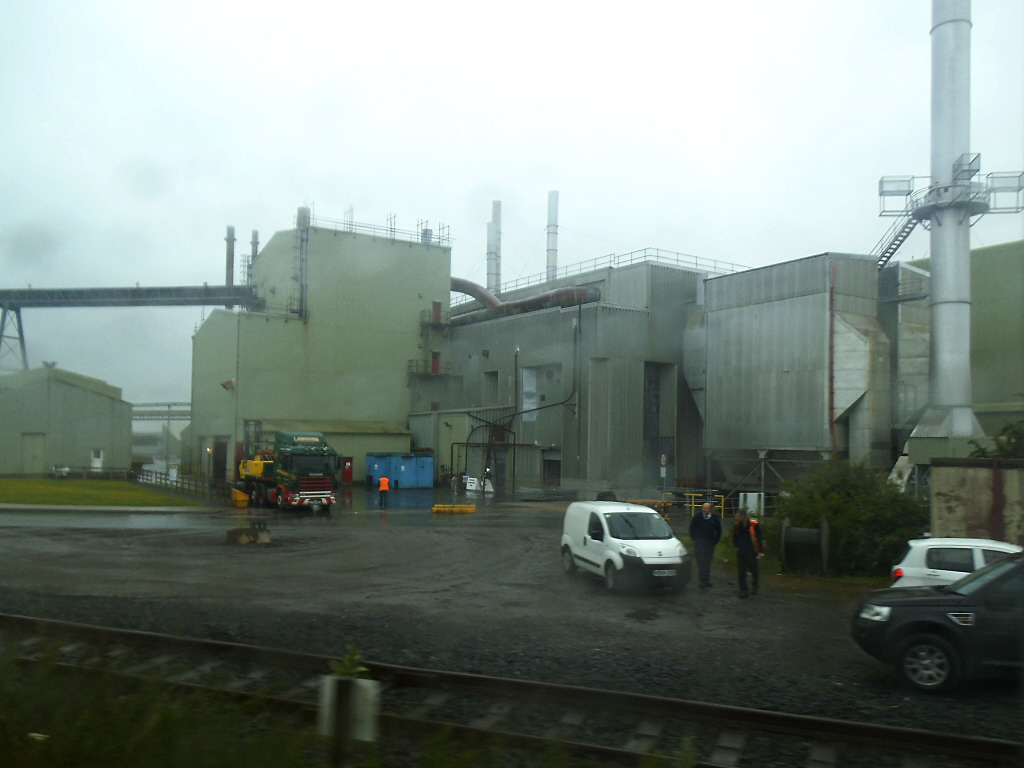
Little survives of the Acorn Bank workings beyond the flooded and overgrown quarry, a filled-in adit, a former gunpowder store and the aerial ropeway's engine house, all within the grounds of Acorn Bank, now a National Trust property open to visitors in summer. Mining continues nearby at Birkshead, feeding what is now described as the largest plasterboard works in the world at Kirkby Thore.
At Acorn Bank: the flooded South Quarry, a filled-in adit, a gunpowder store and the 1926 ropeway engine house. Elsewhere, the working Birkshead Mine and the large British Gypsum processing plant at Kirkby Thore itself.
Redevelopment
Acorn Bank is a National Trust property; the wider district remains an active mining and processing site under British Gypsum.
Related mines
- Longriggs Mine, Appleby — Physically connected underground: from 1975 a conveyor carried crushed gypsum from Birkshead Mine (part of the Kirkby Thore Gypsum Mines group) through storage bins beneath Longriggs on its way to the mill, and both were part of the same British Gypsum operation at Kirkby Thore.
- New Stamphill Mine, Kirkby Thore — Part of the same Kirkby Thore gypsum operation, opened in 1937 as the district's earlier Stamphill mine (also part of that record) was worked out, under the same Gotham Company ownership that ran the whole district by 1927.
Nearby mines
- New Stamphill Mine, Kirkby Thore — 0.7 miles (1.1 km) N
- Longriggs Mine, Appleby — 0.9 miles (1.4 km) SE
- Silverband Mine — 4.0 miles (6.5 km) NE
- Upper Slatesike Mine — 6.6 miles (10.6 km) NE
- Cash Well Mine — 7.0 miles (11.3 km) NE
Straight-line distance, within 9 miles (15 km). Show on the map.
Recorded claims
Individual factual claims, each attached to the source(s) that support it below. Where sources disagree, both are kept.
- Alabaster was worked from surface exposures near Acorn Bank from around 1790; commercial gypsum quarrying began in small workings near Stamphill Farm in the 1850s, with larger operations from the 1880s. 1
- The Boazman family's Acorn Bank quarries moved underground from 1890 as surface working grew difficult; the McGhie brothers' Malley Hill Quarry, developed from 1905, moved underground from 1907. 1
- A water-wheel-powered wire-rope haulage was installed at Acorn Bank in 1923, and a two-mile aerial ropeway, powered by a Crossley oil engine, carried gypsum from the Boazman mine to the McGhie plant from 1926. 1
- Ownership consolidated through takeovers: the Carlisle Plaster and Cement Company (1911) failed and was bought by the Gotham Company in 1918, which took over the Boazman mine in 1925 and the McGhie company in 1927, becoming sole operator in the district. 1
- The Boazman mine at Acorn Bank closed in 1937 despite proven reserves, as processing consolidated elsewhere in the district; a new Stamphill mine and, from 1930s exploration, the Birkshead deposit kept the wider district in production. 1
- The Kirkby Thore works is now described as the largest plasterboard works in the world, owned by British Gypsum Ltd. 2
Photographs & further reading
Sources
- (primary) Gypsum Production in the Kirkby Thore Area — Settle-Carlisle Railway Conservation Area
- (secondary) British Gypsum works, Kirkby Thore — Old Cumbria Gazetteer
Record created: 24 August 2026 · Last researched: 24 August 2026