 MineArchive
Fault
| Also known as | Trouble (North East England), Trap (Somerset) |
|---|---|
| Category | Ground Conditions & Hazards |
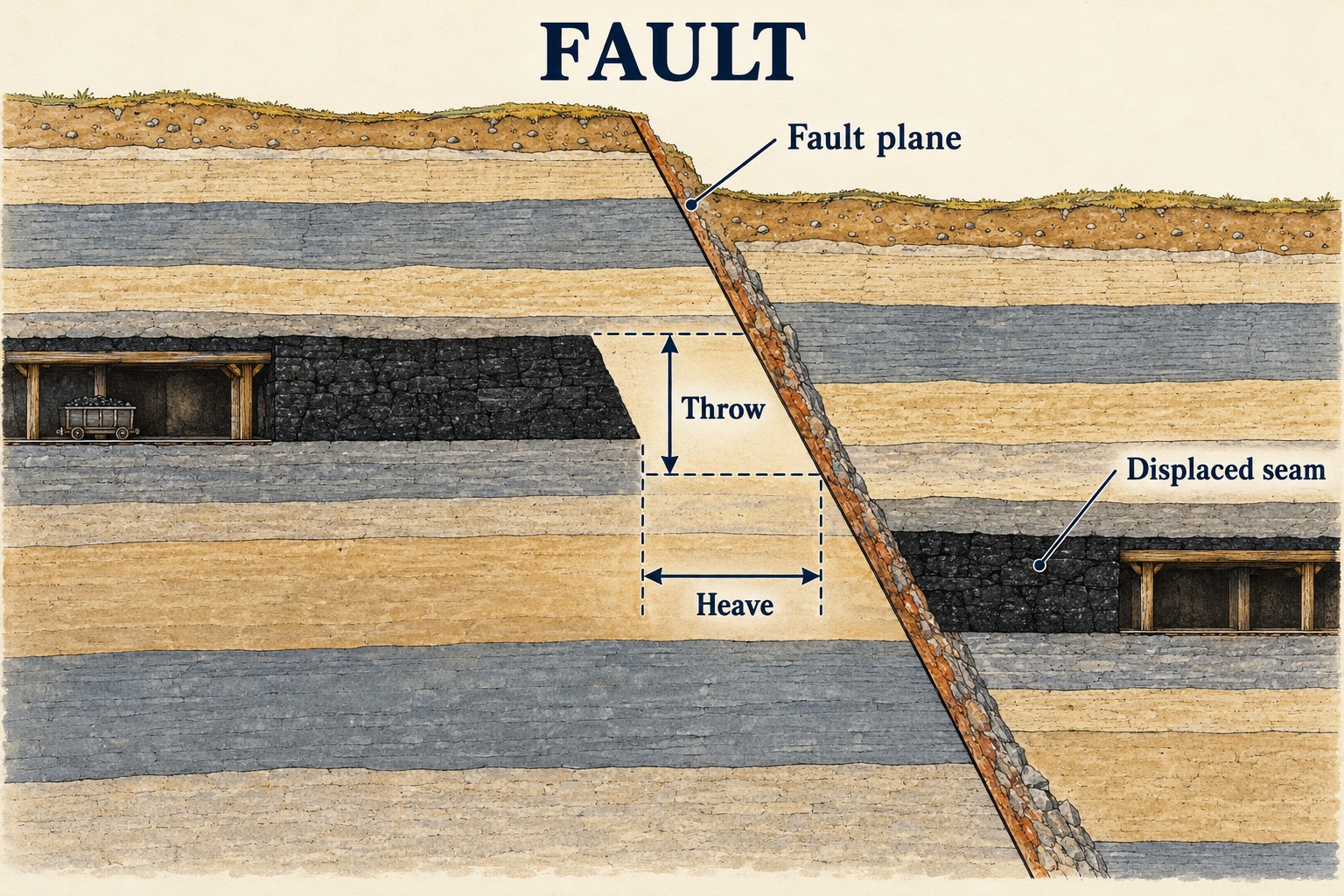
A fracture in the strata along which the rock on one side has moved relative to the other, so that a seam or vein is broken off and continues at a different level. The vertical displacement is the throw and the horizontal shift the heave; a fault that takes the seam down ahead of the workings is a downthrow and one that lifts it an upthrow.
Historical usage
Colliers had words for faults long before geologists classified them. In the Somerset and Bristol coalfields a fault was a trap: John Strachey told the Royal Society in 1719 that where the men found the coal over their heads beyond a ridge it had trapped up, and where it lay under their feet it had trapped down, and Gresley's glossary of 1883 still records trap-up and trap-down in the Bristol coalfield. Northern pitmen called any fault or intrusion trouble. The geologists' hanging wall and footwall came out of the mine, where a man working a tabular ore body stood with the footwall under his feet and the hanging wall above him, and the division of faults into normal and reverse originated in the English coalfields, where normal faults are the commoner kind.
How it worked
A fault is a planar break across which the rock mass has slipped. Where the slip is mostly vertical it is a dip-slip fault: a normal fault drops the hanging wall and a reverse fault lifts it. Where the slip is sideways it is a strike-slip fault. The throw is the vertical part of the displacement and the heave the horizontal, so a seam lost at a fault must be sought again above or below by the throw and along by the heave. A block dropped between two faults dipping towards each other is a graben; where a seam drops and after a distance is thrown up again the miners called it a trough fault. The ground between the broken ends of the seam on either side of the fault plane is the want.
Why it was used
Faults are not made by miners but they shape every working. A heading driven to a fault stops, and the choice is whether to drive a stone drift up or down to find the seam again or to leave it. At Hillhead, north of Glasgow, the Campsie strata were so cut about by faults and dolerite intrusions that beds lower in the series lay higher on the hill than elsewhere, and of two neighbouring pits of similar surface level one met the Hurlet coal at 360 feet and the other at about 72 feet. Campsie became a district of small collieries and limestone mines that each worked an area until an upthrow, a downthrow or an intrusion cut it off.
Risks & limitations
A fault zone is crushed ground, so roof and sides are weak where the seam is broken, and water or gas may be fed from it. Shafts sunk on a fault are hard to make watertight: at Lumpsey ironstone mine in Cleveland one or two of the wedging cribs failed to hold the water, not because of the stone but because the shaft had been sunk on a fault. A large fault can make a colliery worthless. A bore at Hillhead found the seams at 174 feet below ground and unworkable, far from their depth in the pit, which pointed to a major fault running north-east to south-west that cut the pit off from the coalfield it had been meant to work; a trial drift through the fault was more than the lessees could afford, and the colliery was never an economic proposition.
Regional variation
Trap, trap-up and trap-down belong to Somerset and the Bristol coalfield and are long obsolete. Trouble is the North of England word for a fault or intrusion, and want for the gap in the seam at a fault. Throw, heave, dip-slip and strike-slip are the general terms of the Geological Survey's maps and of abandonment plans.
Related terminology
Borehole, Coal Measures, Coal Seam, Shaft Sinking, Tubbing
Mines associated with this term
5 examples chosen from 152 linked records — the term page is not an index.
- Abernant Colliery — Neath Port Talbot (well documented example)
Named 4 times in this record, first in the history: “…took out a High Court injunction against the lodge officials, and faults on its other faces kept output to about half of what was expected.…” - Bedford Colliery — Greater Manchester (well documented example)
Named in this record’s geology: “…The seams here dip generally south and west and are cut by small faults. The Upper Coal Measures are not worked in this part of the…” - Creswell Colliery — Derbyshire (well documented example)
Named in this record’s workings: “…intake roadways served by a trunk belt conveyor system; it was a fault in this system, at a transfer point in the South Western Main Intake…” - Stargate Colliery — Tyne and Wear (well documented example)
Named in this record’s geology: “…the lowest seam of the coalfield. The ninety fathom dyke, a major fault, barred workings to the south-east. Seams worked over the years…” - Tynewydd Colliery, Porth — Rhondda Cynon Taf (well documented example)
Named in this record’s geology: “…had been abandoned and were full of water; the manager believed a fault in the coal would keep it back before the boundary was reached, but…”
Disasters associated with this term
5 examples chosen from 54 linked records, most direct relationship first.
- Abercarn colliery (Prince of Wales) explosion, 1878 (contextual relationship)
Named in this record’s investigation: “…in No. 21 District days before the disaster, identified ventilation faults and defective lamps, and recorded 519 dependents left destitute (131…” - Astley Deep Pit explosion, 1870 (contextual relationship)
Named in this record’s narrative: “…newly come from Staffordshire. Wynne called the cause the old fault: bad management, or rather no management at all.” - Auckland Park Colliery fall, 1907 (contextual relationship)
Named 3 times in this record, first in the cause: “A very heavy fall of stone in a broken working near a downthrow fault: the stone came away from the fault leader on one side and from a…” - Bamfurlong Colliery roof fall, 1899 (contextual relationship)
Named 4 times in this record, first in the summary: “Two colliers working coal left beside a fault at Bamfurlong Colliery were buried by a roof collapse on 25 August…” - Bardsley Colliery explosion, 1858 (contextual relationship)
Named in this record’s summary: “…The inspector, Joseph Dickinson, had warned in writing of the exact faults that caused it, and there was no viewer.”
Sources
- (secondary) Fault (geology) — Wikipedia
- (secondary) Glossary of mining and geological terms — Tatham History Society
- (secondary) Hillhead Colliery, Campsie (British Mining No. 34) — Northern Mine Research Society
- (secondary) Lumpsey Ironstone Mine (British Mining No. 28) — Northern Mine Research Society
- (secondary) Pit Terminology — Healey Hero
- (secondary) Trap sb.4 (Murray's New English Dictionary) — World English Historical Dictionary
Record created: 18 October 2026 · Last researched: 18 October 2026