 MineArchive
Abercarn colliery (Prince of Wales) explosion, 1878
A firedamp explosion tore through Prince of Wales Colliery (Abercarn Colliery) on 11 September 1878, killing 268 men and boys — the third-worst death toll in South Wales Coalfield history.
| Date | 11 September 1878 |
|---|---|
| Mine | Prince of Wales Colliery |
| Region | Caerphilly |
| Type | Explosion |
| Fatalities | 268 (268 men and boys died, the best-supported figure across sources; the NMRS accident page separately states 267 and a Geograph memorial-photo caption gives 272 — an unresolved discrepancy kept as recorded rather than silently picked. Around 325-350 men and boys were underground at the time; 82-100 escaped alive.) |
| Context | During active mining |
Cause
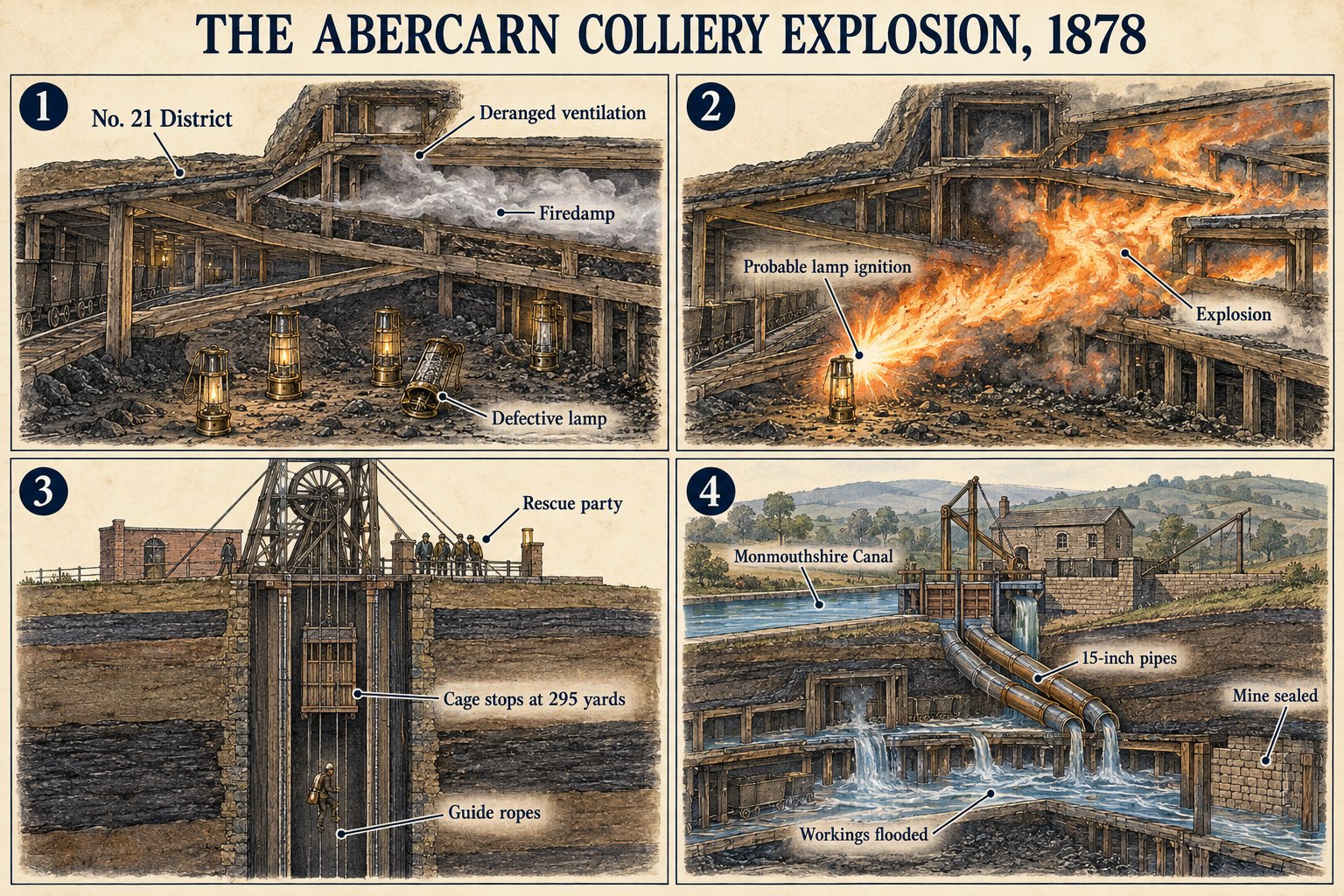
Accumulated firedamp, most likely ignited at a safety lamp; contributing factors identified by the investigation included defective safety lamps found in the district, deranged ventilation allowing gas to build in return airways, and dusty conditions. Gas had been detected in No. 21 District days before the disaster, though the district was reported free of gas on the morning of 11 September, and no inspection had occurred after the first shift went down.
What happened
The explosion struck shortly after midday on 11 September 1878. To extinguish uncontrollable underground fires, the colliery and government-supported engineers flooded the workings using water diverted from the Monmouthshire Canal via wooden shutters and 15-inch pipes — roughly 35 million imperial gallons over about two months. The mine remained closed until 1882; most of the 268 dead were never recovered and remain in the flooded, sealed workings. One further unidentified body was found when the workings were re-entered around 1900.
Rescue & recovery
A rescue party descended about an hour after the blast; the main shaft's winding gear could only reach 295 yards down owing to damage. John Harris climbed out of the cage and down the guide ropes, remaining at the bottom for many hours and helping extract survivors, for which he was awarded a first-class gold Albert Medal; nine Albert Medals in total were awarded for rescue gallantry at Abercarn. A second team tried a ventilation shaft but withdrew owing to explosion risk.
Investigation & inquiry
A coroner's inquest before Coroner W. H. Brewer found gas had been known in No. 21 District days before the disaster, identified ventilation faults and defective lamps, and recorded 519 dependents left destitute (131 widows, 363 fatherless children, 8 dependent parents, 16 dependent brothers).
Legal & regulatory aftermath
Relief costs were estimated at £6,747 a year at 5 shillings a week; London's Lord Mayor raised a public subscription of £400 toward the relief fund.
Memorials & commemoration
A memorial stone at Abercarn bears the names of the dead on both faces; a former mortuary used following the disaster survives at Abercarn cemetery.
Recorded claims
Individual factual claims, each attached to the source(s) that support it below. Where sources disagree, both are kept.
- 268 men and boys died, per Wikipedia and Welsh Coal Mines' named death-roll listing; NMRS's accident page separately gives 267 and a Geograph memorial caption gives 272 — an unresolved discrepancy across sources. 1,2
Related terminology
Mining terms this disaster is structurally linked to, with the nature of the relationship.
- Cage (contextual relationship)
Named in this record’s rescue and recovery: “…reach 295 yards down owing to damage. John Harris climbed out of the cage and down the guide ropes, remaining at the bottom for many hours and…” - Firedamp (contextual relationship)
Named twice in this record, first in the summary: “A firedamp explosion tore through Prince of Wales Colliery (Abercarn Colliery)…” - Return Airway (contextual relationship)
Named in this record’s cause: “…found in the district, deranged ventilation allowing gas to build in return airways, and dusty conditions. Gas had been detected in No. 21 District days…” - Safety Lamp (contextual relationship)
Named in this record’s cause: “Accumulated firedamp, most likely ignited at a safety lamp; contributing factors identified by the investigation included…” - Shaft (contextual relationship)
Named twice in this record, first in the rescue and recovery: “A rescue party descended about an hour after the blast; the main shaft's winding gear could only reach 295 yards down owing to damage. John…”
Sources
- (secondary) Prince of Wales Colliery Explosion - Abercarne - 1878 — Northern Mine Research Society
- (secondary) Abercarn Prince of Wales death roll — Welsh Coal Mines
- (secondary) Abercarn colliery disaster — Wikipedia
Record created: 26 August 2026 · Last researched: 26 August 2026