 MineArchive
Derwent Lead Mines
| Also known as | Ramshaw Lead Mine, Sikehead Mines |
|---|---|
| Location | Ramshaw, Hunstanworth, County Durham — 54.8148, -2.0668 (approximate) |
| Commodities | Lead, Fluorspar |
| Type | Metal |
| Worked | Worked by 1624–Fluorspar worked intermittently until the 1980s |
| Maximum depth | Taylor's Shaft was sunk to a depth of over 250 m. |
| Operators | London Lead Company (1700–1800), Derwent Lead Mining Company (1800–1890) |
Overview
The core of the Derwent lead mines on the east side of the Bolts Burn south of Blanchland: Taylor's Shaft, sunk over 250 m and pumped by flat rods running 470 m down the hillside to waterwheels in the valley, the Sikehead dams that fed them, Jeffrey's smelt mill with its mile-long flue and standing chimney, and the Sikehead shafts of the 1840s. The flat-rod system is one of the most complex known to survive anywhere in England.
History
The early history of the Derwent mines, so called because for most of their life they were worked as a single enterprise, is little known. In 1624 a 21-year grant was made to the Duke of Buckingham for all the silver and lead within ten miles of Muggleswick, which took in these mines. The London Lead Company worked them through the 18th century, but most of what can be seen belongs to the Derwent Lead Mining Company of the 19th. That company appointed John Taylor, reckoned the most accomplished mining engineer of his century, to manage the mines, and he brought in Cornish miners and Cornish methods, building the water system around the Sikehead dams and the great array of flat rods, driven by large waterwheels on the valley floor, that worked the pumps. The Cornish connection ran deep and was not always easy: the population of Blanchland and Hunstanworth rose from about 200 apiece to more than 700 in the 1850s as Cornish families came north, alongside workers from Flintshire, Scotland, Mary Tavy and Arkengarthdale, and in November 1866 a quarrel in the Miner's Arms at Baybridge turned into the riot remembered locally as the Cornie Row, after which eight Cornish miners were charged at Hexham police court. An earlier overhaul had come from Frederick Hall of Easterby, Hall and Company, later the Arkendale and Derwent Lead Mines Company, who integrated the workings around Blanchland and Hunstanworth so that they shared watercourses, reservoirs and roads, started a miners' fund, built the district's first crushing mills and replaced the upright flues at the smelt mills with cheaper horizontal ones; William Deans, of Shildon, was the company's engineer in the first quarter of the 19th century. Lead fell away after the late 19th century, and fluorspar was taken intermittently until the 1980s.
Geology
The mines worked the lead veins of the North Pennine orefield on the east side of the Bolts Burn. Fluorspar, a gangue mineral of the same veins and worthless to the lead miners, became the reason for working the ground again in the 20th century and was taken intermittently until the 1980s.
Workings
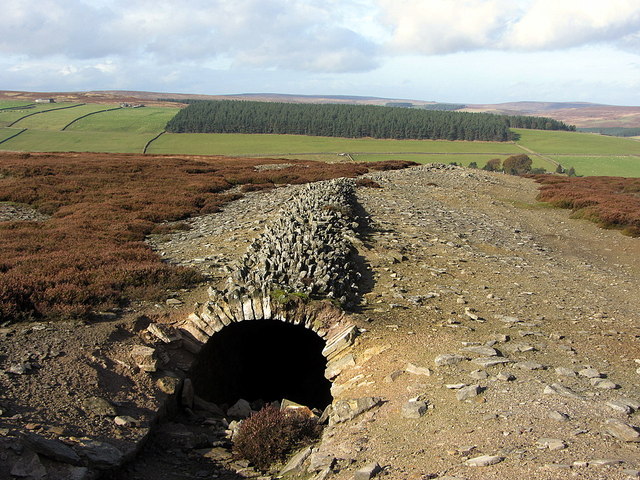
Taylor's Shaft, above the east side of the Bolts Burn valley, was sunk to a depth of over 250 m. Flat rods ran from waterwheels on the valley floor up the hillside to the shaft, where their horizontal motion was turned into the vertical stroke that lifted water from the lower levels; the drystone tunnel that carried them, 0.8 m wide, 1.4 m high and 470 m long, roofed with corbelled stone and covered with turf, survives in part. A gin circle nine metres across lies on the south-east side of the shaft, and to the north-west are the low remains of a four-metre engine house, an 11 m by 3 m boiler house and the base of a 2.5 m chimney, with spoil and boiler clinker beyond. A kilometre to the west-south-west is the site of Jeffrey's smelt mill, now a flat area with terraces below it, undercut by a complex of drystone arched flues and rod tunnels that run on under the modern road; the best preserved stretch measures about 1.7 m each way inside, oval in section with a paved floor. The flue runs on for over a kilometre across open moorland to its chimney, 15 m tall, of coursed random sandstone with a red brick capping and a stepped base seven metres across. West of the chimney lie the two Sikehead dams, one revetted in drystone with a stone overspill and still holding water, the other enclosing two hectares behind banks on three sides with a retained outflow sluice feeding a stone-lined leat. At Sikehead itself are two shafts sunk in the 1840s: Ruth Shaft for pumping, first worked by flat rods from Deborah Level 0.6 km away, and Ellen Shaft for winding, now capped with concrete and an iron plate carrying a small hand capstan. When a branch railway reached Sikehead across the moors, cheap coal made a steam engine worth building and the flat-rod wheel was taken away; the low remains of a Cornish beam engine house and boiler house stand south of Ruth Shaft with a chimney still 14 m high. Beside them are a balance bob pit, a wash kiln and a capstan setting, and just to the west Robinson's Level, whose spoil tip carries a rare ore chute in the Cornish manner, with the wheelpit and drum setting for a 6.1 m waterwheel that wound Ellen Shaft.
Closure
Lead extraction declined after the late 19th century. Fluorspar, which the lead miners had thrown away, was taken from the same ground intermittently until the 1980s; no closing date for that working has yet been located.
What remains
Five separate areas — Taylor's Shaft and a sample of its flat-rod system, Jeffrey's smelt mill with its flues, the last 130 m of flue with its chimney and the eastern Sikehead dam, the western dam, and the Sikehead mine and dressing floor — are a scheduled monument. The flat-rod tunnel has collapsed along much of its length though intact sections survive; the flue system is partly intact and partly fallen in, and the length crossing the improved pasture south of the plantation is believed destroyed and is not scheduled. Taylor's Shaft is capped with timber sleepers inside a drystone wall, Ellen Shaft with concrete and an iron plate. Both chimneys still stand, and the eastern dam still holds water, which is led to the Presser pumping station.
Taylor's Shaft and its drystone flat-rod tunnel, gin circle, engine and boiler houses and chimney base; the site of Jeffrey's smelt mill with its terraces, arched flues and rod tunnels; over a kilometre of flue and its 15 m chimney; the two Sikehead dams with revetments, sluice and leat; Ruth and Ellen shafts, the Cornish engine house, boiler house and 14 m chimney, balance bob pit, wash kiln and capstan settings; Robinson's Level with its Cornish ore chute, wheelpit and drum-wheel setting.
Redevelopment
None on the scheduled areas. Water from the eastern Sikehead dam is still led to the Presser pumping station, which is not part of the monument.
Related mines
- Shildon Lead Mine — Both were part of the Blanchland and Hunstanworth lead enterprise that Frederick Hall integrated to share watercourses, reservoirs and roads; William Deans, of Shildon, was engineer to the Derwent mines in the first quarter of the 19th century.
Nearby mines
- Blanchland Fluor Mines — 2.9 km NE, Northumberland
- Beldon Lead Mine — 4.1 km NW
- Rookhope (Boltsburn Mine) — 4.4 km SW
- Shildon Lead Mine — 4.4 km N, Northumberland
- Lintzgarth Mine — 5.0 km SW
Straight-line distance, within 15 km. Show on the map.
Recorded claims
Individual factual claims, each attached to the source(s) that support it below. Where sources disagree, both are kept.
- A 21 year grant was made in 1624 to the Duke of Buckingham for all silver and lead within 10 miles of Muggleswick, including the Derwent mines. 1
- The mines were worked by the London Lead Company in the 18th century, though most of the visible remains relate to the Derwent Lead Mining Company in the 19th. 1
- John Taylor, appointed to manage the mines, introduced Cornish miners and their techniques and built a water management system around the Sikehead dams with an extensive flat-rod system powered by large waterwheels on the valley floor, one of the most complex known to survive on any mining site in England. 1
- Taylor's Shaft was sunk to a depth of over 250 m, and the drystone flat-rod tunnel running to it measures 0.8 m wide by 1.4 m high by 470 m long. 1
- The extraction of lead declined after the late 19th century, though fluorspar extraction continued intermittently until the 1980s. 1
- The population of Blanchland and Hunstanworth rose from around 200 apiece to more than 700 in the 1850s as Cornish miners came north, with others from Flintshire, Scotland, Mary Tavy and Arkengarthdale. 2
- Frederick Hall of Easterby, Hall and Company, later the Arkendale and Derwent Lead Mines Company, integrated the workings around Blanchland and Hunstanworth so that they shared watercourses, reservoirs, roads and other facilities, introduced a miners' fund, built the district's first crushing mills and replaced the upright flues at the smelt mills with horizontal ones. 2
Photographs & further reading
A local history account of the Cornish miners who came north to the Derwent lead mines, drawing on the letters of William Deans, engineer to the mines, and on the 1866 riot at Baybridge.
View sourceSources
- (primary) Derwent lead mines: Taylor's Shaft, Jeffrey's smelt mill, Sikehead dams and Sikehead mine (List entry 1015862) — Historic England
- (secondary) When 'The Cornies' came — Hunstanworth History
Record created: 22 September 2026 · Last researched: 22 September 2026