 MineArchive
Blanchland Fluor Mines
| Also known as | Whiteheaps Mine, Blanchland Fluor Mines Ltd |
|---|---|
| Location | Whiteheaps and Ramshaw, above Blanchland, Northumberland — 54.8380, -2.0480 (approximate) |
| Commodities | Fluorspar, Lead |
| Type | Mineral |
| Worked | from 1938 |
| Maximum depth | Fluorspar work was above the 30 Fathom Level, wound at one of the twin Whiteheaps shafts |
| Operators | Hunstanworth Mines Ltd (1916–1932), Blanchland Fluor Mines Ltd (1938–?) |
Overview
The fluorspar working of the old Derwent lead mines above Blanchland, taken over in 1938 by Blanchland Fluor Mines Ltd after six years of idleness. The company did not look for new ore: it robbed the fluorspar the lead miners had left standing in the wide veins, sold it to Scottish steelworks, and raised about 22,500 tons in all. In 1948 it employed fourteen men and wound its ore up a shaft on a small colliery hoist driven by a chain off the back axle of a twelve horsepower Austin car.
History
The ground had been worked for lead since the eighteenth century, and a company report of 1948 sets out the succession: the London Lead Company from 1725 to 1806, Easterby, Hall and Company to 1810, the Derwent Mining Company to 1883, then thirty-three years idle, Hunstanworth Mines Ltd from 1916 to 1932, idle again, and Blanchland Fluor Mines Ltd from 1938. When the Hunstanworth company stopped in 1932 its equipment was bought and dismantled by George Cohen, Sons and Co. Ltd, so the new company started from very little.
Blanchland Fluor Mines Ltd worked from 1938 for about two years, mainly for fluorspar, which it sold to Messrs Colvilles (Steels) Ltd for steelmaking; it got 5,038 tons in that first spell, against the 15,000 tons the Hunstanworth company had taken between 1924 and 1932. The mines were idle again from 1940 to 1945 and the company resumed after the war. It leased 240 acres from Edward Joicey of Blenkinsop Hall, Haltwhistle, on two annual dead rents of £35 for minerals and £12 for land, with royalties on a sliding scale against the fluorspar price: fourpence-halfpenny a ton when spar was under eighteen shillings, rising to a shilling when it passed twenty-five. It had no right to work the dumps, which had been assigned to a Mr Hinchcliff.
When the accessible workings were examined in December 1948 the manager was R. E. Adamson and the principal shareholder R. E. Horrocks with half the shares. Fourteen men were employed, ten of them mining and hand-picking about forty tons of ore a week. Work concentrated on robbing fluorspar left by the lead miners in the wide quarter-point veins called White Vein, Red Vein and the Red Vein String, in ground above the 30 Fathom Level and only a limited distance either side of the drawing shaft. Much development work followed in the 1960s and 1970s under the British Steel Corporation, which took ownership from the company.
Geology
The North Pennine orefield's fluorspar zone, centred on Weardale and reaching north to Hunstanworth. Here fluorite fills wide quarter-point veins — White Vein, Red Vein and the Red Vein String — that earlier generations had worked for the lead in them, leaving the spar standing as waste. The ore at Whiteheaps was lead with a high silver content when it was worked as a lead mine; what made the ground pay again was the steel industry's need for fluorspar as a flux.
Geological setting: Veins and Lodes (well documented example)
Workings
The drawing shaft was one of the twin shafts at Whiteheaps Mine, and the plant in 1948 was improvised throughout: a small colliery hoist driven by a chain from the back axle of a twelve horsepower Austin car, and two sixty-five horsepower diesel lorry engines running the compressors that in turn drove the pumps and two Holman S-9 jackhammer drills. Ten men mined and hand-picked around forty tons of ore a week, working the wide veins above the 30 Fathom Level for a limited distance either side of the shaft.
Closure
The closure date is not known for the company's own working. The British Steel Corporation took ownership and did much development work through the 1960s and 1970s, and fluorspar mining continued near Hunstanworth until the 1990s.
What remains
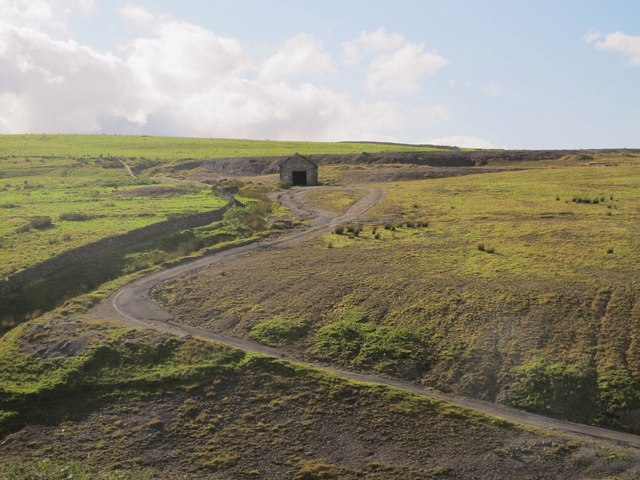
The Whiteheaps and Sikehead sites survive on the moors above Blanchland as shafts, dams and spoil. The Sikehead chimney still stands to fourteen metres with a base three and a half metres across and a firebrick arched opening; it served a Cornish beam engine whose housing survives only as rubble beside it. The flue that took fumes from Jeffrey's lead smelt mill in the Ramshaw valley also survives.
Shafts, dams and spoil at Whiteheaps and Sikehead; the Sikehead chimney stands to fourteen metres beside the rubble of its engine house, and the flue from Jeffrey's smelt mill survives.
Related mines
- Groverake Mine — Both worked the North Pennine fluorspar zone in the twentieth century after their lead had gone, and both passed through British Steel Corporation ownership; Blanchland is named on the Groverake record.
- Shildon Lead Mine — Both part of the Derwent lead mines above Blanchland; Blanchland Fluor Mines reworked the old Derwent ground for fluorspar from 1938.
Nearby mines
- Shildon Lead Mine — 1.3 miles (2.1 km) NW
- Derwent Lead Mines — 1.8 miles (2.9 km) SW, County Durham
- Beldon Lead Mine — 2.6 miles (4.2 km) W, County Durham
- Colpitts Colliery — 3.9 miles (6.2 km) N
- Rookhope (Boltsburn Mine) — 4.5 miles (7.3 km) SW, County Durham
Straight-line distance, within 9 miles (15 km). Show on the map.
Recorded claims
Individual factual claims, each attached to the source(s) that support it below. Where sources disagree, both are kept.
- A company report of 1948 gives the succession as London Lead Company 1725-1806, Easterby, Hall and Company 1807-1810, Derwent Mining Company 1810-1883, idle to 1916, Hunstanworth Mines Ltd 1916-1932, idle to 1938, then Blanchland Fluor Mines Ltd from 1938 to 1940 and again from 1945. 1
- Blanchland Fluor Mines Ltd got 5,038 tons of fluorspar between 1938 and 1940 and about 22,500 tons in total; the Hunstanworth Mines Company had taken 15,000 tons from 1924 to 1932. 1
- In December 1948 the company employed fourteen men under the manager R. E. Adamson, ten of whom mined and hand-picked about forty tons of ore a week; the hoist at the drawing shaft was driven by a chain from the back axle of a twelve horsepower Austin car, and two sixty-five horsepower diesel lorry engines ran the compressors. 1
- The company leased 240 acres from Edward Joicey of Blenkinsop Hall on dead rents of £35 for minerals and £12 for land, with fluorspar royalties sliding from fourpence-halfpenny a ton below eighteen shillings to a shilling above twenty-five; it had no right to work the dumps, which were assigned to a Mr Hinchcliff. 1
Photographs & further reading
The Northern Mine Research Society's full monograph on the Blanchland and Hunstanworth mines, with the company chronology, the 1948 inspection and the royalty terms.
View sourceSources
- (secondary) British Mining No. 70: the Derwent Mines (Northern Mine Research Society monograph, December 2002) — Northern Mine Research Society
- (observational) Sikehead Mine Chimneys, Blanchland — Fabulous North
- (observational) Whiteheaps Mine — Geograph Britain and Ireland
Record created: 9 September 2026 · Last researched: 9 September 2026