 MineArchive
Shildon Lead Mine
| Also known as | Shildon Engine House, Shildon Castle |
|---|---|
| Location | Shildon, north of Blanchland, beside Shildon Burn, Northumberland — 54.8544, -2.0646 (approximate) |
| Commodity | Lead |
| Type | Metal |
| Worked | By 1806 (engine house c. 1805-06)–No reliable closure date has yet been located. |
| Maximum depth | Unknown. |
| Operators | Easterby, Hall and Company (1806–1810), Derwent Mining Company (1810–?) |
Overview
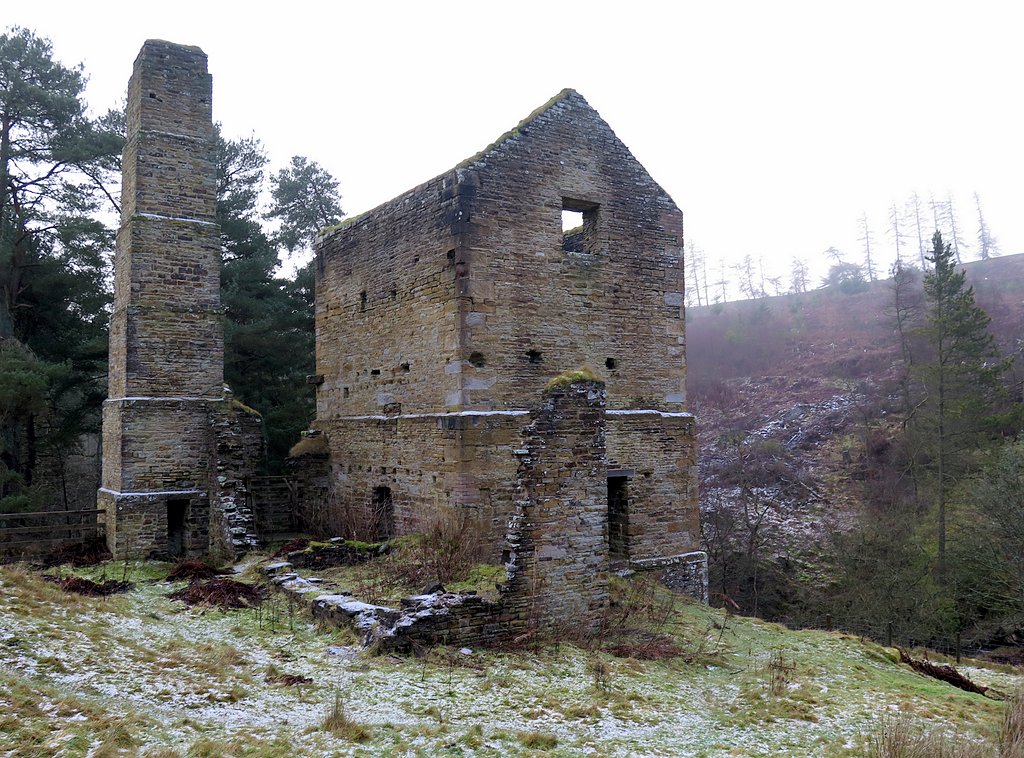
A lead mine of the upper Derwent above Blanchland, drained in the early 19th century by the only Cornish-style engine house in the North East; the five-storey shell and its chimney, later turned into flats as 'Shildon Castle', still stand beside Shildon Burn.
History
Lead had long been mined around Blanchland from shallow shafts that flooded and were soon exhausted. In 1806 Easterby, Hall and Company took over the lease and brought in coal-fired steam engines to drain the workings and drive machinery, and around 1805-06 the engine house at Shildon was built for a Cornish pumping engine; the Hunstanworth history society describes it as a massive Boulton and Watt engine that pumped for only around ten years. In 1810, by Historic England's account, the Derwent Mining Company took over mining at Shildon. Coal had to be carried a long way to the remote valley, and from about 1812 water-powered machinery took over, after which the industry thrived; Frederick Hall integrated the Blanchland and Hunstanworth mines to share watercourses, reservoirs and roads. William Deans of Shildon was engineer to the Derwent mines in the first quarter of the century. The sources differ on the engine's later years: the North Pennines geopark says an enormous steam engine was installed in the 1840s in a last attempt to keep the mines dry, while Historic England records the pumping engine being removed between 1840 and 1850 and taken to Walker Colliery on the Tyne. Cheaper imported lead undermined the mines from the mid-19th century, the engine house was redundant by the 1860s, and it was converted into flats for mining families as 'Shildon Castle', a community of some 170 people, many of whose young families left for the goldfields of Australia and America. It was abandoned about a century ago.
Geology
Lead veins of the North Pennine orefield in the upper Derwent valley, the ore galena.
Workings
A pumping shaft drained by a Cornish engine, the beam working through a tall arch in the south face of the engine house.
Closure
Unknown.
What remains
A roofless five-storey engine house in three stages divided by chamfered set-backs, the south face of tooled stone with a tall round-headed arch; the boiler house survives as foundations apart from its tall square chimney, which stands intact.
The engine house shell and chimney; boiler house foundations.
Redevelopment
Converted to flats for mining families after the engine went, then abandoned; now a scheduled monument and Grade II listed building.
Related mines
- Blanchland Fluor Mines — Both part of the Derwent lead mines above Blanchland; Blanchland Fluor Mines reworked the old Derwent ground for fluorspar from 1938.
Nearby mines
- Blanchland Fluor Mines — 2.1 km SE
- Rookhope (Boltsburn Mine) — 8.6 km S, County Durham
- Lintzgarth Mine — 8.7 km SW, County Durham
- Groverake Mine — 9.1 km SW, County Durham
- Frazer's Hush Mine — 10.0 km SW, County Durham
Straight-line distance, within 15 km. Show on the map.
What's uncertain
Points where sources disagree or the record could not be settled; both accounts are kept. All open questions in the archive.
- The North Pennines geopark says an enormous steam engine was installed in the 1840s in a final attempt to keep the mines dry; Historic England says the pumping engine was removed between 1840 and 1850. (disputed) 1,3
Recorded claims
Individual factual claims, each attached to the source(s) that support it below. Where sources disagree, both are kept.
- The engine house, also known as Shildon Castle, of early 19th century date, housed a Cornish pumping engine used for the Derwent lead mines; the engine was constructed around 1800-1810; in 1810 the Derwent Mining Company took over mining at Shildon from Easterby Hall and Co.; between 1840 and 1850 the pumping engine was removed to Walker Colliery; afterwards the building housed several families. 1
- Built around 1806, the only Cornish-style engine house in the North East; its Boulton and Watt engine pumped water from the mines for around 10 years. 2
- The North Pennines geopark says an enormous steam engine was installed in the 1840s in a final attempt to keep the mines dry; Historic England says the pumping engine was removed between 1840 and 1850. (disputed) 1,3
- In 1806 Easterby Hall and Co. took over the lease at Blanchland and installed coal-fired steam engines; water-powered machines from around 1812; the engine house redundant by the 1860s and converted to flats as 'Shildon Castle'. 4
- The engine house was converted to flats for mining families, abandoned around 100 years ago; the community of 170 declined after the mid-1800s as cheaper lead was imported. 3
Photographs & further reading
The scheduling entry describing the engine house, its chimney and the engine's removal to Walker Colliery.
View sourceSources
- (primary) Shildon Cornish engine house (NHLE 1006415), scheduling text as reproduced by AncientMonuments.uk — Historic England, via AncientMonuments.uk
- (secondary) When 'The Cornies' came — Hunstanworth History
- (secondary) Shildon Engine House geosite — North Pennines National Landscape
- (observational) Shildon Engine House in Blanchland — Fabulous North
Record created: 21 September 2026 · Last researched: 21 September 2026