 MineArchive
Flats
| Also known as | Replacement flat (geological usage) |
|---|---|
| Dialect | Derbyshire and the Pennines |
| Category | Mine Workings & Access |
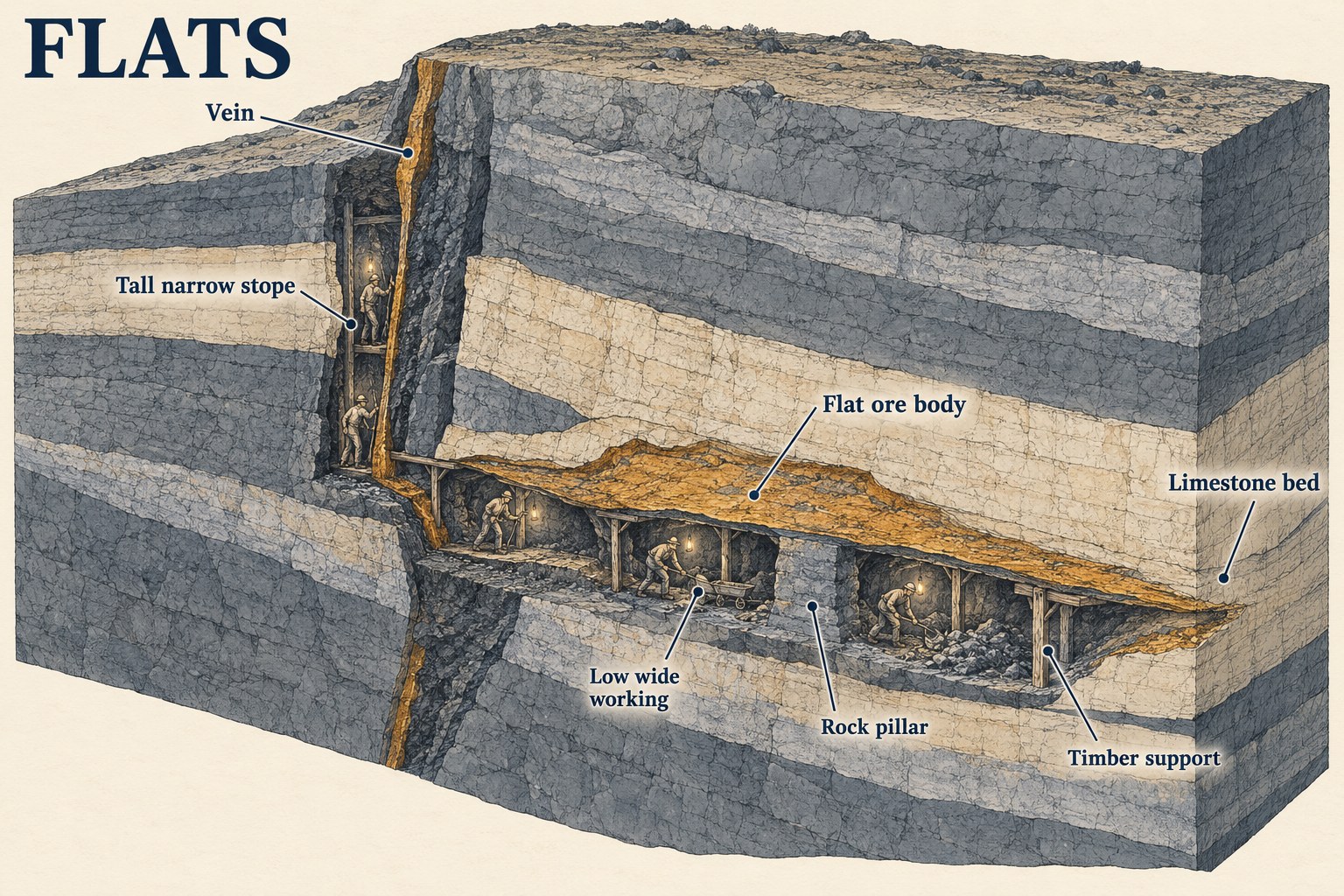
Sub-horizontal replacement ore bodies spreading sideways out of a vein where it meets a rock that will react with the mineralising fluid — most often a particular bed of limestone. Where a vein is a sheet standing on edge, a flat lies down along the bedding, and can be many times wider than the vein that fed it.
Historical usage
Flats were the making of the Derbyshire and Yorkshire orefields and of the Northern Pennines. In the South Pennine Orefield miners worked steeply inclined fissure veins — rakes, with thinner groups called scrins — and found that where those veins crossed receptive limestone beneath the impermeable shale cover, the ore spread out sideways into flats. In the North Pennines the Great Limestone was the great host: at Groverake the veins were at their widest and richest where they cut it, and at Boltsburn in Rookhope the flats were rich enough to keep the mine among the district's leading producers well into the 20th century.
How it worked
Miners rarely found a flat from the surface, because flats rarely reach it. The normal route was to follow a rake or a scrin sideways into the limestone and watch for the ore to open out. Once found, a flat was worked outward from the vein along the bed — a low, wide, spreading working rather than the tall narrow stope of vein mining, and one where the roof had to be held on pillars or timber because there was no natural arch to it.
Why it was used
Not a choice but a discovery: a flat is a shape ore takes, and the reason it mattered is that it concentrated far more mineral in one place than the feeding vein ever did. A mine that found a good flat could work profitably for years on ground the vein alone would not have justified.
Risks & limitations
Flats are unpredictable in extent, and no amount of driving guarantees finding one — a great deal of dead ground was cut in the search. Because they follow bedding rather than a fissure, they can also be cut off abruptly by faulting, and their wide, low workings need deliberate support: the roof of a flat is a bedding plane, which is exactly the surface most inclined to part.
Regional variation
'Flat' is Pennine and Peak District vocabulary. Derbyshire miners distinguished flats from pipes — irregular tubes or pockets filling older cavities in the rock — and both from the rakes and scrins that fed them. Cornish miners, working a granite-related orefield with a quite different chemistry, had little use for the word; the closest hard-rock equivalents there are the carbona bodies of the tin ground.
Related terminology
Fluorspar, Lead, Limestone, Pipe Vein, Rake, Scrin, Stope, Vein
Mines associated with this term
5 examples chosen from 24 linked records — the term page is not an index.
- Carrs Mine — Cumbria (well documented example)
Named 6 times in this record, first in the history: “…and the Smallcleugh Cross Vein beneath Smallcleugh Mine, and opening flats, the horizontal replacement bodies in the limestone, on more than…” - Bryngwiog Lead Mine — Flintshire (well documented example)
Named in this record’s geology: “…of Halkyn Mountain in Flintshire, where galena occurs in veins and flats in the Carboniferous Limestone. The field has been mined since at…” - Buckden Gavel Mine — North Yorkshire (well documented example)
Named 4 times in this record, first in the summary: “…unusual in Wharfedale for taking most of its ore from pipes and flats in the Main Limestone rather than from veins. A level was driven at…” - Coalcleugh — Northumberland (well documented example)
Named twice in this record, first in the history: “…the Coalcleugh and Barneycraig ground, and among them a number of flats. The numbers are those of a major mine. The Beaumont Company worked…” - Crossfield Mine — Cumbria (well documented example)
Named in this record’s workings: “…In this district, where all the ore had been removed from the flats, the resulting voids were commonly packed with waste rock or blown…”
Disasters associated with this term
Included only where MineArchive's own research gives a reasonable evidential basis, with the nature of the relationship stated — not every disaster where this term might plausibly apply.
- Parkhouse Colliery explosion, 1882 (contextual relationship)
Named twice in this record, first in the cause: “…had happened almost at once in the cross-cuts of Nos. 1 and 3 flats; the jury placed the origin most probably in No. 3 flat and put the…” - Weetslade Colliery Explosion (contextual relationship)
Named 3 times in this record, first in the contributing factors: “…the ventilation to keep the turbine pump running, and both flats gassed out and were fenced off. The power cable up the 3rd North…”
Sources
- (primary) Mineral Resources report for the Peak District National Park — British Geological Survey / NERC
- (secondary) Peak District Mineralisation — The Peak District
Record created: 25 August 2026 · Last researched: 25 August 2026