 MineArchive
Balance Bob
| Dialect | Cornish |
|---|---|
| Category | Structures & Machinery |
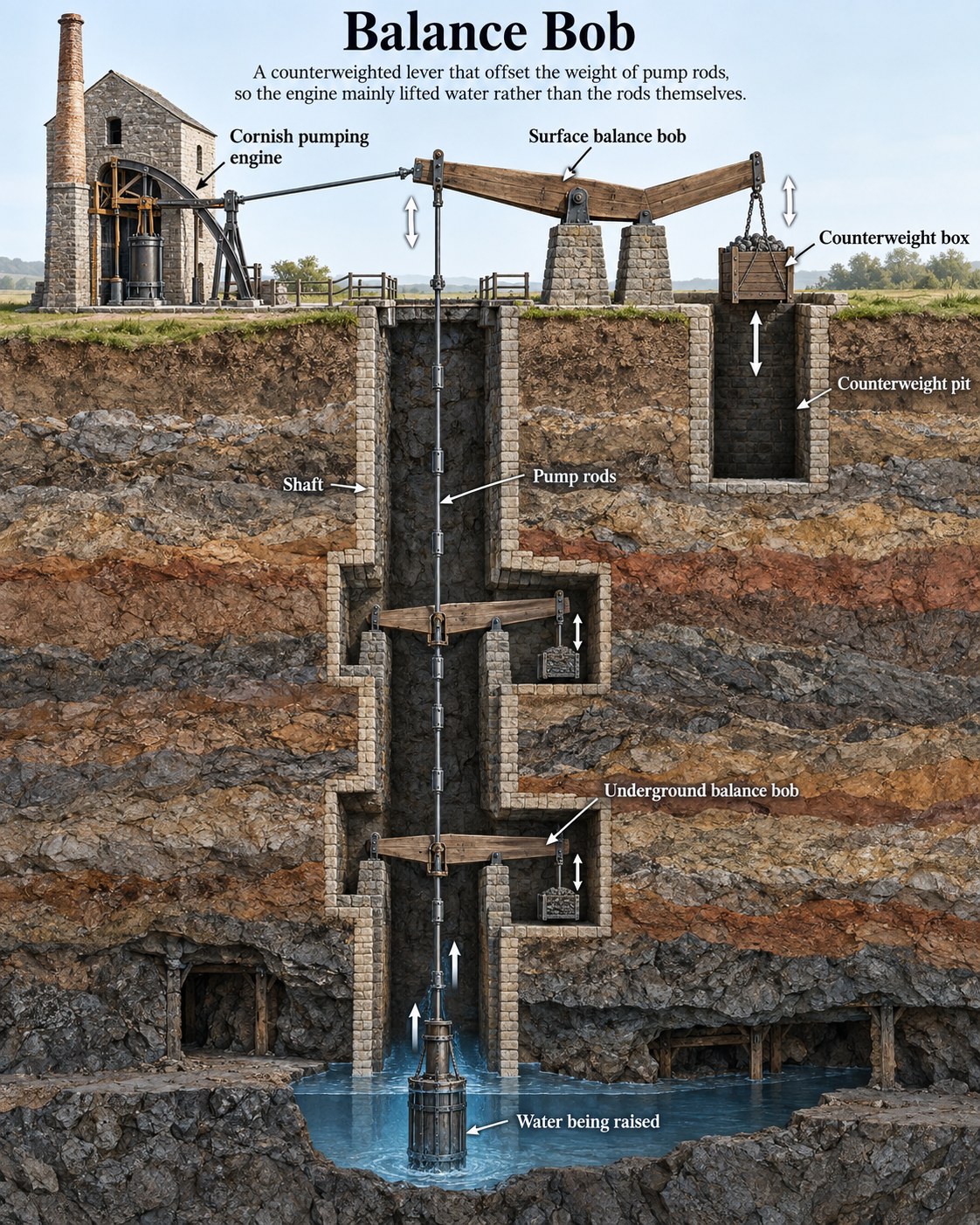
A large counterweighted lever, attached to a shaft's pump rods, that offset the rods' own weight so that a Cornish pumping engine only had to do the work of lifting the water itself.
Historical usage
Balance bobs were standard equipment on deep Cornish-engine-pumped shafts, since the pump rods (or 'pitwork') running the full depth of a mine could themselves weigh a very great deal, quite apart from any water being lifted.
How it worked
A surface balance bob sat on a pair of plinths or a masonry support beside the shaft, with a large box of scrap iron or rock as its counterweight working up and down in an adjacent stone-lined pit; on deeper shafts, further balance bobs were installed in chambers cut into the shaft wall itself at intervals, to counterbalance the rods' weight at that depth as well.
Why it was used
Without a balance bob, a pumping engine would have to expend most of its power simply raising and lowering the pump rods themselves before it could do any useful work lifting water; the counterweight let the engine's power go almost entirely into pumping, which mattered enormously as shafts reached ever greater, and heavier, depths.
Risks & limitations
A balance bob had to be sized correctly for the pump rods it served — too light, and the engine still laboured under the rods' weight; too heavy, and the engine instead fought the counterweight on the return stroke.
Regional variation
The device and its name are strongly associated with Cornish mining engineering specifically, developed alongside the distinctive Cornish beam pumping engine.
Related terminology
Mines associated with this term
5 examples chosen from 6 linked records — the term page is not an index.
- Derwent Lead Mines — County Durham (well documented example)
Named twice in this record, first in the workings: “…of Ruth Shaft with a chimney still 14 m high. Beside them are a balance bob pit, a wash kiln and a capstan setting, and just to the west…” - Ramsley Mine — Devon (well documented example)
Named in this record’s history: “…— survived in fair condition, though the connecting rods and balance bobs had been removed for scrap in the intervening years. The ground was…” - Cwmsymlog Mine — Ceredigion (well documented example)
Named in this record’s surface remains: “…stands by the site of the engine house; Pryse's Shaft retains a balance-bob pit and tunnels for its transmission rods, a partly filled stope is…” - Green Hurth Mine — County Durham (well documented example)
Named twice in this record, first in the workings: “…wheel; flat rods ran 530 m uphill from it to the shaft, their balance-bob mountings still in place at either end of the pit, with a second set…” - Minera Lead Mines — Wrexham (well documented example)
A balance bob survives among the site's remains, alongside the restored Meadow Shaft Cornish engine house and replica headgear.
Sources
- (primary) Definition of pump bob — Mindat
- (secondary) A Cornish mining glossary — Cornish Mining World Heritage Site (UNESCO)
Record created: 21 August 2026 · Last researched: 21 August 2026