 MineArchive
Flat Rods
| Also known as | Flat-Rod (Singular/hyphenated form as sometimes used, e.g. 'flat-rod systems'.) |
|---|---|
| Category | Structures & Machinery |
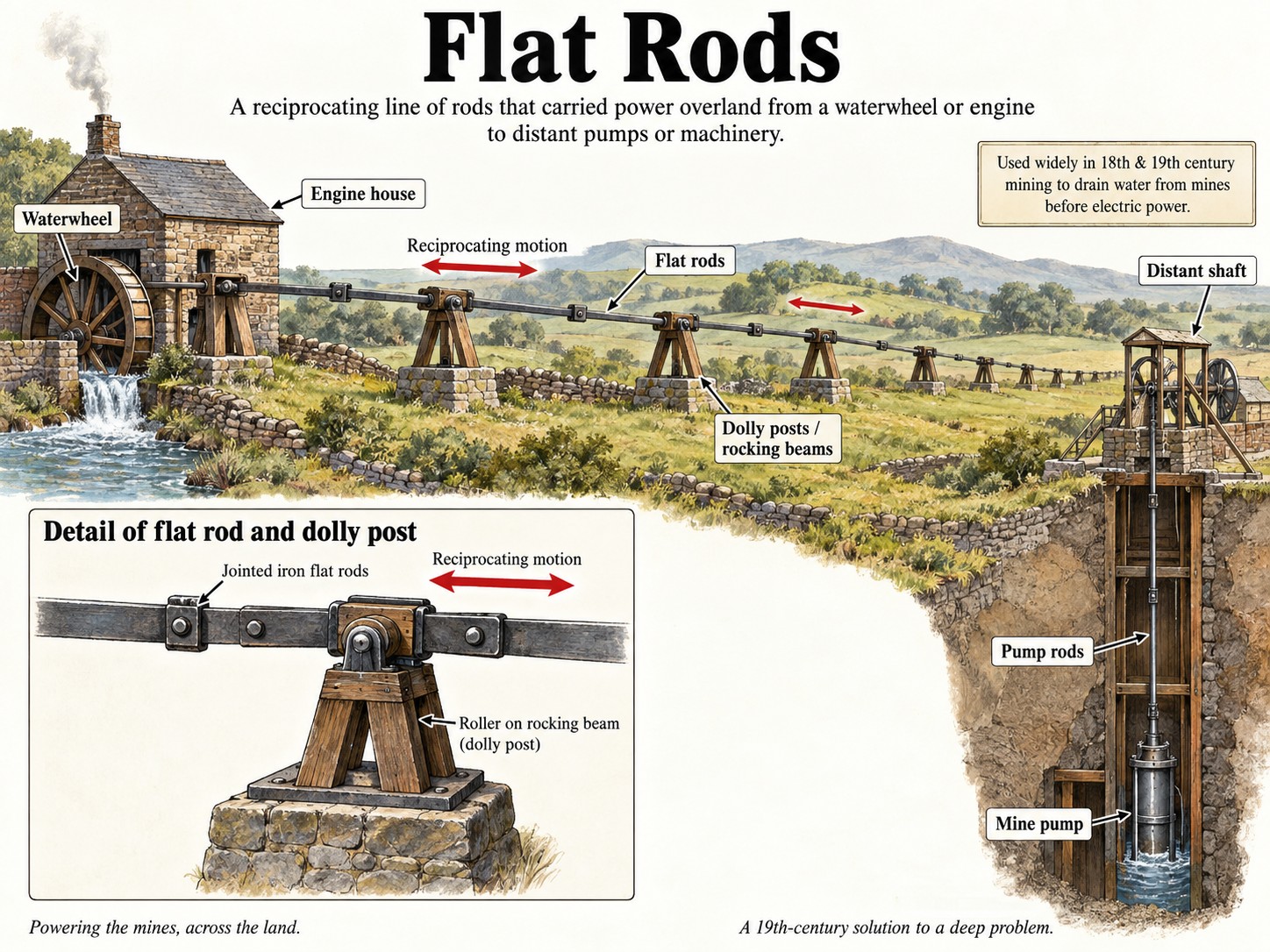
A reciprocating system of jointed iron or timber rods that carried mechanical power overland from a waterwheel or engine to pumps or other machinery some distance away, often up to a quarter of a mile — a way of putting one water-power source to work at several places at once, without needing a separate wheel or engine at each.
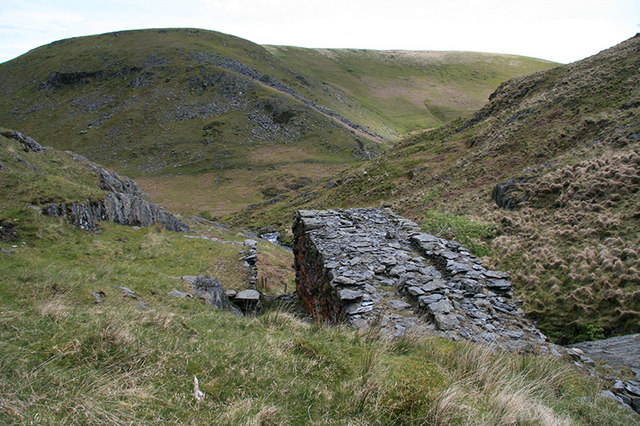
Historical usage
Flat rod systems were used wherever a mine's best water-power site didn't sit directly over the shaft that needed pumping, a common mismatch given how site-specific a good waterwheel location actually was. They're recorded across Cornish and Devon metal mines and Welsh china clay works from at least the 18th century, remaining in occasional use as late as the mid-20th century — a 35-foot waterwheel was still recorded driving a system of rods at the Wheal Martyn china clay works into the 1940s.
How it worked
A waterwheel or engine drove one end of a long line of rods, laid roughly horizontally (or at a shallow incline) and supported at intervals on pivoted rocking beams or rollers called dolly posts; the rods moved back and forth in a reciprocating stroke, typically twelve to fifteen feet, transmitting that motion along the line to a distant shaft, where it drove pump rods or other machinery. Iron rods, jointed with articulated fittings that could be bolted or screwed together, replaced older timber rods over the 19th century, proving more durable and easier to route through awkward ground, structures or vegetation than a straight timber run could manage.
Why it was used
Flat rods let a single waterwheel or engine serve pumping or winding machinery some distance away, avoiding the cost of a second power source at every point that needed one — particularly valuable where the best water supply for a wheel and the point where pumping was actually needed didn't coincide.
Risks & limitations
The system depended on a long, exposed mechanical run staying properly aligned and maintained over its whole length; friction and wear at every joint and support point reduced the power actually delivered at the far end compared to what the driving wheel or engine put in, and a run of any real length represented a substantial ongoing maintenance commitment in its own right.
Related terminology
Mines associated with this term
5 examples chosen from 12 linked records — the term page is not an index.
- Derwent Lead Mines — County Durham (well documented example)
Named 9 times in this record, first in the summary: “…south of Blanchland: Taylor's Shaft, sunk over 250 m and pumped by flat rods running 470 m down the hillside to waterwheels in the valley, the…” - Belstone Mine — Devon (well documented example)
Named twice in this record, first in the history: “…the mine's pumps through around 2,000 feet of 2.5-inch Swedish steel flat rods. After the mine's 1891 closure the wheel fell into decay and was…” - Blainscough Colliery — Lancashire (well documented example)
Named in this record’s workings: “…north; a 30-foot Guibal fan of 1873; a surface pumping engine with flat rods; compressed-air haulage.” - Broomfield Colliery — Greater Manchester (well documented example)
Named in this record’s workings: “…horizontal Haigh Foundry winder under a 55-foot wooden headgear; flat-rod bucket pumps; a 27-foot Walker fan of about 1880; five Lancashire…” - Caradon Hill Medieval and Post-Medieval Mines — Cornwall (well documented example)
Named 3 times in this record, first in the history: “…remains include at least five adits and a rare, largely intact flat-rod system that transferred pumping power from the lower shaft's engine…”
Sources
- (secondary) Cornish Mining Dictionary — Model Railway Engineer
- (secondary) The Mechanical Transmission of Power (1): Stangenkunst — Low-Tech Magazine
Record created: 22 August 2026 · Last researched: 22 August 2026