 MineArchive
Basset and Grylls Mine
| Also known as | Porkellis Mine, Wheal Basset and Grylls, Porkellis United, Porkellis Tin Mines |
|---|---|
| Location | Porkellis Moor, Wendron, near Helston, Cornwall — 50.1481, -5.2270 (approximate) |
| Commodity | Tin |
| Type | Metal |
| Worked | 1845–1938 |
| Maximum depth | 90 fathoms (Old Men's shaft) |
Overview
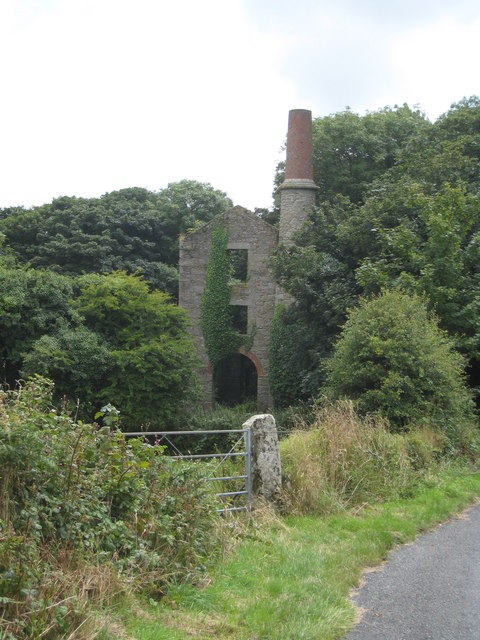
A tin mine on Porkellis Moor in Wendron parish, near Helston, also called Porkellis United. In August 1858 a pond of tin slimes over an old shaft collapsed into the workings, killing seven men; the mine went on, was reopened in 1907 and finally closed before the Second World War. Tyacke's engine house survives.
History
Basset and Grylls, first called Porkellis United and including the workings of Wheal Cock, lay on Porkellis Moor in the parish of Wendron, about three miles from Helston. The ground had been heavily worked by the 'old men' and was soft, needing careful timbering, and tin streamers had covered about half an acre of the surface with slime and waste from the stamps over an old shaft sunk forty or fifty years before. A Mr Jenkin and partners noticed its promise in 1845 but did not hold the mineral rights. The mine worked the north lodes from a flat-rod shaft used as a sump, 65 fathoms deep.
On 24 August 1858 men working too close to the floor of the old shaft weakened it; it gave way, and slime and water poured down and through the 24 fathom crosscut into the deeper workings, where some fifty men were at work. The ground fell in over an area of about 2,000 square fathoms, taking ten or twelve dressing frames with it, and seven men died (see Disasters, below). Afterwards the pumping engine was moved further up the road towards Porkellis, where its engine house on Tyacke's shaft stands today, and the mine turned to the Tymorgie lodes, which proved less rich; the engines were put up for sale in 1859. By 1864 a 60-inch pumping engine, a whim, a pump and stamps of 80 heads were at work, and a new 60-inch engine was ordered from Harvey and Company in 1872, when the Porkellis Moor section was given up.
Between 1852 and 1880 the mine produced 4,323 tons of tin. It was reopened as Basset and Grylls in 1907, chiefly around Old Men's shaft, producing 327 tons of tin by 1914, and was worked by several companies until 1926, as Jantar for a time, and as Porkellis Tin Mines from 1933 until it was abandoned just before the Second World War. On the moor the concrete supports of an elevated tramway, buddles and an arsenic stack survive.
Geology
Tin lodes of the Wendron district: the Cock, Old Men's, Tymorgie (north and south), Wilkin, Cope's, Bennet's and Garlidna lodes, in ground softened by earlier workings.
Workings
Many shafts, among them Tyack's (80 fathoms), Old Men's (90 fathoms), Drigger's (85), Eastern (61) and Gundry's (60); a flat-rod shaft used as a sump; pumping, winding and stamps engines and a waterwheel; later an elevated tramway to a processing mill.
Closure
The Porkellis Moor section was abandoned in 1872; the mine reopened in 1907 and, as Porkellis Tin Mines, was abandoned for good just before the Second World War.
What remains
Tyacke's engine house stands well preserved in woodland by the road into Porkellis; on the moor are buddles, crusher foundations, the concrete pylons of an elevated tramway and an arsenic stack.
Tyacke's pumping engine house, buddles, an arsenic stack, a water tank and the concrete supports of an elevated tramway.
Redevelopment
Unknown.
Related mines
- Wheal Cock — Basset and Grylls, first called Porkellis United, included the workings of Wheal Cock.
Nearby mines
- East Wheal Lovell — 0.7 miles (1.1 km) SE
- Medlyn Moor Mine — 1.0 miles (1.6 km) NE
- Poldark Mine — 1.0 miles (1.7 km) SW
- Wheal Lovell — 1.4 miles (2.2 km) S
- Polhigey Mine — 1.6 miles (2.5 km) N
Straight-line distance, within 9 miles (15 km). Show on the map.
Disasters & major incidents
-
Basset and Grylls Mine inrush, 1858
24 August 1858 · Flooding / Inundation · 7 fatalities
On 24 August 1858 the floor of an old shaft at Porkellis, filled to three or four fathoms with dressing-floor waste and covered by half an acre of tin slimes, gave way. Slime and water poured down through the 24 fathom crosscut into the deep workings, where some fifty men ran for their lives; seven were buried. The ground fell in over about 2,000 square fathoms and the bodies could not be recovered.
What's uncertain
Points where sources disagree or the record could not be settled; both accounts are kept. All open questions in the archive.
- Between 1852 and 1880 it produced 4,323 tons of tin. (disputed) 1
- Working from 1852 to 1914 it produced 4,650 tons of tin. (disputed) 4
Recorded claims
Individual factual claims, each attached to the source(s) that support it below. Where sources disagree, both are kept.
- Basset and Grylls was originally named Porkellis United and included Wheal Cock. 1,2
- On 24 August 1858 a collapse of slimes into the workings killed seven men. 3,1
- After the accident the pumping engine was moved to Tyacke's shaft, where its engine house stands. 1,2
- Between 1852 and 1880 it produced 4,323 tons of tin. (disputed) 1
- Working from 1852 to 1914 it produced 4,650 tons of tin. (disputed) 4
- It was reopened in 1907 and worked as Porkellis Tin Mines until 1938. 1,4
Photographs & further reading
Photographs of the dressing floors and tramway supports taken in 1997.
View sourceThe mine's history, shafts, lodes and output, with the 1858 disaster.
View sourceSources
- (observational) Explore Cornwall: Basset and Grylls — Explore Cornwall
- (observational) Geograph: Engine house at Porkellis — Geograph Britain and Ireland
- (secondary) NMRS: Porkellis Mine Slime Inrush, Helston, 1858 — Northern Mine Research Society
- (observational) Cornish Mine Images: Basset and Grylls Mine — Cornish Mine Images
Record created: 11 October 2026 · Last researched: 11 October 2026