 MineArchive
East Wheal Lovell
| Also known as | Tregonebris Mine, Fatwork Mine |
|---|---|
| Location | Carnebone, beside the A394 north-east of Helston, Wendron, Cornwall — 50.1384, -5.2208 (approximate) |
| Commodity | Tin |
| Type | Metal |
| Worked | 1790s (as Tregonebris); East Wheal Lovell from 1859–1891 (1881 by one account) |
| Maximum depth | At least 110 fathoms (the 110 fathom level, 1876) |
Overview
The richest of Wendron's Lovell mines: a tin mine at Carnebone that paid dividends from 1863 to 1874, when a rich pipe of ore made it the most profitable tin mine in Cornwall for a time and bred a crop of imitators. Its 50-inch engine house on Roger's shaft is Grade II listed and is now a home.
History
East Wheal Lovell, at Carnebone beside the A394 north-east of Helston, was the most celebrated of Wendron's Lovell mines. It grew from two older groups of workings: Tregonebris, which had a pumping engine in the 1790s, and a detached section to the east, Fatwork, still drained by a waterwheel working rag-and-chain pumps; as Tregonebris and Carnebone Fatwork they produced tin from 1853 to 1859. Worked as East Wheal Lovell from 1859, the mine struck a rich tin deposit at 60 fathoms and paid dividends from 1863 to 1874, £27,000 of them between October 1869 and May 1871 alone. In 1870 about 80 workers raised £17,000 of tin at a cost of just over £4,000, a profit described at the time as never exceeded in any tin mine in Cornwall. Its success bred imitators: Great East Wheal Lovell (1864-67), reputedly a scam that produced no tin at all at great expense, and New East Wheal Lovell (1868-70). In 1873 Kelly's Directory described a cost-book company on a Duchy of Cornwall lease at one-eighteenth, with 16 known lodes, four working shafts of 94, 42, 26 and 18 fathoms, 50-inch and 30-inch pumping engines, an 18-inch whim and 24 heads of stamps; Henry Rogers of Helston was purser, Roger Quentrall manager and Nicholas Peters resident agent. Clement Le Neve Foster, describing the mine in 1876, found the orebody between the 40 and 110 fathom levels to be a single continuous pipe. The dividend of 1874 was the last paid by any Wendron mine; the fall in the tin price that followed the Tasmanian discoveries brought decline, and the mine worked on until 1891 by one account (1881 by another), reportedly running the last steam beam engine in the district, with a brief revival in 1927-29. Its 50-inch pumping engine house on Roger's shaft, perhaps named after the purser, is Grade II listed and was converted into a house between 2019 and 2021.
Geology
Tin lodes in granite, 16 known in 1873, some bearing 25 degrees north of east and others nearly east-west, all underlying north; the rich ore struck at 60 fathoms formed a continuous pipe-like shoot between the 40 and 110 fathom levels.
Geological setting: Veins and Lodes (well documented example)
Workings
Two groups of workings, Tregonebris and Fatwork. In 1873 four working shafts of 94, 42, 26 and 18 fathoms, with 50-inch and 30-inch pumping engines, an 18-inch steam whim and water power driving 24 heads of stamps. The rich orebody at Fatwork was worked as a continuous pipe from the 40 to the 110 fathom level.
Closure
Dividends ended in 1874 as the tin price fell after the Tasmanian discoveries. The mine worked on in decline until 1891 by Cornish Mine Images' and Wikipedia's account, or 1881 by the World Heritage Site's, and was briefly revived in 1927-29; abandonment plans for the Tregonebris section are dated 1874.
What remains
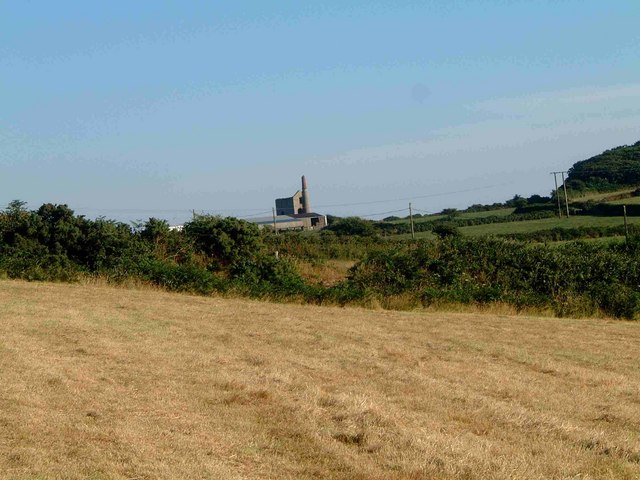
The 50-inch pumping engine house on Roger's shaft is Grade II listed (1988) and was converted into a dwelling between 2019 and 2021.
The 50-inch pumping engine house and its chimney on Roger's shaft, now a house.
Nearby mines
- Poldark Mine — 0.8 km SW
- Medlyn Moor Mine — 2.2 km N
- Rosemanowes Quarry — 4.7 km NE
- Oatfield Mine — 6.6 km W
- Crenver & Wheal Abraham — 7.1 km W
Straight-line distance, within 15 km. Show on the map.
People
- Clement Le Neve Foster · author, 1876 — Described the East Wheal Lovell orebody in 'Remarks upon the Tin Deposits of East Wheal Lovell' (1876).
- Nicholas Peters · agent, 1873 — Resident agent in 1873.
- Roger Quentrall · manager, 1873 — Manager in 1873.
- Henry Rogers · official, 1873 — Purser in 1873, of Helston; the engine house may have been called Roger's after him.
What's uncertain
Points where sources disagree or the record could not be settled; both accounts are kept. All open questions in the archive.
- East Wheal Lovell worked from 1859 to 1891, producing 2,405 tons of tin. (disputed) 4,1
- The yearly production table for 1859-1891 totals 1,846.7 tons of black tin worth £121,579. (disputed) 1
- East Wheal Lovell operated until 1881 and reportedly had the last steam beam engine to work in the Wendron district. (disputed) 2
Recorded claims
Individual factual claims, each attached to the source(s) that support it below. Where sources disagree, both are kept.
- Tregonebris had a pumping engine in the 1790s, with a detached section to the east, Fatwork, drained by a waterwheel working rag-and-chain pumps; as Tregonebris and Carnebone Fatwork the mines produced tin from 1853 to 1859. 1
- A rich tin deposit was struck at 60 fathoms and between 1863 and 1874 the mine paid dividends, £27,000 between October 1869 and May 1871 alone; the 1874 dividend was the last paid by any Wendron mine. 1
- In 1870 East Lovell employed about 80 mine workers and raised £17,000 of tin ore at a cost of just over £4,000, a profit described at the time as never exceeded in any tin mine in Cornwall. 2
- East Wheal Lovell's prosperity led to imitation mines such as Great East Wheal Lovell (1864-67), reputedly a scam that produced no tin at great expense, and New East Wheal Lovell (1868-70). 2,1
- In 1873 East Wheal Lovell Tin Mine was worked by a cost-book company on a 21-year Duchy of Cornwall lease at 1/18, with 16 known lodes, four working shafts of 94, 42, 26 and 18 fathoms, 50-inch and 30-inch pumping engines and 24 heads of stamps; purser Henry Rogers, manager Roger Quentrall, resident agent Nicholas Peters. 3
- Clement Le Neve Foster described the orebody between the 40 and 110 fathom levels in 1876 as one continuous pipe. 1
- East Wheal Lovell worked from 1859 to 1891, producing 2,405 tons of tin. (disputed) 4,1
- The yearly production table for 1859-1891 totals 1,846.7 tons of black tin worth £121,579. (disputed) 1
- East Wheal Lovell operated until 1881 and reportedly had the last steam beam engine to work in the Wendron district. (disputed) 2
- The engine house, perhaps known as Roger's after the purser Henry Rogers, is Grade II listed (17 June 1988) and was converted into a dwelling between 2019 and 2021. 1
- Abandonment plans of Wheal Lovell East (Tregonebris), for tin ore, on eleven sheets, are dated 1874. 5
Photographs & further reading
Photographs including the 50-inch engine house on Roger's shaft.
View sourceThe hamlet's history, with East Wheal Lovell's dividends, yearly output and employment tables.
View sourceTrail notes on the Lovell mines, East Lovell's 1870 profits and the Great East Lovell scam.
View sourceSources
- (secondary) Carnebone — Wikipedia
- (secondary) Wendron Mining District: Delve Deeper (audio trail notes) — Cornish Mining World Heritage Site
- (secondary) Wheal Lovell Mine, Cornwall — Cornwall Calling
- (secondary) Wendron Mining District — Cornish Mine Images
- (primary) Wheal Lovell East (Tregonebris) (Mining Remediation Authority abandonment plan OMR144A, via BGS catalogue item 21864480) — British Geological Survey / Mining Remediation Authority
Record created: 18 September 2026 · Last researched: 18 September 2026