 MineArchive
Rag and Chain Pump
| Also known as | Chain and rag pump, Chain and washer pump (generic name for the wider device family) |
|---|---|
| Category | Structures & Machinery |
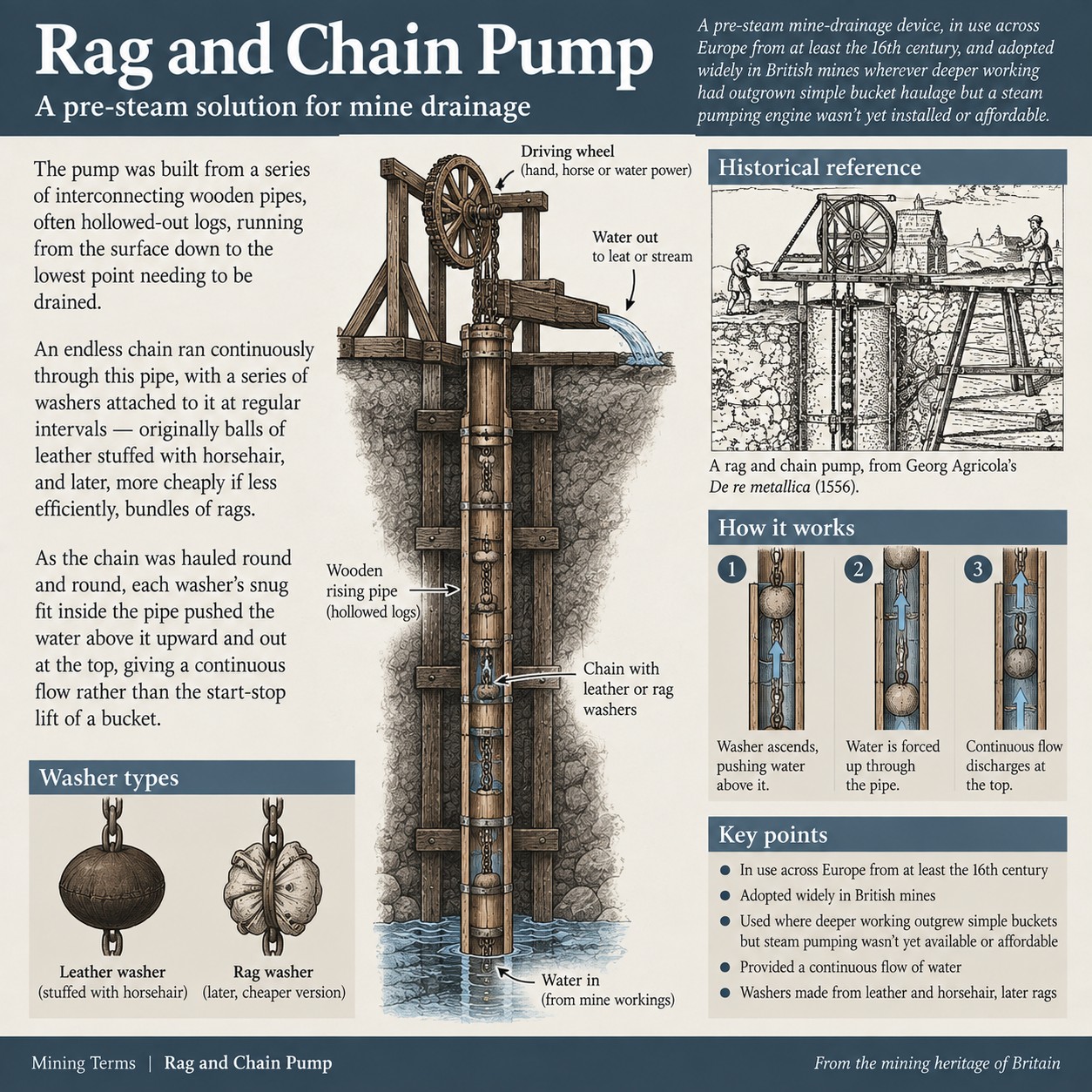
A mine-drainage pump in which an endless chain fitted at intervals with washers of leather or bundled rag is hauled continuously through a wooden pipe, each washer lifting the water above it to the surface.
Historical usage
A pre-steam mine-drainage device, in use across Europe from at least the 16th century — the German mineralogist Georg Agricola illustrated one in his De re metallica (1556) — and adopted widely in British mines wherever deeper working had outgrown simple bucket haulage but a steam pumping engine wasn't yet installed or affordable.
How it worked
The pump was built from a series of interconnecting wooden pipes, often hollowed-out logs, running from the surface down to the lowest point needing to be drained. An endless chain ran continuously through this pipe, with a series of washers attached to it at regular intervals — originally balls of leather stuffed with horsehair, and later, more cheaply if less efficiently, bundles of rags. As the chain was hauled round and round, each washer's snug fit inside the pipe pushed the water above it upward and out at the top, giving a continuous flow rather than the start-stop lift of a bucket.
Why it was used
It let a mine keep pace with drainage as workings went deeper than a simple kibble-and-bucket system could manage, without the cost and engineering of a piston pump or, later, a steam engine. It was valued for being cheap to build, straightforward to maintain, and reliable in everyday use.
Risks & limitations
The pump needed continuous power to turn the chain — originally a horse whim, later a waterwheel where a suitable head of water was available. A site without a nearby stream needed an artificial leat to bring water to the wheel, a real infrastructure cost that limited where the method could be used economically.
Regional variation
Recorded in use across Cornish tin and copper mines, among them the workings later rediscovered and reopened as Poldark Mine, where a surviving example is displayed.
Related terminology
Mines associated with this term
Included only where MineArchive's own research gives a reasonable evidential basis — not every mine where this might plausibly apply.
- Poldark Mine — Cornwall (surviving physical example)
A surviving rag and chain pump is displayed on site at Poldark Mine, used to raise water before the days of steam. - East Wheal Lovell — Cornwall (well documented example)
Named in this record’s history: “…section to the east, Fatwork, still drained by a waterwheel working rag-and-chain pumps; as Tregonebris and Carnebone Fatwork they produced tin from 1853 to…”
Sources
- (secondary) Chain pump — Wikipedia
- (secondary) Cornish Mining WHS - Early Mining Methods — Cornish Mining World Heritage Site
Record created: 28 August 2026 · Last researched: 28 August 2026