 MineArchive
Elvan
| Dialect | Cornish |
|---|---|
| Category | Place-names & Language |
The Cornish and Devon miners' name for the quartz-feldspar-porphyry dykes that cut across the region's tin and copper lodes — from the Cornish elven, 'spark'.
Historical usage
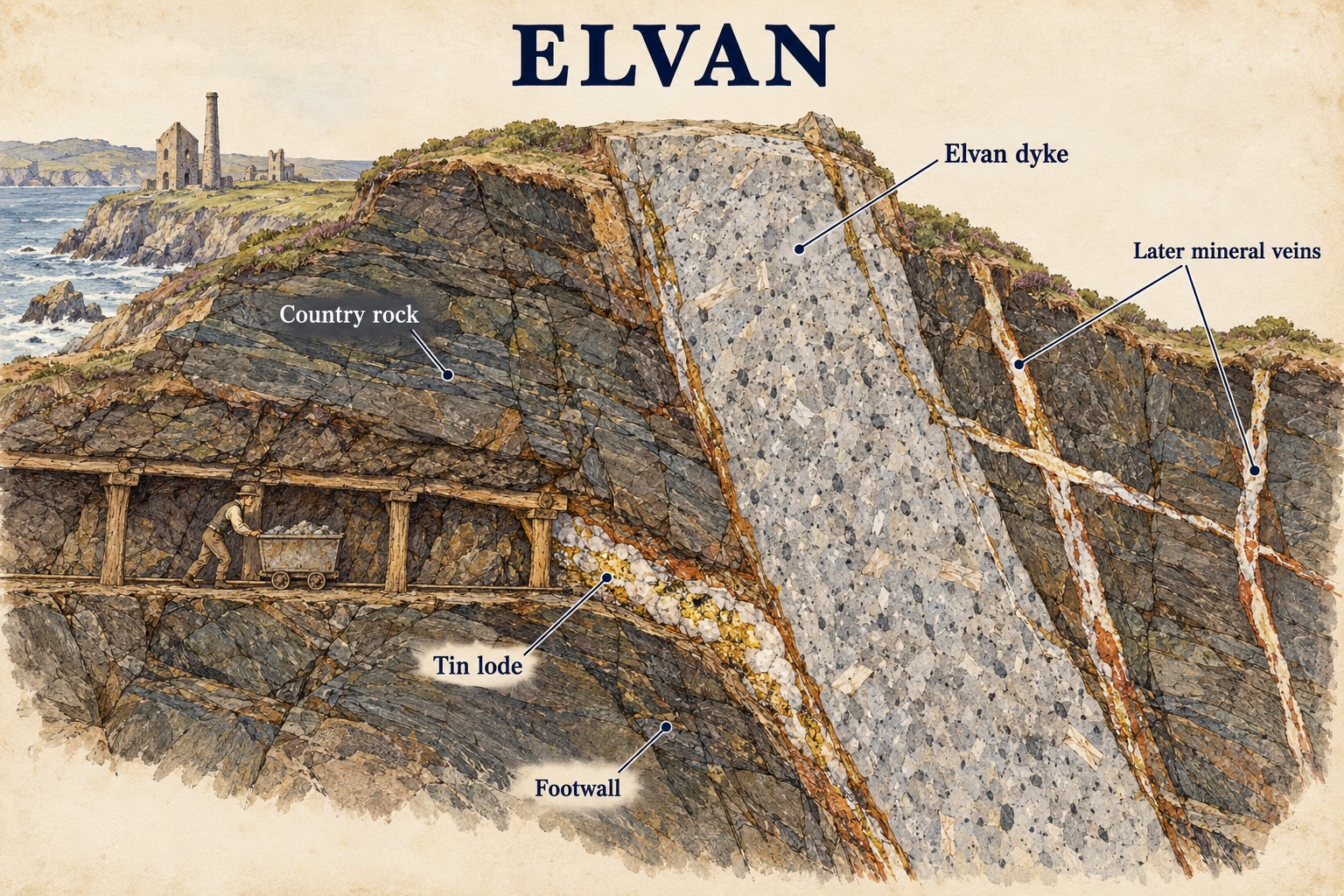
Elvan dykes were intruded into the Mylor Slates and surrounding country rock around 280-285 million years ago, a later phase of the same granite-related igneous activity that produced Cornwall's tin and copper mineralisation. Miners recognised early on that the dykes' distribution broadly tracked that of the hydrothermal tin-bearing veins they were following underground, making elvan a useful, if imperfect, guide when prospecting.
How it worked
At some mines an elvan dyke appears to have directly controlled where a lode was deposited — at Wheal Coates, for instance, a tin lode developed along the footwall of an elvan dyke — while at others a broad, highly mineralised elvan itself crossed several separate lodes. Later mineral-bearing fluids from the same cooling granite deposited the tin and copper ores in fissures cutting through and around the elvan, chiefly trending east-north-east.
Why it was used
Beyond its role as a guide to ore, elvan's hardness and fine grain made it a valued building stone in its own right — quarried varieties such as Pentewan, Polyphant and Catacleuse stone were prized for finely carved work like doorways — and it was later quarried in bulk for road-building aggregate.
Risks & limitations
Most elvan quarries are now disused, their stone displaced first by other building materials and later by imported aggregate; its usefulness as an ore-prospecting guide was also always partial, since not every elvan dyke controlled or accompanied worthwhile mineralisation.
Regional variation
A term specific to Cornwall and Devon, where these dykes are common; the same kind of quartz-porphyry intrusion occurs elsewhere in Britain but is not locally called elvan outside the south-west.
Related terminology
Mines associated with this term
5 examples chosen from 11 linked records — the term page is not an index.
- Cann Quarry — Devon (well documented example)
Named 5 times in this record, first in the history: “…jointly from 1874. By 1839 the quarry was also raising porphyritic elvan stone alongside slate, and by the time Edward Gullett took the lease…” - Consolidated Mines — Cornwall (well documented example)
Named in this record’s geology: “…cutting through killas (metamorphic slate), crossed by intrusive elvan dykes; the Virgin Lode was the most productive, stoped continuously…” - Wheal Fortune — Cornwall (well documented example)
Named in this record’s geology: “…following structural weaknesses, in which an east-west elvan (quartz-feldspar porphyry) dyke that had displaced the earlier…” - East Wheal Lovell — Cornwall (well documented example)
Named in this record’s surface remains: “…house on Roger's shaft, a mid-19th-century house of granite and elvan rubble with granite dressings and round brick arches, two storeys…” - Great Carnon Stream Works — Cornwall (well documented example)
Named in this record’s geology: “…tin ground - six inches to six feet of subangular granite, slate, elvan, quartz and quartzose slate carrying tin ore in large masses and in…”
Sources
- (secondary) Elvan — Wikipedia
- (secondary) Granite porphyry (Elvan) - St Austell — Virtual Microscope (Open University)
Record created: 27 August 2026 · Last researched: 27 August 2026