 MineArchive
Consolidated Mines
| Location | Near St Day, Gwennap, Cornwall — 50.2350, -5.1631 (exact) |
|---|---|
| Commodities | Copper, Arsenic, Pyrite, Tin, Zinc |
| Type | Metal |
| Worked | 1782–1870 |
| Maximum depth | 300 fathoms (Woolf's Shaft) |
| Operators | John Taylor (1819–1857), Arthur Woolf (1819–?), Clifford Amalgamated Mines (1861–1870) |
Overview
Consolidated Mines, in the Gwennap district near St Day, was Cornwall's single most productive mine of the early 19th century — at its peak the largest copper producer in the world, employing some 3,000 people in a parish once called ‘the richest square mile in the Old World’.
History
Consolidated Mines was formed in 1782 through the merger of several older 18th-century workings — Wheal Virgin, West Wheal Virgin, Wheal Girl, Wheal Maid, Wheal Fortune and Carharrack Mine — whose individual operations had closed around 1779 under the weight of flooding and coal costs. The new combined mine adopted Boulton & Watt's steam technology on an unprecedented scale, replacing seven old Newcomen engines with five more efficient Boulton & Watt engines and saving an estimated £11,000 a year in coal, though it still paid Boulton & Watt £2,500 annually in patent dues, later reduced to £1,000 once the partners took a direct interest in the mine. In 1784 Consolidated Mines installed Cornwall's first steam winding engine, and in 1788 one of only two underground pumping engines then working anywhere in the county. By the late 1780s the mine employed over 1,000 people — one of only two Cornish mines of that scale — though 1787 alone recorded a loss of £8,000, and the operation had closed substantially by 1811. The mining entrepreneur John Taylor raised around £65,000 to restart the mine in 1819, bringing in Arthur Woolf as chief engineer; in 1820–21 Woolf designed and installed two 90-inch single-cylinder pumping engines, at the time the largest and most powerful steam engines in the world, built by the Neath Abbey Ironworks. A 58-inch engine followed in 1824, with three more engines added by 1829. From 1824 Taylor ran Consolidated Mines as a single concern together with the neighbouring United Mines, and built the Redruth and Chasewater Railway that year to carry ore to the port at Devoran. Between 1823 and 1825 alone, Consolidated Mines produced 12.5% of the entire copper output of Great Britain. Employment peaked at around 3,000 workers in 1838–39, when 826 men and boys worked below 100 fathoms, at an average depth of 229 fathoms; by 1836, more than a quarter of Gwennap parish's population of 8,539 worked at the mine. Between 1819 and 1858, Consolidated Mines raised a total of 442,493 tons of ore for 34,011 tons of metal, worth over £2 million — the largest output recorded by any single mine in Cornwall — with the peak year, 1839, alone producing 24,535 tons of ore, 1,970 tons of metal and £144,545 in value. Consolidated Mines ceased working in 1857 after John Taylor's lease was not renewed by the mineral rights holders; in 1861 it merged with United Mines and Wheal Clifford to form Clifford Amalgamated Mines, which struggled on unprofitably until final closure in 1870, when the machinery was dismantled and the buildings largely demolished.
Geology
The mine worked around eight main lodes cutting through killas (metamorphic slate), crossed by intrusive elvan dykes; the Virgin Lode was the most productive, stoped continuously for more than 1.3 miles (2.1km). Copper was the primary product, alongside black tin, arsenic, pyrite and small quantities of zinc ore.
Geological setting: Veins and Lodes (well documented example)
Workings
Woolf's Shaft, sunk in 1826, reached 300 fathoms, among the deepest workings in the district. Underground conditions at depth were extreme: air temperature at the 294-fathom level reached 96°F, and as much as 108°F in places, while water at the bottom of Davey's Shaft ran at 92.5°F and was used by miners to cool themselves.
Closure
Consolidated Mines ceased working in 1857, when it was clear that the copper mines of west Cornwall were nearing exhaustion and foreign production — Chilean above all — was taking the market. In 1861 it amalgamated with the neighbouring United Mines and Wheal Clifford to form Clifford Amalgamated Mines, which carried on unprofitably until 1870. Even at that final closure the group still had twenty engines at work, nine of them pumping, with seven whims, a man engine and a crusher. Grace’s Guide dates the end of Consolidated itself to 1858 rather than 1857, and the amalgamation to 1857 rather than 1861.
What remains
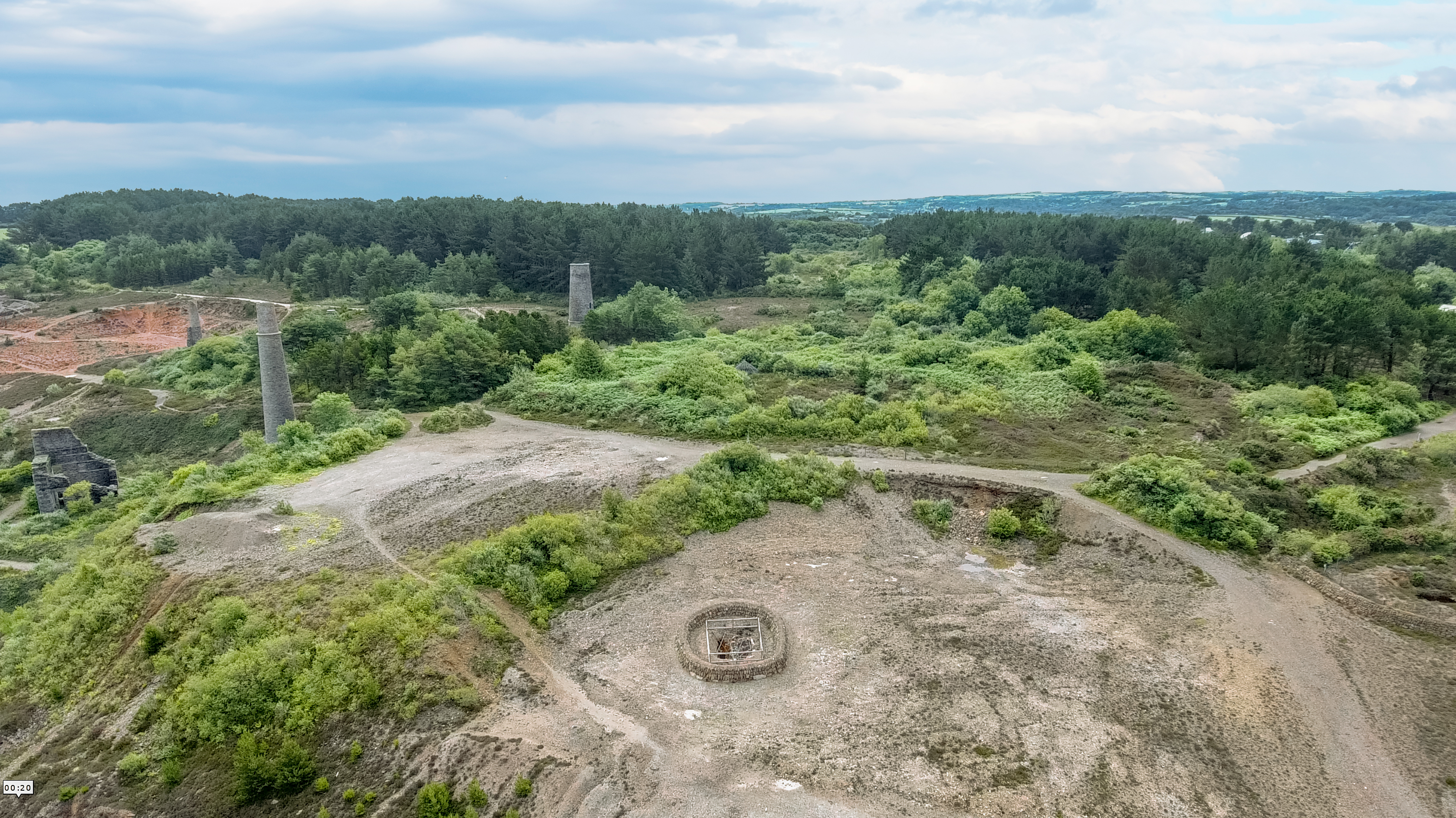
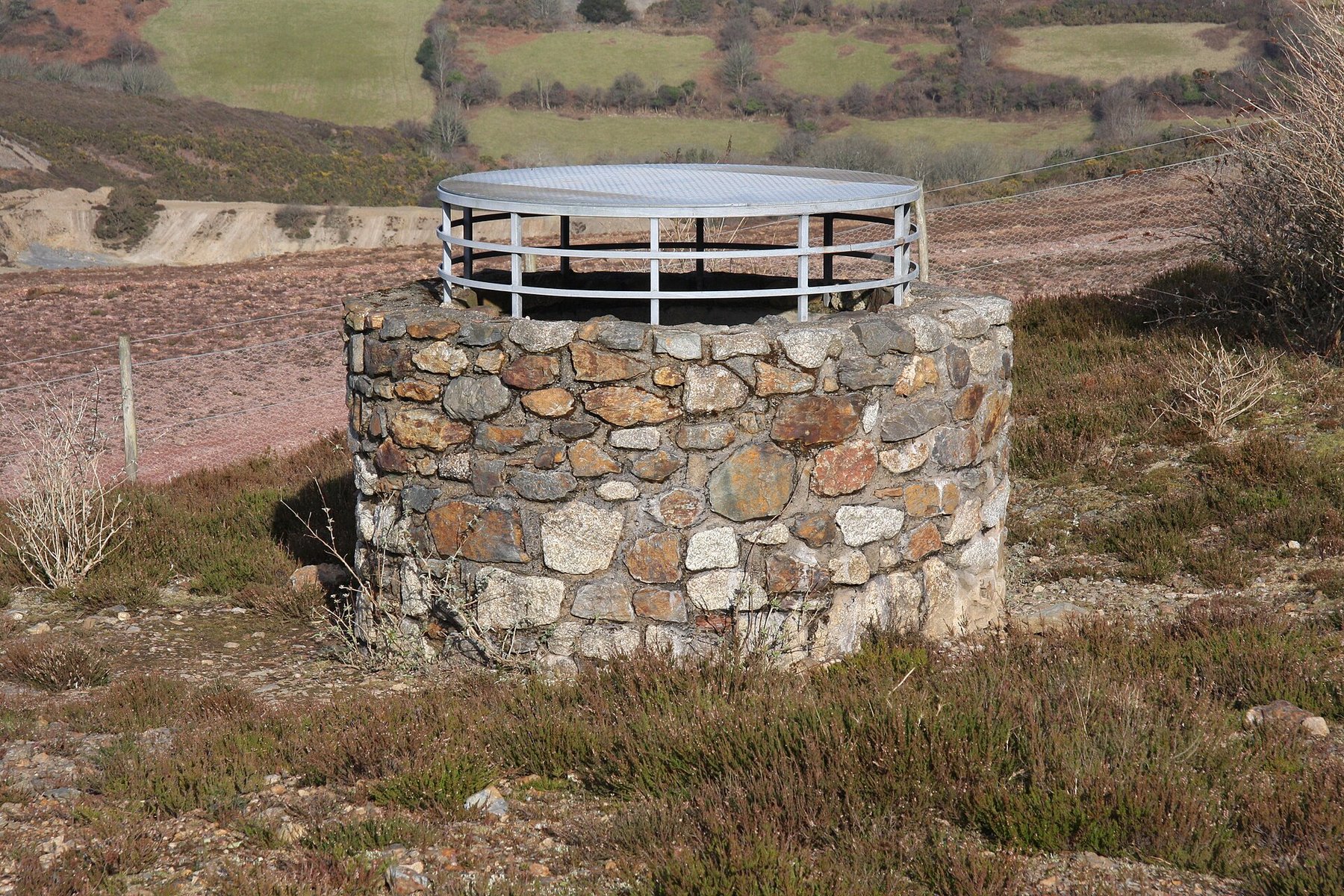
Several capped shafts — including Bawden's and Michell's, both still open and covered with wire mesh — survive today, along with two ruined engine houses, a tall chimney, and the clock tower built at the former Wheal Maid site, all part of the Gwennap Mining District within the Cornwall and West Devon Mining Landscape World Heritage Site. The mine's fame was such that later ventures elsewhere, including Devon Great Consols, borrowed the ‘Consols’ name.
Several capped shafts, Bawden’s and Michell’s among them, still open beneath wire mesh; two ruined engine houses; a tall chimney; and the clock tower at the former Wheal Maid site — a round tapered tower of killas rubble with granite quoins, jambstones, voussoirs and copings, standing on an octagonal base, its clock gone and its interior smoke-blackened. It is listed grade II.
Related mines
- Cusvey Mine — Cusvey was incorporated into John Taylor's Consolidated Mines from 1819 and later worked with the group under United Mines and Clifford Amalgamated.
- Great County Adit — The mines that merged to form Consolidated were jointly running seven Newcomen engines to pump their water into the Great County Adit before the 1782 amalgamation, and Consolidated went on discharging into the same system — the drainage connection that made deep working in the Gwennap district possible at all.
- United Mines — The two great Gwennap combines merged in 1857 to form Clifford Amalgamated Mines.
- Wheal Clifford — Merged with Wheal Clifford and United Mines into Clifford Amalgamated Mines in 1861.
- Wheal Fortune — Wheal Fortune was one of the older 18th-century workings merged to form Consolidated Mines.
- Wheal Maid — Wheal Maid was one of the older 18th-century workings merged to form Consolidated Mines.
Nearby mines
- Wheal Clifford — 0.1 miles (0.1 km) SE
- Wheal Baddon — 0.2 miles (0.3 km) SW
- Wheal Maid — 0.2 miles (0.3 km) NW
- Wheal Squire — 0.2 miles (0.4 km) S
- Copper Hill Mine — 0.4 miles (0.7 km) SW
Straight-line distance, within 9 miles (15 km). Show on the map.
What's uncertain
Points where sources disagree or the record could not be settled; both accounts are kept. All open questions in the archive.
- Wikipedia dates Consolidated Mines' formation to 1782, from the merger of Wheal Virgin, West Wheal Virgin, Wheal Girl, Wheal Maid, Wheal Fortune and Carharrack Mine. (disputed) 2
- Cornwall Calling instead dates the mine's formation to 1780. (disputed) 3
- Wikipedia records Consolidated Mines ceasing work in 1857 and amalgamating with United Mines and Wheal Clifford in 1861 to form Clifford Amalgamated Mines, which continued unprofitably until 1870; Grace’s Guide gives the closure as 1858 and the amalgamation with United as 1857. (disputed) 2,4
Recorded claims
Individual factual claims, each attached to the source(s) that support it below. Where sources disagree, both are kept.
- Between 1823 and 1825, Consolidated Mines alone produced 12.5% of the entire copper output of Great Britain. 1
- Employment at Consolidated Mines peaked at around 3,000 workers in 1838–39; by 1836, more than a quarter of Gwennap parish's population of 8,539 worked at the mine. 2
- Between 1819 and 1858, Consolidated Mines raised a total of 442,493 tons of ore for 34,011 tons of metal, worth over £2 million — the largest output recorded by any single mine in Cornwall. 2
- The two 90-inch pumping engines installed by Arthur Woolf in 1820–21 were, at the time, the largest and most powerful steam engines in the world. 2
- At the 294-fathom level, air temperature reached 96°F and as much as 108°F in places; water at the bottom of Davey's Shaft ran at 92.5°F and was used by miners to cool themselves. 2
- In November 1831, an eight-year-old child was killed near the mine's 120-fathom level — one of the youngest recorded deaths in a Cornish mine. 2
- Wikipedia dates Consolidated Mines' formation to 1782, from the merger of Wheal Virgin, West Wheal Virgin, Wheal Girl, Wheal Maid, Wheal Fortune and Carharrack Mine. (disputed) 2
- Cornwall Calling instead dates the mine's formation to 1780. (disputed) 3
- Consolidated Mines was formed in 1782 by amalgamating neighbouring mines including Wheal Girl, West Wheal Virgin, Wheal Virgin, Wheal Maid, Wheal Fortune and Carharrack. Their workings were already interconnected and all of them had closed during 1779, defeated by water: they were jointly running seven Newcomen engines to pump into the Great County Adit and could neither keep the levels down nor afford the coal. 2
- Five Boulton and Watt engines replaced the seven Newcomens and were working by 1782, saving almost £11,000 a year in coal. Boulton and Watt built the first steam whim in Cornwall here in 1784, and in 1788 installed an underground pumping engine at the Wheal Virgin site — one of only two underground engines installed in Cornwall before 1850. 2
- Wikipedia records Consolidated Mines ceasing work in 1857 and amalgamating with United Mines and Wheal Clifford in 1861 to form Clifford Amalgamated Mines, which continued unprofitably until 1870; Grace’s Guide gives the closure as 1858 and the amalgamation with United as 1857. (disputed) 2,4
- When the mine finally closed in 1870 it still had twenty engines at work, including nine pumping engines, seven whims, one man engine and a crusher. 4
- The clock tower at the former Wheal Maid site is listed grade II: a round tapered tower of killas rubble with granite quoins, jambstones, voussoirs and copings over an octagonal base, dating from the early nineteenth century, its clock removed or fallen and its interior smoke-blackened. 5
Photographs & further reading
The statutory description of the surviving clock tower at the former Wheal Maid site, down to its killas rubble, its granite dressings and its missing clock.
View sourceThe fullest general account of the mine: the 1782 amalgamation, the Boulton and Watt engines that made it possible, John Taylor’s revival from 1819 and the closures of the 1850s.
View sourceSources
- (secondary) Consolidated Mines, Chimney, Gwennap — Historic England
- (secondary) Consolidated Mines — Wikipedia
- (secondary) Gwennap Mining District — Cornwall Calling
- (secondary) Consolidated Mines — Graces Guide
- (primary) Consolidated Mines, Clocktower, Gwennap — list entry 1136402 — Historic England, via British Listed Buildings
- (observational) Great Consolidated Mines — Explore Cornwall
- (primary) Mine plan: Clifford Amalgamated Consolidated and United ... Wheal Fortune ... (abandonment plan, Copper Ore, 1870) — BGS / Mining Remediation Authority mine plans catalogue
Record created: 20 August 2026 · Last researched: 6 September 2026