 MineArchive
China Clay
| Category | Commodities |
|---|---|
| Commodity page | China Clay → |
China clay, or kaolin, is a soft white clay used chiefly in papermaking, ceramics and paint, worked in Cornwall by washing it out of decomposed granite with high-pressure water jets.
Historical usage
Deposits of unusually fine, white-firing china clay were found in Cornwall in the mid-18th century, launching a Cornish industry that grew hugely through the 19th century as tin mining declined; by 1910 Cornwall was producing around half the world's china clay, some one million tonnes a year, three-quarters of it exported.
How it worked
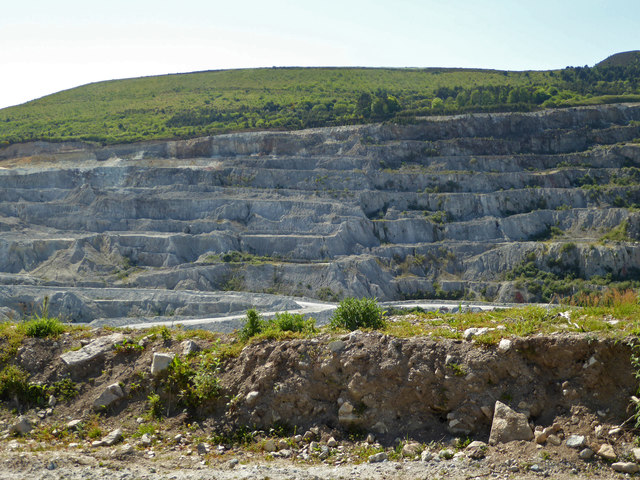
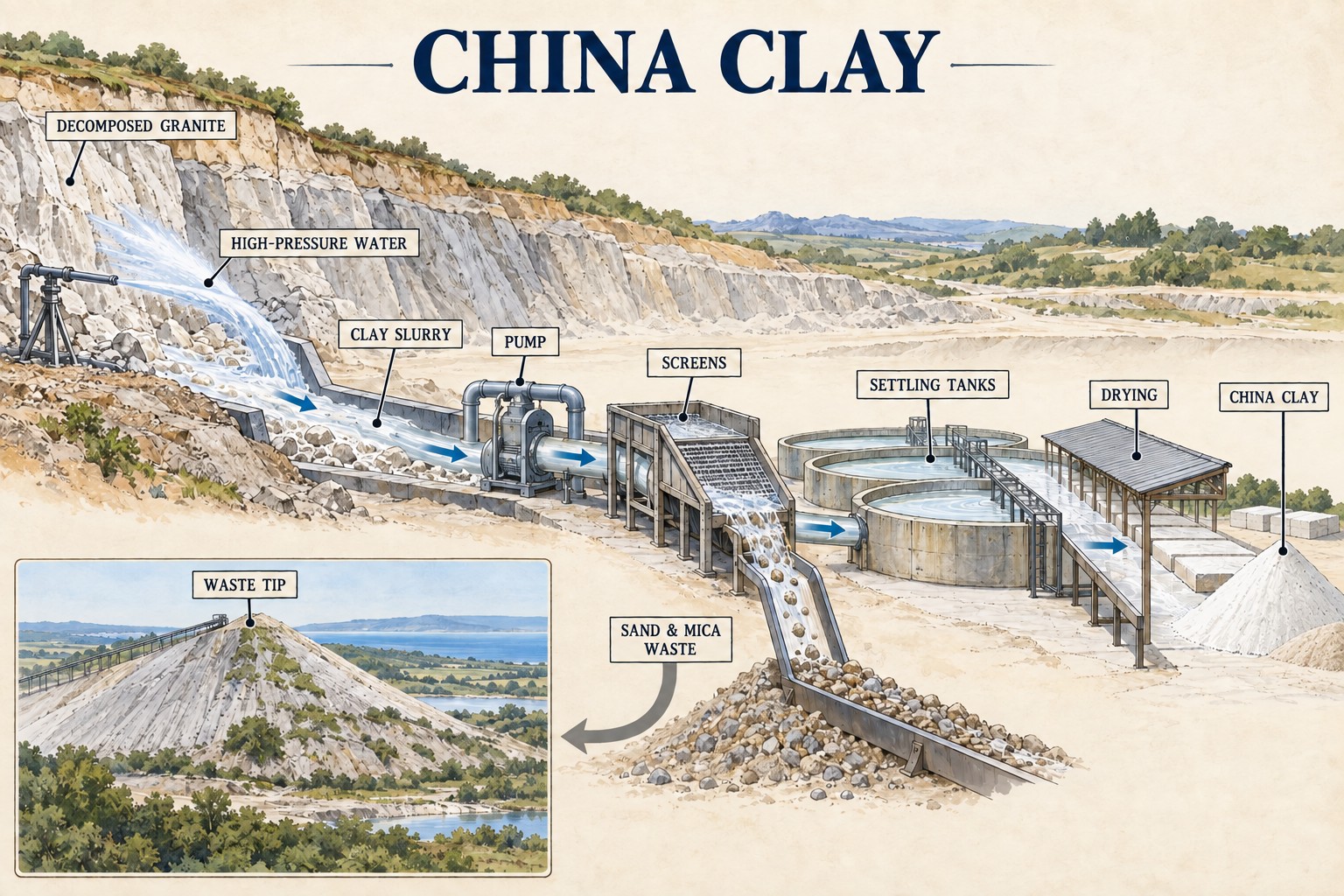
Clay pits were worked by directing powerful jets of water at the decomposed granite face ('china clay rock'), breaking it down into a slurry that was then pumped away, screened to remove coarse mica and quartz waste, and settled and refined into pure clay before drying. The huge conical waste tips of unwanted sand and mica this left behind — the 'Cornish Alps' — became as much a landmark of the industry as the pits themselves.
Why it was used
Kaolin's fine particle size, whiteness and chemical inertness made it valuable as a coating and filler in papermaking, giving paper its brightness and printability, and as a raw material in ceramics, paint, rubber and pharmaceuticals.
Value over time
The industry consolidated in 1919 when its three main producers merged to form English China Clays, which went on to dominate the Cornish trade for most of the 20th century. Employment peaked at around 5,500 in the late 1970s, but rising energy costs and growing overseas competition steadily eroded Cornwall's position; the French group Imerys bought English China Clays in 1999 for £756 million, then moved much of its production to Brazil in the following decade, leaving fewer than 2,000 people employed in the Cornish industry today, even though the St Austell deposits themselves are estimated to have decades of extractable clay left.
Hazards & challenges
China clay working exposes miners and quarrymen to fine dust from both the kaolinised clay itself and the surrounding decomposed granite, which still carries a meaningful proportion of free silica; radiological surveys of kaolin industry workers have recorded pneumoconiosis consistent with this dust exposure, historically the industry's principal long-term health hazard, alongside the everyday physical risks of quarrying deep, wet, unstable pit faces.
Risks & limitations
China clay is a bulky, low-value-per-tonne material like coal, so its economics depend on being close to export infrastructure and able to compete on cost with clay deposits found elsewhere in the world; as cheaper overseas sources came on stream through the later 20th century, Cornwall's higher production costs became an increasingly serious competitive disadvantage.
Related terminology
Ball Clay, China Stone, Feldspar, Growan, Hydraulic Mining, Stent
Mines associated with this term
5 examples chosen from 10 linked records — the term page is not an index.
- Snaefell Mine — Isle of Man (well documented example)
When the mine closed its pumping waterwheel was dismantled and shipped to Cornwall, rebuilt to pump slurry at a china clay pit. - Carclaze Pit — Cornwall (well documented example)
Four centuries of tin working exposed one of Cornwall's richest china clay deposits almost by accident, and the pit changed commodity rather than closing. - Castlecaldwell Feldspar Mine — County Fermanagh (well documented example)
Named twice in this record, first in the history: “…lands in 1853. It found workable deposits of feldspar and kaolin (china clay) at Larkhill, a townland around eight miles from Belleek within the…” - Goonvean Pit — Cornwall (well documented example)
Named 5 times in this record, first in the summary: “A St Austell-district china clay pit worked by the Goonvean and Rostowrack China Clay Co. from 1932,…” - Headon Quarry — Devon (well documented example)
Named 7 times in this record, first in the summary: “A china clay quarry at Sparkwell, on the south-western edge of Dartmoor, worked…”
See every mine that worked china clay →
Sources
- (primary) Kaolin dust concentrations and pneumoconiosis at a kaolin mine — PubMed Central
- (secondary) St Austell Clay Pits — Wikipedia
- (secondary) The China Clay Industry — Cornwall Guide
Record created: 20 August 2026 · Last researched: 20 August 2026