 MineArchive
Ball Clay
| Also known as | Potters' Clay (The older trade name for the same material) |
|---|---|
| Category | Commodities |
| Commodity page | Ball Clay → |
A kaolinitic sedimentary clay — commonly 20-80% kaolinite, 10-25% mica and 6-65% quartz, with organic matter — that is exceptionally plastic and fires to a buff, cream or off-white body. It is not dug where it formed: unlike china clay, which is washed out of the granite it weathered from, ball clay was carried away by water and redeposited in sedimentary basins, and the sorting on that journey is what makes it fine and plastic.
Historical usage
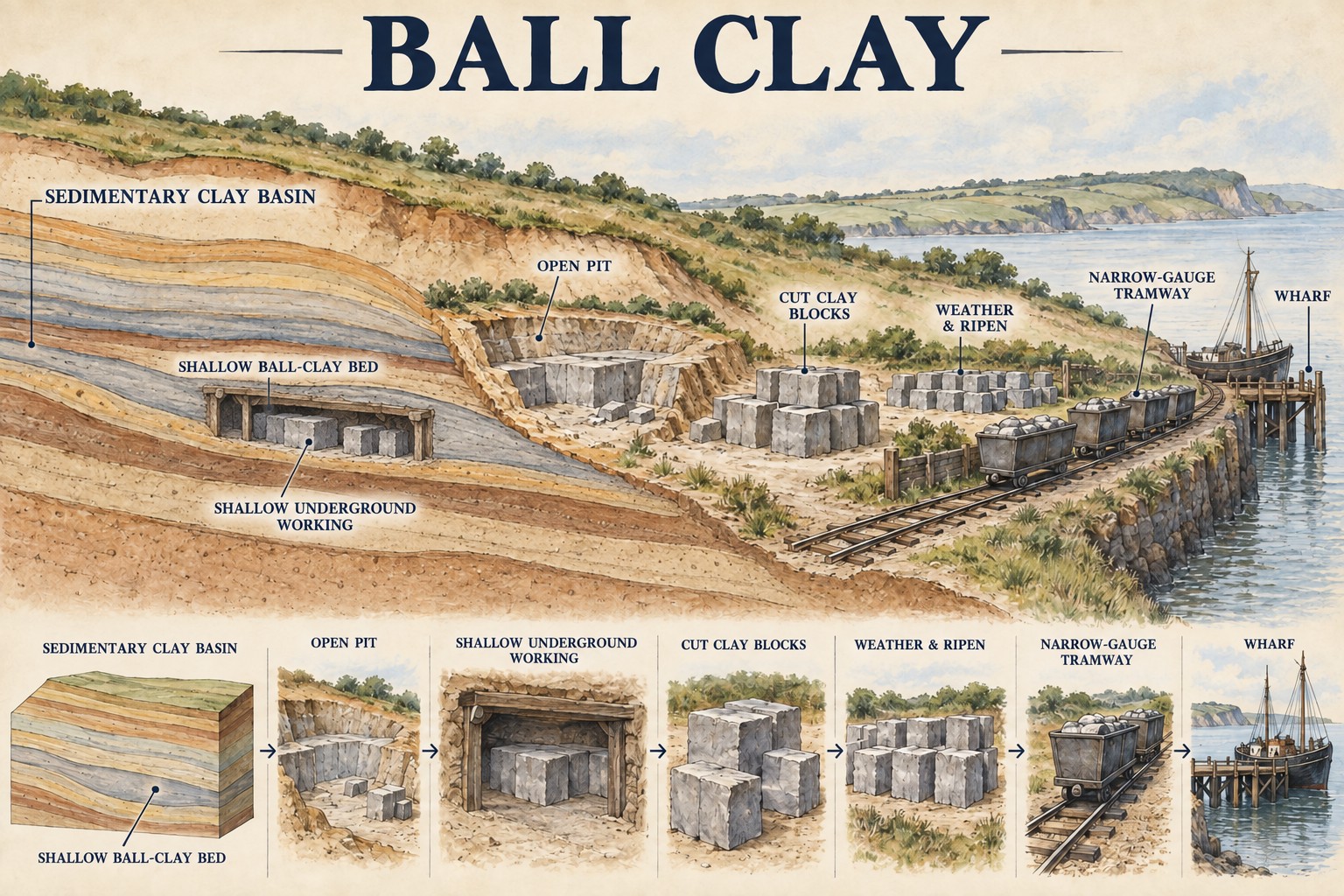
The name is a working-practice fossil. In 18th-century Dorset and Devon the clay was cut out in cubes which rounded off into balls as they were hauled and shipped, and the name stuck to the material. Its commercial history begins with the potteries: Josiah Wedgwood signed a contract for 1,400 tons a year in 1771, and in Purbeck the trade goes back further still — Joseph Pike founded the family clay business and his son William was supplying Wedgwood by 1791. Britain has three ball clay fields: the Bovey Basin in south Devon, the Petrockstow Basin in north Devon and the Wareham area of Dorset.
How it worked
Worked from open pits and shallow underground workings rather than deep mines, because the deposits are sedimentary basin fills lying near the surface. The distinctive part of the process is what happens after digging: the clay was hauled to a central point and left in the open to weather and 'ripen' before shipment. Moving it was the real engineering problem — the Purbeck firms each built their own narrow-gauge tramway to water, Fayle's Middlebere line from 1806 to Poole Harbour and Pike Brothers' from around 1840 to a quay on the Frome.
Why it was used
For plasticity and unfired strength. Ball clay lets a potter or a machine form a thin-walled shape that holds together before firing, and it keeps its rheology in a casting slip. Few clays do this well, which is why the deposits that do are worked so intensively and shipped so far.
Value over time
Ball clay's value has always been tied to somebody else's product rather than its own. The 18th-century market was the Staffordshire potteries; by 2008 the largest single end-use was sanitaryware at around 40% by volume, with total UK production worth about £82 million. Britain remains a significant producer at roughly a million tonnes a year in the early 2000s, against China at about two million, Germany three million and Ukraine three and a half. That is an unusual position for a British extractive industry: not a survivor of decline but a continuing exporter, because the deposits are genuinely scarce and the quality is good.
Hazards & challenges
Ball clay carries a significant quartz fraction — up to 65% in some beds — so the respirable crystalline silica risk of any clay working applies, and applies harder to the dry handling and milling end than to the wet pit. The pits themselves are shallow and open rather than deep, which removes the classic underground hazards but leaves unstable wet faces; the shallow underground workings that were driven where the best beds lay under cover carried the ordinary risk of collapse in soft ground. No hazard specific to ball clay beyond silica is recorded.
Risks & limitations
The deposits are geographically very limited — the geological conditions that produce a ball clay are narrow, and Britain's three basins are the whole national resource. The material is also low-value for its bulk, which is why the industry's history is largely a history of transport: tramways, wharves and shipping rather than mining technique.
Regional variation
Devon and Dorset are the British fields, and the Purbeck material is worked and shipped separately from the Bovey and Petrockstow clays. 'Potters' clay' is the older name; 'ball clay' won out because of how it was cut and carried, not because of anything about the clay itself.
Related terminology
Mines associated with this term
Included only where MineArchive's own research gives a reasonable evidential basis — not every mine where this might plausibly apply.
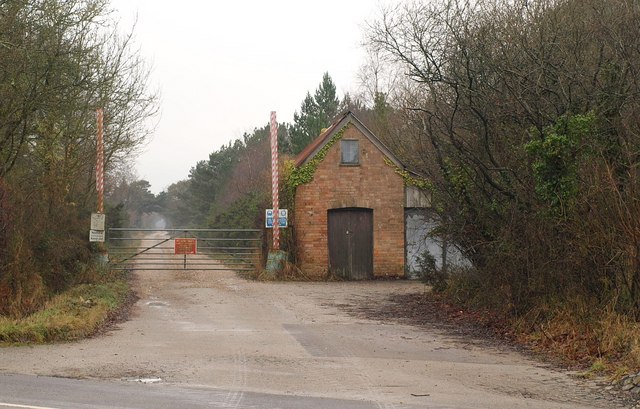
- Furzebrook and Norden Ball Clay Pits — Dorset (well documented example)
The Purbeck pits at Furzebrook and Norden are the archive's record of the Dorset ball clay field, one of the three British sources, and of the tramways built to move a clay too valuable to cart.
See every mine that worked ball clay →
Sources
- (secondary) Ball clay — Wikipedia
- (secondary) Clay History — Purbeck Mining Museum
- (secondary) Purbeck's clay railways — Dorset Life
Record created: 25 August 2026 · Last researched: 26 August 2026