 MineArchive
Stent
| Also known as | China Clay Waste (the plain descriptive term used outside Cornwall/Devon) |
|---|---|
| Dialect | Cornish |
| Category | Place-names & Language |
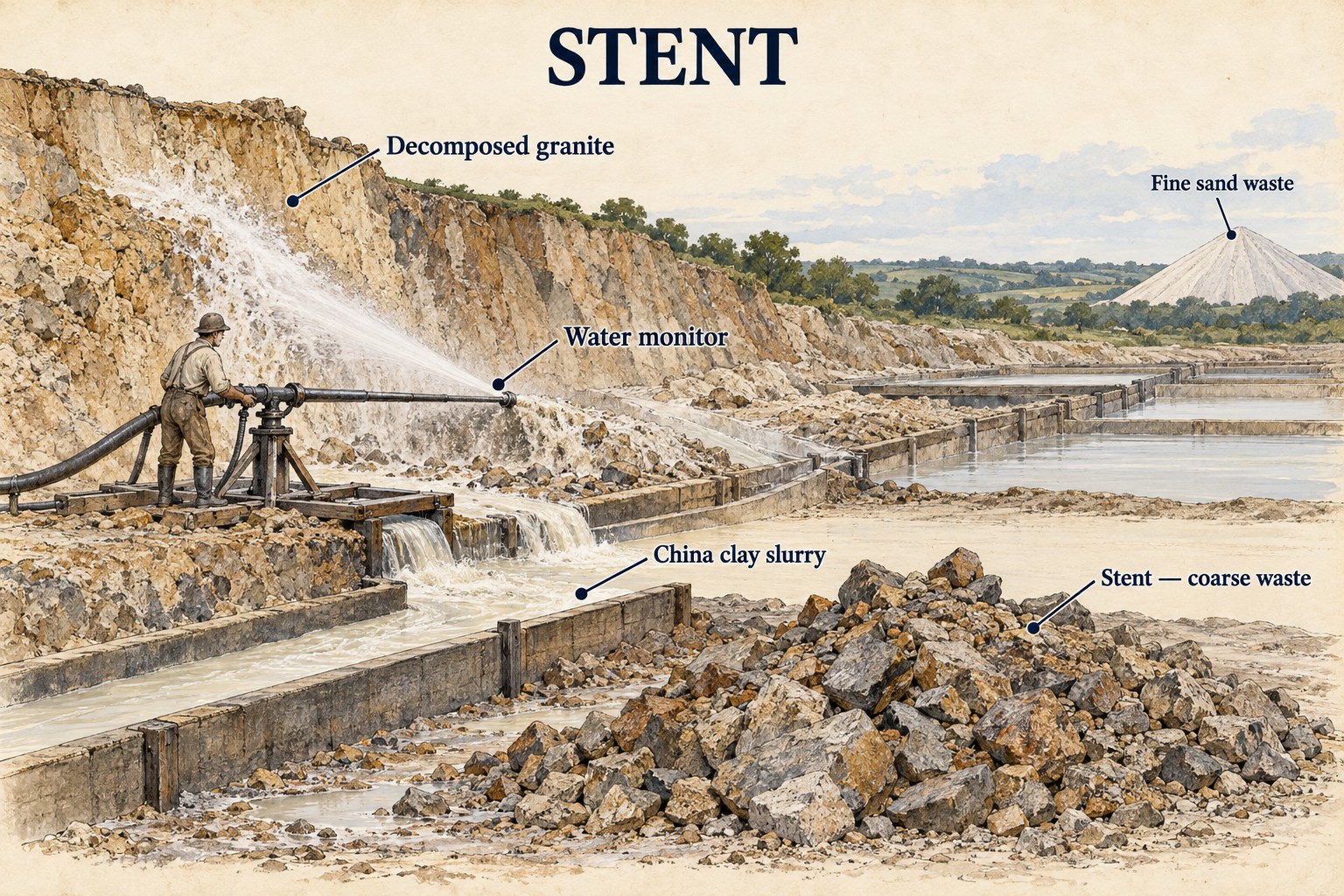
The Cornish and Devon dialect word for the waste granite left over once china clay has been washed out of it -- distinct from the clay itself, which is the only part of the rock actually sold.
Historical usage
China clay (kaolin) forms as a weathered component within granite, and has to be separated from the surrounding rock by high-pressure water jetting rather than by blasting or cutting the granite out whole. What is left once the clay has been washed away is stent -- coarse waste rock rather than the fine white sand also produced by the same washing process, which forms the pyramid-shaped tips that gave the St Austell china clay district its nickname of the 'Cornish Alps'. Modern china clay quarrying, centred on the St Austell Granite (around 83.5% of UK output) and the Bodmin Moor Granite, has left millions of tonnes of stent stockpiled at working and former pits such as Gunheath Quarry near St Austell.
Why it was used
Separating china clay from its host granite by water jetting is efficient for recovering the clay itself, but it necessarily produces the coarse waste rock -- stent -- as an unavoidable by-product; there was for most of the industry's history no economic reason to do anything with it beyond tipping it.
Risks & limitations
Left simply as spoil, stent accumulated in enormous volumes over the industry's history, permanently reshaping the landscape of mid-Cornwall into the white-tipped hills still visible today; only recently has it found a genuine second use, crushed and screened for recycled aggregate in road and building projects rather than left as dead spoil.
Related terminology
Mines associated with this term
Included only where MineArchive's own research gives a reasonable evidential basis — not every mine where this might plausibly apply.
- Duffryn Rhondda Colliery — Neath Port Talbot (well documented example)
Named in this record’s history: “…from a machine-cut Six-Feet face where each collier had a six-yard stent yielding 22 tons on a 48-hour turnover. From 1959 methane drained…” - Headon Quarry — Devon (well documented example)
Named in this record’s history: “…and separate the china clay from the surrounding waste granite ('stent'). The wider china clay industry on this edge of Dartmoor grew…”
Sources
- (primary) Mineral Resources map for Cornwall — British Geological Survey / NERC
- (secondary) Stent higher grade recycling — Aggregates Business
Record created: 30 August 2026 · Last researched: 30 August 2026