 MineArchive
China Stone
| Also known as | Cornish Stone (The trade name outside Cornwall) |
|---|---|
| Category | Commodities |
| Commodity page | China Stone → |
A medium-grained, feldspar-rich, partially kaolinised granite, distinguished by the near-absence of iron-bearing minerals — quartz, feldspar, mica, kaolinite and fluorspar, and almost nothing that would stain a fired body. It is the flux in the porcelain recipe: china clay gives the ware its whiteness and plasticity, china stone melts at firing temperature and binds it into something hard and translucent.
Historical usage
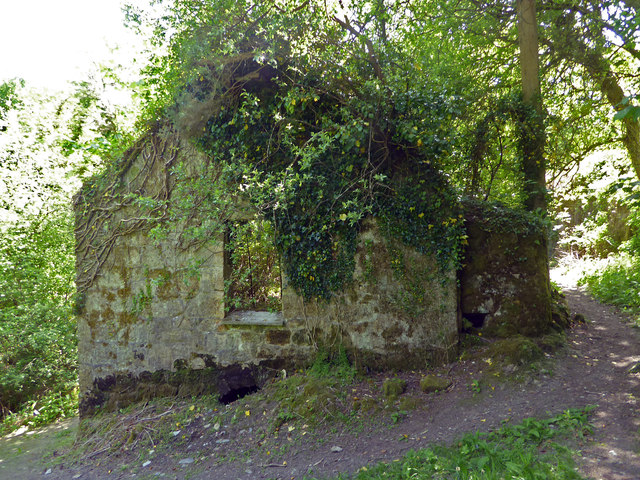
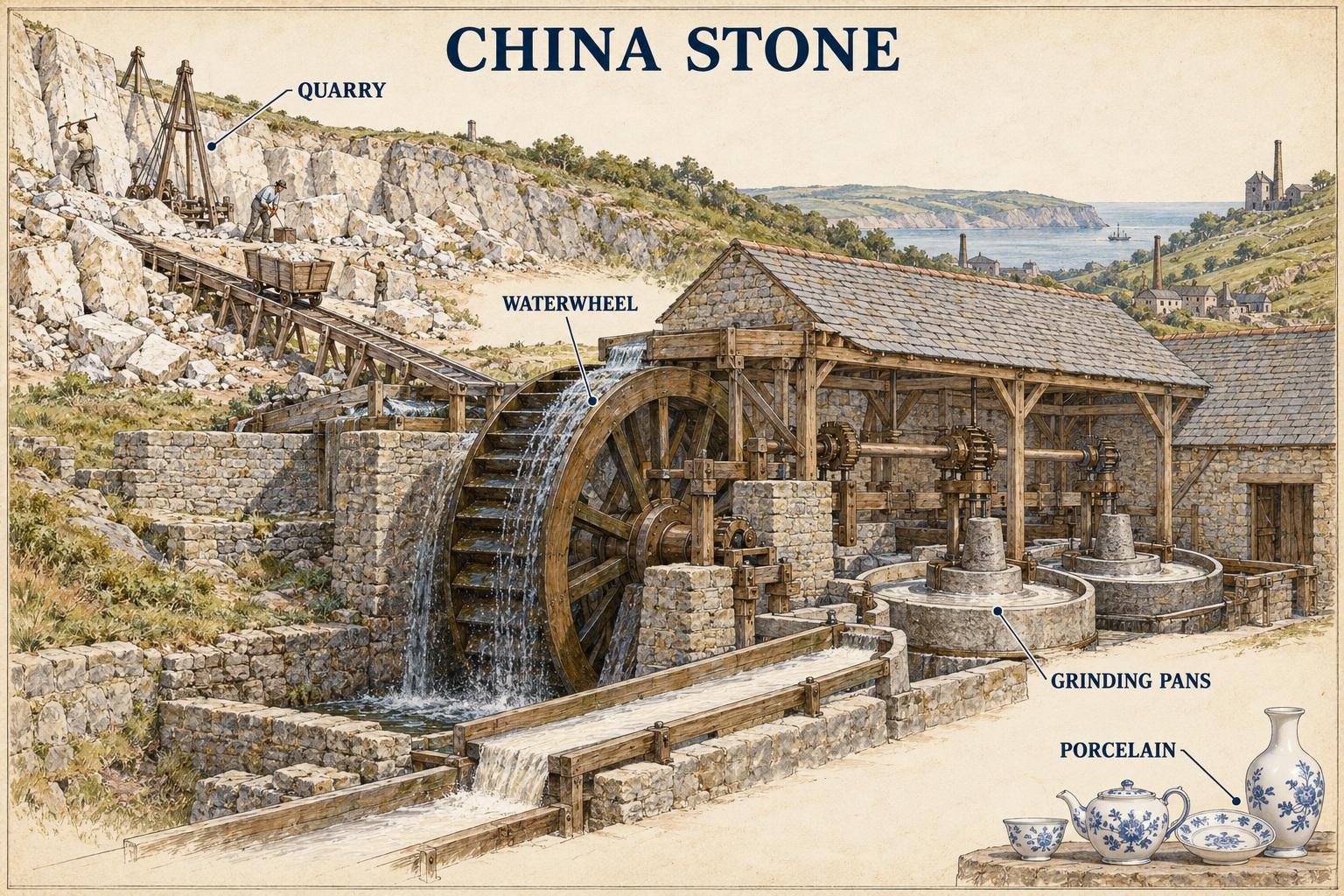
It is inseparable from the invention of English porcelain. The Plymouth chemist William Cookworthy, hunting for a native equivalent of the Chinese porcelain materials, found decomposed granite at Tregonning Hill near Helston in 1745 — locally called growan, and soon renamed china stone. Quarrying and milling in the Tregargus Valley began around 1870 and eventually filled that steep narrow valley with seven separate water-powered mills. The largest, Big Wheel Mill of 1898, drove six grinding pans from a waterwheel thirty feet across carrying 105 buckets. Production centred on one area near St Austell for the whole life of the industry.
How it worked
Unlike china clay, which is washed out of the granite hydraulically, china stone is quarried as rock and must be ground. That is why the Tregargus Valley looks as it does: the mills are the industry, sited along a steep stream for the water power to turn grinding pans. Stone was quarried above, brought down, crushed and ground to a fine powder, then shipped to the Staffordshire potteries.
Why it was used
Because porcelain needs a flux and this granite is an unusually clean one. The absence of iron is the whole commercial argument: iron in the flux gives a fired body a grey or buff cast, and the point of porcelain is that it is white.
Value over time
Production peaked in the early 1950s at around 70,000 tonnes a year. The market for the lower grades collapsed during the 1960s — the last of the Tregargus mills closed in 1965 — and the largest producer, English China Clays, stopped altogether in 1973. What finished it was substitution rather than exhaustion: feldspar concentrates and other industrially processed fluxes are chemically purer, more consistent and easier to handle than a natural stone. By 2001 sales were down to about 2,800 tonnes a year against imported alternatives and a shrinking domestic pottery industry, and the last Cornish china stone quarry closed in 2006.
Hazards & challenges
No hazard specific to china stone is recorded, and it would be wrong to invent one. What applies is the ordinary risk of the process: this is a quartz-bearing granite that was crushed and ground dry in mills, and respirable crystalline silica from that work carries the same silicosis risk as any hard-rock grinding. The pottery industry it supplied knew that risk well under its own name — potters' rot.
Risks & limitations
A natural rock cannot compete with a manufactured product on consistency, and that is what eventually killed it. China stone varies from quarry to quarry and bed to bed; a modern automated pottery wants a flux with predictable composition every time. It is also heavy, low-value and quarried in one small part of Cornwall, so haulage is a permanent drag on the margin.
Regional variation
Called china stone in Cornwall and Cornish stone in the trade elsewhere; growan is the older Cornish word for the decomposed granite before Cookworthy's discovery gave it a market. It is sometimes confused with petuntse, the Chinese pottery stone, which is similar in role but different in mineralogy.
Related terminology
Mines associated with this term
Included only where MineArchive's own research gives a reasonable evidential basis — not every mine where this might plausibly apply.
- Tregargus China Stone Quarries — Cornwall (well documented example)
The seven water-powered mills of the Tregargus Valley existed for no other purpose than grinding this one stone, and the archive's record of them is the record of the trade.
See every mine that worked china stone →
Sources
- (observational) Discover Tregargus Valley — The Cornish Bird
- (primary) Tregargus Valley china stone quarries & mills — Cornwall and Isles of Scilly Local Heritage List
- (secondary) China stone — Wikipedia
- (secondary) Tregargus Valley — Grace's Guide
Record created: 24 August 2026 · Last researched: 26 August 2026