 MineArchive
Tregargus China Stone Quarries
| Also known as | Tregargus Valley China Stone Mills |
|---|---|
| Location | Tregargus Valley, near St Stephen-in-Brannel, Cornwall — 50.3495, -4.8841 (approximate) |
| Commodity | China Stone |
| Type | Quarry |
| Worked | Worked from around 1870–1965 (last mill closed) |
Overview
A steep Cornish valley that once held seven water-powered mills, all built to grind one very specific stone into the ingredient that actually makes porcelain hold together — china clay gets the credit, but china stone is what makes it work as a ceramic.
History
China stone — a partially kaolinised granite distinct from, but related to, the china clay worked more famously nearby — was identified as a useful raw material by the Plymouth chemist William Cookworthy, whose search for a genuine English porcelain led him in 1745 to the decomposed granite he found at Tregonning Hill near Helston, locally called 'growan' and soon renamed china stone. Quarrying and milling in the Tregargus Valley itself began around 1870, eventually filling the steep, narrow valley with seven separate water-powered mills grinding china stone for the pottery industry. The largest, Big Wheel Mill, was built in 1898 with six grinding pans driven by a waterwheel thirty feet across carrying 105 buckets — one of the largest of its kind anywhere in Cornwall. The market for the lower grades of china stone collapsed in the 1960s, and the last of the Tregargus mills closed in 1965.
Geology
China stone is a medium-grained, feldspar-rich granite that has been kaolinised — chemically weathered by hydrothermal fluids — to a lesser degree than the china clay deposits worked nearby, so that it still retains enough unweathered feldspar, quartz and mica to behave as a genuine ceramic flux rather than breaking down entirely into clay. It occurs in only one part of Cornwall, around St Austell, and nowhere else in useful quantity in Britain.
Workings
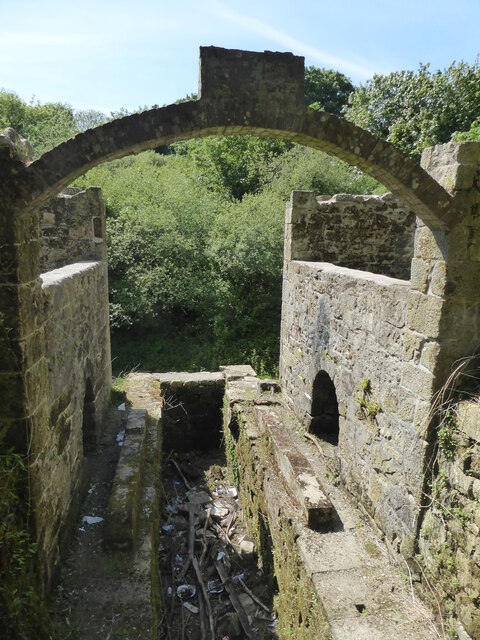
Stone was quarried nearby and brought to the Tregargus mills to be crushed and then ground to powder between rotating slabs of china stone itself, the process driven entirely by water power drawn off leats built along the valley to feed each mill's waterwheel in turn. The valley's surviving infrastructure includes pan-kilns for drying the ground stone, a mica drag for separating out unwanted mica, a blacksmith's shop, bridges and the trackbeds of disused tramways.
Closure
The mills closed as demand for the lower grades of china stone they produced collapsed in the 1960s, the last closing in 1965; china stone production continued elsewhere in Cornwall on a reduced scale into the 21st century before the last remaining quarry closed in 2006.
What remains
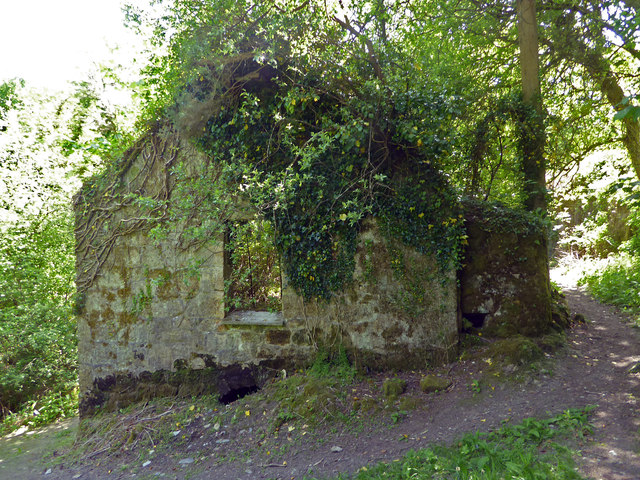
Of the valley's original seven mills, five survive in some form, including Trevear Mill with its attached pan-kiln and miller's cottage, and the derelict Big Wheel Mill site with its associated tramways and leats. The Cornwall Engine Preservation Society and other local groups have worked to preserve some of the buildings and waterwheels, and the valley is now a public walking route.
Five surviving mill buildings including Trevear Mill and Big Wheel Mill, pan-kilns, a mica drag, leats, tramway trackbeds and a blacksmith's shop.
Redevelopment
Preserved as a heritage walking route through the valley; no built redevelopment.
Nearby mines
- Goonvean Pit — 0.8 miles (1.4 km) N
- South Terras Mine — 1.3 miles (2.1 km) SW
- Great Dowgas Mine — 2.0 miles (3.2 km) SE
- Ventonwyn Mine — 2.3 miles (3.8 km) SE
- Wheal Remfry — 2.9 miles (4.6 km) NW
Straight-line distance, within 9 miles (15 km). Show on the map.
Recorded claims
Individual factual claims, each attached to the source(s) that support it below. Where sources disagree, both are kept.
- William Cookworthy's search for English porcelain led him in 1745 to decomposed granite at Tregonning Hill near Helston, locally called 'growan' and soon renamed china stone. 1
- Quarrying and milling began in the Tregargus Valley itself around 1870, eventually filling it with seven separate water-powered mills. 1
- Big Wheel Mill, built in 1898, had six grinding pans driven by a 30 ft waterwheel carrying 105 buckets, one of the largest of its kind in Cornwall. 2
- China stone is a partially kaolinised, feldspar-rich granite found only in one part of Cornwall, distinct from china clay though formed by a lesser degree of the same weathering process. 3
- Demand for lower grades of china stone collapsed in the 1960s and the last Tregargus mill closed in 1965. 1
- Five of the valley's seven original mills survive, including Trevear Mill and the Big Wheel Mill site, with some buildings and waterwheels preserved by local heritage groups. 4,2
Sources
- (secondary) Tregargus Valley — Grace's Guide
- (primary) Tregargus Valley china stone quarries & mills — Cornwall and Isles of Scilly Local Heritage List
- (secondary) China stone — Wikipedia
- (observational) Discover Tregargus Valley — The Cornish Bird
Record created: 24 August 2026 · Last researched: 24 August 2026