 MineArchive
Great Dowgas Mine
| Also known as | Dowgas Great, Great Dowgas, St Stephen Tin and Copper Mines |
|---|---|
| Location | Downderry, near St Stephen-in-Brannel, Cornwall — 50.3233, -4.8669 (approximate) |
| Commodities | Copper, Tin, Cobalt, Nickel |
| Type | Metal |
| Worked | c. 1719–1913 |
| Maximum depth | 46 fathoms (Engine Shaft, on New North Lode) |
| Operators | Ventonwyn Mining Syndicate |
Overview
A tin and copper mine near St Stephen-in-Brannel, mid Cornwall, worked intermittently from about 1719 until final closure in 1913. It developed five roughly parallel, south-east-trending lodes, was drained by a deep adit running into the neighbouring St Austell Consols sett, and in its last working period was amalgamated with the smaller Ventonwyn Mine. Contemporary opinion in 1865 rated it “always a poor mine”, and the surviving record bears that out: modest, erratic tin and copper output rather than any single period of prosperity.
History
Great Dowgas is first recorded selling a small quantity of black tin around 1719, though no figures survive for its earliest years. It was reworked repeatedly through the 18th and 19th centuries without ever becoming a major producer: in 1865 the mining writer Thomas Spargo judged that it “was always a poor mine, and the works have wholly ceased, at least underground, but the sett, I believe, has not been surrendered.” Recorded output confirms the mine's marginal character rather than contradicting Spargo's assessment. Up to 1832 it had produced copper ore worth at least £12,000, with tin worth more than £9,000 recorded for 1828–1832 alone. Official statistics give 120 tons of black tin for 1856–1860, and in 1857 the mine also raised 4 tons of cobalt ore, whose exact mode of occurrence in the lodes was not established at the time. The mine's final working period ran from the early 1900s to 1913, when it was worked jointly with the neighbouring Ventonwyn Mine; a further 47 tons of black tin were raised for 1907–1913, mostly as a by-product of pyrite extraction from the upper levels, which was the chief output by the end. Ventonwyn itself, run separately for many years by the Ventonwyn Mining Syndicate and recorded in Cornish trade directories and the London and Westcountry Chamber of Mines' own records between the 1880s and 1912, appears to have ceased its own independent working around 1907, after which its ground was worked as part of the combined operation. For a short period in 1873, Great Dowgas was also worked jointly with part of the adjoining St Austell Consols sett under the joint name ‘St Stephen Tin and Copper Mines’ — a temporary trading arrangement rather than a separate, permanent mine, and the origin of the alternative name sometimes attached to the site. The mine finally closed in 1913; BGS/Mining Remediation Authority abandonment-plan records for ‘Dowgas Great and Ventonwyn Hewas St. Austell Consols’ independently confirm a September 1913 abandonment date. An earlier phase of working under the name ‘Dowgas United Great’ is separately recorded as abandoned in 1861, indicating at least one earlier company reorganisation before the final, longer-lived combination with Ventonwyn.
Geology
The mine worked five south-east-trending lodes within a transverse distance of about 130 fathoms, named from north to south Woodhead's Lode, New North Lode, Copper Lode, Goffins Lode (also called Coffins Lode, or Great Stopes Lode) and South Lode. The principal lode, Goffins Lode, was developed from several shafts over some 300 fathoms along strike; it occupied a crush zone filled mainly with quartz and pyrite in a matrix of killas fragments. Cassiterite occurred only sporadically along its length, with the richer ground concentrated in the eastern part, where the lode crossed an elvan dyke before passing into killas and dying out.
Geological setting: Hydrothermal Deposits (well documented example), Veins and Lodes (well documented example)
Workings
The workings were drained by a deep adit that begins near Coombe and follows the valley north-eastwards to Brannel farm, where it turns south-east and continues into the St Austell Consols sett, a distance of more than a mile. A cross-cut driven south-west below Dowgas farm connects to Engine Shaft, sunk on New North Lode to 46 fathoms below surface. In the 18th century, Goffins Lode had already been worked from open gunnises at shallow depth, apparently abandoned once the tin grades there became poor.
Closure
The mine closed for the last time in 1913, after a final period in which pyrite from the upper levels, rather than tin or copper ore, was the main material raised.
What remains
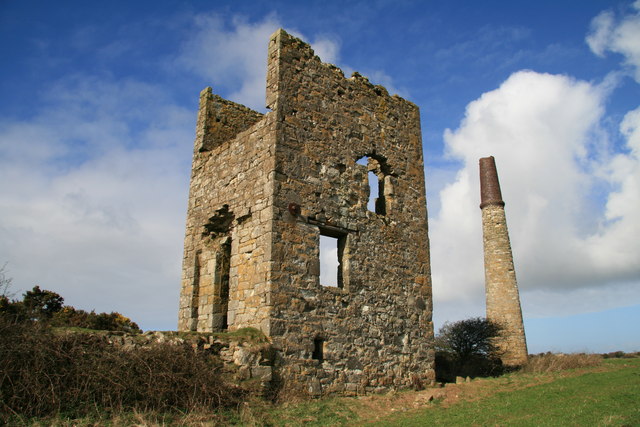
Great Dowgas's own engine house at Engine Shaft has not survived, though its chimney stack still stands. At the neighbouring Ventonwyn Mine site, the engine house and chimney that once housed a 35-inch cylinder rotative engine driving the stamps also survive, and were reported in 2008 as a well-known local landmark near Hewas Water.
A standing chimney stack at the former Engine Shaft; the more substantial engine house and chimney of the former Ventonwyn stamps engine, on a ridge near Hewas Water.
Redevelopment
Unknown.
Related mines
- Ventonwyn Mine — Worked jointly with Great Dowgas from about 1907 and abandoned with it in 1913 under the combined title 'Dowgas Great and Ventonwyn Hewas St. Austell Consols'.
Nearby mines
- Ventonwyn Mine — 0.4 miles (0.6 km) SE
- South Terras Mine — 1.8 miles (3.0 km) NW
- South Polgooth Mine — 2.0 miles (3.1 km) E
- Tregargus China Stone Quarries — 2.0 miles (3.2 km) NW
- Goonvean Pit — 2.8 miles (4.4 km) N
Straight-line distance, within 9 miles (15 km). Show on the map.
What's uncertain
Points where sources disagree or the record could not be settled; both accounts are kept. All open questions in the archive.
- Great Dowgas Mine is first recorded selling a small quantity of black tin around 1719; no earlier production figures survive, and the mine was reworked repeatedly, without great success, until 1913. (uncertain) 1
Recorded claims
Individual factual claims, each attached to the source(s) that support it below. Where sources disagree, both are kept.
- Great Dowgas Mine is first recorded selling a small quantity of black tin around 1719; no earlier production figures survive, and the mine was reworked repeatedly, without great success, until 1913. (uncertain) 1
- In 1865 the mining writer Thomas Spargo judged the mine “always a poor mine, and the works have wholly ceased, at least underground, but the sett, I believe, has not been surrendered.” 1
- The mine worked five south-east-trending lodes within a transverse distance of about 130 fathoms (Woodhead's Lode, New North Lode, Copper Lode, Goffins/Coffins/Great Stopes Lode, South Lode); the main lode, Goffins Lode, was a quartz-and-pyrite-filled crush zone in killas, with cassiterite occurring only sporadically and richest where the lode crossed an elvan dyke. 1
- A deep adit drained the workings from near Coombe, running north-east then south-east into the St Austell Consols sett (over a mile in total); Engine Shaft, on New North Lode, reached 46 fathoms below surface via a cross-cut driven south-west below Dowgas farm. 1
- Up to 1832 the mine produced copper ore worth at least £12,000, with tin worth over £9,000 recorded for 1828–1832; official output figures give 120 tons of black tin for 1856–1860 and 47 tons for 1907–1913, with 4 tons of cobalt ore also raised in 1857. 1
- In its final working period, Great Dowgas was amalgamated with the neighbouring Ventonwyn Mine, run for some three decades by the Ventonwyn Mining Syndicate; Ventonwyn's own engine house drove the stamps with a 35-inch cylinder rotative engine, and its independent working seems to have ended around 1907, after which its ground was worked as part of the combined operation. 1,2,3
- For a short period in 1873, Great Dowgas was worked jointly with part of the adjoining St Austell Consols sett under the trading name 'St Stephen Tin and Copper Mines' — a temporary arrangement, not a separate permanent mine, and the source of the alternative name occasionally attached to the site. 1
- BGS/Mining Remediation Authority mine-plan records list 'Dowgas Great and Ventonwyn Hewas St. Austell Consols' as abandoned in September 1913, independently corroborating Mindat's closure date; an earlier working, 'Dowgas United Great', is separately recorded as abandoned in 1861, evidence of at least one earlier reorganisation of the mine's operating company. 4,5
- A BGS mine plan covering the wider area, 'Brannel-Dowgas Area Masters Field OS No 3896' (BGS series MP24113), survives with a publicly viewable digitised scan through the BGS mine plans catalogue. 6
- Great Dowgas's own engine house at Engine Shaft has not survived, though its chimney stack still stands. A 2008 observational report describes the separate engine house and chimney at the former Ventonwyn stamps site, near Hewas Water, as a well-known local landmark, still standing. 1,3
Photographs & further reading
A publicly viewable digitised scan of BGS mine plan MP24113, covering the Brannel-Dowgas area in which Great Dowgas Mine lies.
View sourceAn album of historic and modern photographs of Great Dowgas Tin Mine on the AditNow mine-exploration site, with location data credited to contributors Roy Morton and Roy Fellows.
View sourceSources
- (secondary) Great Dowgas Mine (St Stephen Tin and Copper Mines), Downderry, St Stephen-in-Brannel, Cornwall — Mindat.org
- (secondary) Ventonwyn Mine — Northern Mine Research Society
- (observational) Ventonwyn Mine (photograph) — Geograph Britain and Ireland
- (primary) Dowgas Great and Ventonwyn Hewas St. Austell Consols (mine abandonment plan, MRA OM6143) — British Geological Survey / Mining Remediation Authority
- (primary) Dowgas United Great (mine abandonment plan) — British Geological Survey / Mining Remediation Authority
- (primary) Brannel-Dowgas Area Masters Field OS No 3896 (BGS mine plan MP24113) — British Geological Survey
Record created: 29 August 2026 · Last researched: 29 August 2026