 MineArchive
Gunnies
| Also known as | Gunny, Gunniss, Gunnis (Cornish) |
|---|---|
| Dialect | Cornish |
| Category | Mine Workings & Access |
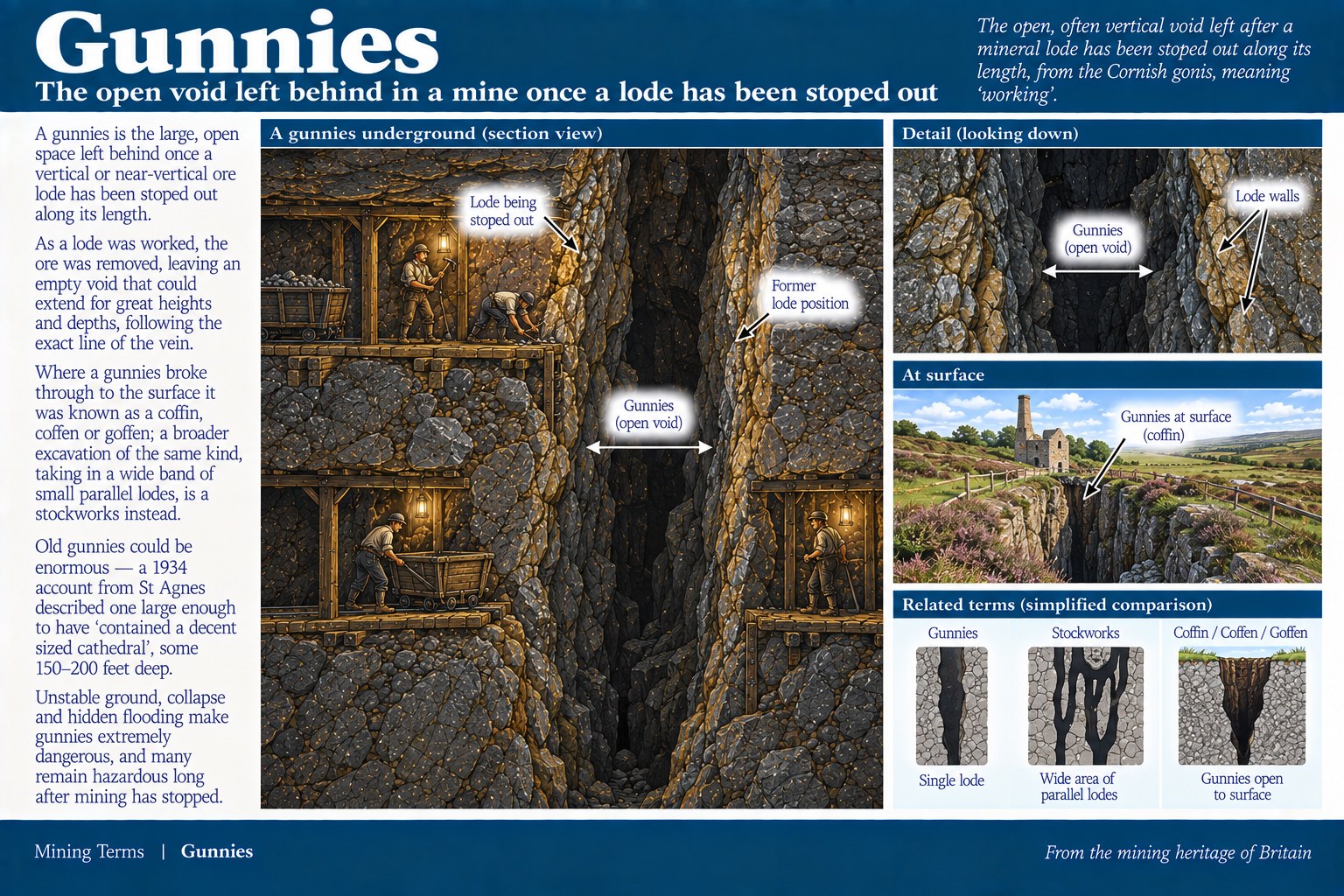
The open void left behind in a mine once a vertical or near-vertical ore lode has been stoped out along its length — from the Cornish gonis, meaning 'working'.
Historical usage
A genuinely old term, in continuous Cornish use from medieval mining through to the 19th and early 20th centuries; where early miners worked a lode by following it straight down from the surface, the resulting trench is often distinguished as an 'open-work', and the presence of old open-works is frequently the earliest surviving evidence of mining in an area at all. William Pryce recorded the word in 1778, by which date it was also serving as a unit of measurement, a single gunnies being reckoned at three feet.
How it worked
As a lode was worked out along its width and length, the excavated space behind the miners simply remained open unless deliberately filled, forming a gunnies running along the line of the vein. Where a lode was rich enough, narrow enough and steep enough, it could be taken out entirely from top to bottom rather than worked selectively or left with supporting pillars, and what remains is a long, narrow chasm following the exact line the ore took through the rock. Where such a void broke through to the surface, it was known as a coffin, coffen or goffen; a broader excavation of the same kind, taking in a wide band of small parallel lodes rather than one narrow one, is a stockworks instead. Underground, old gunnies could reach enormous size — an account from St Agnes in 1934 described one large enough to have 'contained a decent sized cathedral', some 150-200 feet deep.
Why it was used
Working a lode out completely, rather than leaving supporting pillars, recovered the maximum possible ore from a deposit rich enough to justify it — appropriate for a narrow, well-defined, high-grade vertical lode where the ground on either side held little worth returning for. Recognising and respecting the old gunnies afterwards mattered for basic survival underground: a lode already worked out and left open told later miners exactly where not to blast blind, and warned them of large void space nearby that might be flooded, unstable, or both.
Risks & limitations
A gunnies is exactly the kind of large void that makes old workings dangerous long after mining stops: unsupported spans could and did collapse — Dolcoath's own 1901 records warned of 'immense gunnies' still slowly moving 73 years after a major 1828 collapse — and a gunnies that had silently flooded was lethal to break into by accident, the exact mechanism behind the 1893 Wheal Owles disaster elsewhere in this site's own records, where breaking into old flooded workings killed nineteen men and a boy in minutes. A large gunnies left open at surface remains a hazard today: at Wheal Frementor a worked-out vertical tin deposit left one some 4 metres wide, 70 metres deep and 200 metres long, with sheer drops behind nothing more than a modern fence.
Regional variation
A specifically Cornish term, tied to the Cornish language and to Cornwall and west Devon's characteristic narrow, steeply dipping tin and copper lodes; the word is not generally used outside this district's mining vocabulary, and the mining village of Gunnislake takes part of its name from it. Old, disused gunnies were also often deliberately backfilled with waste rock (deads) as later working progressed, both to disperse waste and to reduce the hazard of leaving a large void open indefinitely.
Related terminology
Mines associated with this term
Included only where MineArchive's own research gives a reasonable evidential basis — not every mine where this might plausibly apply.
- Wheal Fortune — Cornwall (well documented example)
Named twice in this record, first in the workings: “…site and considered of great antiquity, is a large openwork (a "gunnis" or "coffin") about 10 m long and up to 18 m deep, divided in two by…” - Wheal Hermon — Cornwall (well documented example)
Named 4 times in this record, first in the workings: “…of outcrop pits and openworks on the valley lodes, narrow slot-like gunnises with large waste dumps on the central lodes in the cliff, and small…” - Wheal Frementor — Devon (well documented example)
Named 6 times in this record, first in the summary: “…worked-out vertical deposit left an exceptional open void known as a gunnis.” - Drakewalls Mine — Cornwall (well documented example)
Named 3 times in this record, first in the summary: “…Hill in the Tamar Valley, first worked as a long open cutting, or 'gunnis', along a lode that came up to the surface. It saw every stage of…” - Great Dowgas Mine — Cornwall (well documented example)
Named in this record’s workings: “…In the 18th century, Goffins Lode had already been worked from open gunnises at shallow depth, apparently abandoned once the tin grades there…”
Sources
- (secondary) A Cornish mining glossary — Cornish Mining World Heritage Site (UNESCO)
- (secondary) Glossary — Cornish Mining World Heritage Site
- (secondary) Glossary of Mining Terms — Open University Geological Society (South West Branch)
- (secondary) Gunnies — Wikipedia
Record created: 20 August 2026 · Last researched: 20 August 2026