 MineArchive
Drakewalls Mine
| Also known as | Drake's Wall Mine, Drakes Walls Mine |
|---|---|
| Location | Drakewalls, top of Gunnislake Hill, near Albaston, Calstock parish, Cornwall — 50.5144, -4.2222 (exact) |
| Commodities | Tin, Arsenic, Copper, Tungsten |
| Type | Metal |
| Worked | Medieval (tin streaming); open workings by c. 1540–c. 1910; 3 men employed in 1918 |
| Maximum depth | Unknown; worked first as a deep open cutting, then underground, leaving large stopes. |
| Operators | Drakewalls Mining Company (1860–1898), John Taylor & Sons (1901–1901), British Mining and Metal Company (1906–1913) |
Overview
A tin mine at the top of Gunnislake Hill in the Tamar Valley, first worked as a long open cutting, or 'gunnis', along a lode that came up to the surface. It saw every stage of Cornish tin working from medieval streaming to 19th-century underground mining, and in the 1860s it was one of the richest tin mines in the county. Men were refused work for joining a union in 1866, and in 1889 two miners were dug out alive after two days entombed. It closed for the last time in about 1910.
History
Drakewalls, or Drake's Wall, worked a tin lode that came up to the surface, so it was one of the earliest mines at work in East Cornwall, and during the 18th century it was worked in a long open cutting to a considerable depth. An advertisement of 1793 described it as worked for upwards of a century and never known to fail. It also yielded copper, wolfram, arsenic, molybdenum, lead and silver, and in 1844 it saw the first use of Robert Oxland's method for separating wolfram from tin. The mine employed 398 people in 1859. In the 1860s and early 1870s, as D.B. Barton put it, it sold £218,000 worth of black tin in seventeen years without sinking the mine so much as a fathom. In 1866 the management refused work to members of a newly formed union, and the men struck; they rode a man who was willing to go below on a rail through Gunnislake, and the dispute ended only with troops and miners brought from other districts. From 1872 the East Cornwall Mineral Railway passed the mine on its way to the quays at Calstock. Employment fell to 130 in 1884 and about 100 in the 1890s under Moses Bawden. In February 1889 William Bant and John Rule were buried by sand while filling a worked-out stope; after two nights, rescuers blasted a channel 18 fathoms down with small charges of dynamite and pulled them out alive. The company went into liquidation in 1897-98. John Taylor and Sons reopened the mine in 1901, spending nearly two years pumping it dry, but it closed again in 1905, worked briefly in 1909-10, and was down to a handful of men by 1918.
Geology
A tin lode in the Gunnislake granite district that came up to the surface; it also carried copper, wolfram, arsenic, molybdenum, lead and silver.
Geological setting: Veins and Lodes (well documented example)
Workings
A long open cutting, the 'gunnis', later extended underground; a pumping engine house over the shaft now labelled Matthew's; sidings on the East Cornwall Mineral Railway from 1872.
Closure
Main working ended in 1905 after the 1901 reopening; worked again in 1909-10, and a few men were still returned in 1908 and 1918.
What remains
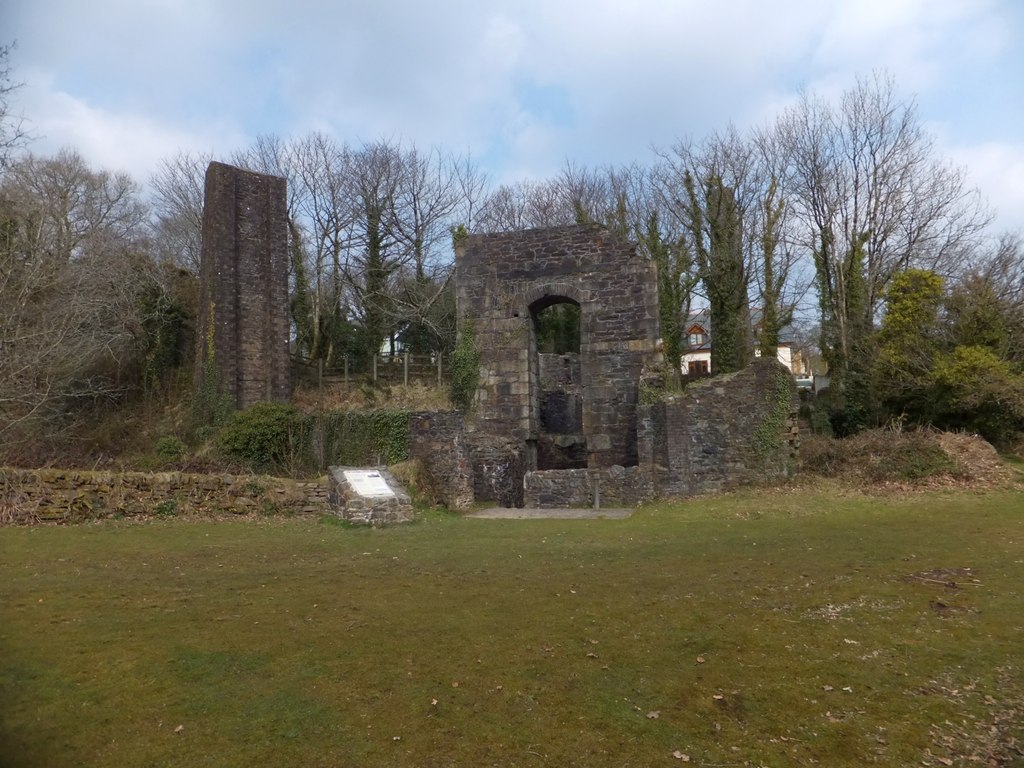
The stabilised ruins of the engine house and other buildings stand beside the Tamar Valley Centre, managed by Cornwall Council and open to the public.
Engine house, chimney and ruined surface buildings; the gunnis itself was filled in in the 1950s.
Redevelopment
None known; the ruins are managed by Cornwall Council and open to the public, next to the Tamar Valley Centre.
Related mines
- Gunnislake Clitters Mine — With Drakewalls, the most important mine of the Gunnislake district; both served by the East Cornwall Mineral Railway.
Nearby mines
- Hingston Down Quarry — 1.0 km NW
- Bedford United Mine — 1.4 km NW, Devon
- Gunnislake Clitters Mine — 1.6 km N
- Danescombe Mine — 1.7 km S
- Wheal Frementor — 1.9 km N, Devon
Straight-line distance, within 15 km. Show on the map.
People
- William Bant · survivor, 1889 — Entombed by sand for two nights in February 1889 and rescued alive.
- Moses Bawden · manager, 1883–1898 — Manager of Drakewalls in 1883 and 1892-98, and its purser at the 1889 rescue.
- Thomas Chapman · rescuer, 1889 — The mine's pitman, who led the rescue and was lowered down to free the two men.
- Thomas Gerry (d. 1869) · victim, 1869 — Of Calstock; killed in an accident at the mine in 1869.
- Thomas Gregory · manager, 1859–1871 — Manager of Drakewalls 1859-71.
- Percival Norton Johnson · official, 1847 — Company chairman in 1847; also of Johnson Matthey.
- Robert Oxland · inventor, 1844 — His method for separating wolfram from tin was first used at Drakewalls in 1844.
- John Rule · survivor, 1889 — Entombed with William Bant in February 1889 and rescued alive.
- William Skewis · manager, 1872–1877 — Manager of Drakewalls 1872-77.
- William Francis Tucker (d. 1859) · victim, 1859 — Killed at the mine aged 15; buried 20 March 1859.
What's uncertain
Points where sources disagree or the record could not be settled; both accounts are kept. All open questions in the archive.
- It was worked from the 11th century to 1905 (also 1909-10), originally from a long gunnis or open cutting. (uncertain) 2,3
Recorded claims
Individual factual claims, each attached to the source(s) that support it below. Where sources disagree, both are kept.
- Drakewalls saw all stages of tin production: streaming from medieval times, openworks of the 16th century, and true mining in the later 18th and 19th centuries. 1
- It was worked from the 11th century to 1905 (also 1909-10), originally from a long gunnis or open cutting. (uncertain) 2,3
- In the 1860s and early 1870s Drakewalls sold £218,000 worth of black tin in seventeen years without sinking the mine a fathom (Barton). 3
- The mine employed 398 people in 1859, 350 in 1861, 130 in 1884 and 112 in 1895. 2
- In 1866 men connected with a newly formed union were refused work; the men struck, and the dispute ended with troops and miners from other areas. 2,4
- In 1844 Dr Robert Oxland's method for separating wolfram from tin was first used here. 2
- On 5 February 1889 William Bant and John Rule were entombed by falling sand; after two nights they were reached by blasting a channel 18 fathoms down and brought out alive. 2,4
- Reopened by John Taylor & Sons in 1901 after nearly two years' pumping, it closed for the last time in 1910. 2,4
- An abandonment plan of Drakewalls Mine survives. 5
Photographs & further reading
A visit to the engine house, with newspaper quotes from 1793 and 1866.
View sourceOwners, managers and agents 1847-1913, employment figures, the 1866 strike and the 1889 rescue.
View sourceSources
- (secondary) Mining in Calstock Parish — Calstock Parish Archive
- (secondary) Drakewalls Mine, Cornwall — Cornwall Calling
- (secondary) The East Cornwall Mineral Railway - Part 2 — Roger Farnworth (citing D.B. Barton)
- (observational) Random Mine of the Day: Drakewalls Mine Engine House — bunn (LiveJournal)
- (primary) BGS / Mining Remediation Authority mine plans: DRAKEWALLS MINE — British Geological Survey / Mining Remediation Authority
Record created: 18 September 2026 · Last researched: 18 September 2026