 MineArchive
Hingston Down Quarry
| Also known as | Hingston Down Consols |
|---|---|
| Location | Hingston Down, above Gunnislake, Cornwall — 50.5217, -4.2298 (approximate) |
| Commodities | Granite, Copper, Tin |
| Type | Quarry |
| Worked | From the 18th century–1908 |
| Operators | Hingston Down Quarry Co Ltd (1924–?) |
Overview
A granite (elvan) quarry above Gunnislake that has worked continuously since 1924, cutting southward through the ground and old workings of the earlier Hingston Down Consols copper and tin mine — itself worked on a hill whose tin riches were already proverbial by the medieval period.
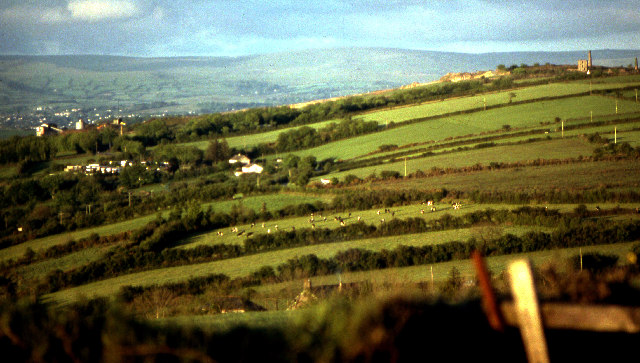
History
Hingston Down was a byword for mineral wealth long before the modern quarry: an old Cornish rhyme held that 'Hingston Down well ywrought is worth London town dearly bought', reflecting a tradition of tin streaming and working on the hill going back a century or more before Hingston Down Consols opened for copper in 1846. Consols struck rich copper ground in 1850 and, employing 225 people by 1864, became a substantial producer: between 1850 and 1880 it raised 64,440 tons of copper ore alongside 4 tons of tin concentrate, reaching a depth of 172 fathoms by the mid-1870s before winding up in 1885. It reopened briefly around 1900 in conjunction with the neighbouring Clitters United Mines, and again independently from 1905 to 1908 or 1909, this later period producing 250 tons of tin concentrate, 200 tons of arsenic and 146 tons of tungsten ore.
The present granite quarry began operating in 1924 under the Hingston Down Quarry Co Ltd, working elvan stone for roadstone on the north side of the hill and dispatching around twenty 15-ton wagons a day via the East Cornwall Mineral Railway. As quarrying extended south it cut directly through the lodes and old workings of Hingston Down Consols. The quarry passed to Amalgamated Roadstone Limited and later to Hanson Aggregates, and remains the only working quarry within half a mile of Gunnislake.
Geology
Elvan, quarried as granite, above Gunnislake, the quarry cutting southward through the ground and old workings of the earlier Hingston Down Consols copper and tin mine.
Workings
Hingston Down Consols reached 172 fathoms by the mid-1870s working copper and tin lodes; the present granite quarry has since cut southward through this same ground, exposing and removing sections of the old mine's lodes and workings as it has extended.
Closure
Unknown.
What remains
The quarry remains in active operation, the sole working quarry within half a mile of Gunnislake, producing elvan roadstone. Little survives of Hingston Down Consols' own surface structures, its ground having been substantially removed or built over by the quarry's own extension southward. The wider hill, including former mine and quarry ground, forms part of the Hingston Down Quarry and Consols Site of Special Scientific Interest.
Nearby mines
- Bedford United Mine — 0.3 miles (0.4 km) NW, Devon
- Gunnislake Clitters Mine — 0.5 miles (0.7 km) N
- Drakewalls Mine — 0.6 miles (1.0 km) SE
- Wheal Frementor — 0.7 miles (1.1 km) N, Devon
- Devon Great Consols — 1.2 miles (1.9 km) N, Devon
Straight-line distance, within 9 miles (15 km). Show on the map.
Recorded claims
Individual factual claims, each attached to the source(s) that support it below. Where sources disagree, both are kept.
- Hingston Down Consols opened for copper in 1846, struck rich ground in 1850, and raised 64,440 tons of copper ore and 4 tons of tin concentrate between 1850 and 1880, reaching 172 fathoms by the mid-1870s. 1
- The mine wound up in 1885, reopened briefly around 1900 with Clitters United Mines, and worked again independently from 1905 to around 1908-9, producing 250 tons of tin concentrate, 200 tons of arsenic and 146 tons of tungsten ore in that final period. 1
- The granite quarry began operating in 1924 under Hingston Down Quarry Co Ltd, later passing to Amalgamated Roadstone Limited and then Hanson Aggregates. 2
- As the quarry extended southward it cut through the lodes and workings of the earlier Hingston Down Consols mine. 1
Sources
- (secondary) Hingston Down Consols Mine Cornwall — Cornwall Calling
- (secondary) Quarrying — Calstock Parish History Group
Record created: 26 August 2026 · Last researched: 26 August 2026