 MineArchive
Carclaze Pit
| Also known as | Carclaze Old Tin Pit, Great Carclaze China Clay Works, Baal Pit |
|---|---|
| Location | Carclaze, St Austell, Cornwall — 50.3535, -4.7808 (exact) |
| Commodities | China Clay, Tin |
| Type | Quarry |
| Worked | From 1851–Around 2002 |
| Maximum depth | About 46 m (150 ft) deep by 1873 |
| Operators | Great Treverbyn China Clay Co. Ltd (1913–1966) |
Overview
A vast open pit worked for over 400 years — first for tin, its walls already a tourist attraction to 18th-century geological visitors, and then, almost by accident, for one of Cornwall's richest deposits of china clay.
History
Carclaze is thought to have begun as tin streaming in the valley below the hill, the workings following a rich vein up to its crest until an enormous open stockwork of tin ore was exposed and worked as a pit rather than a streamwork. It was already a celebrated sight by the mid-18th century: the French mining engineer M. Jars, visiting for the Académie Royale des Sciences in 1764, gave one of the earliest scientific accounts of it, and the pit became a standard stop for geological visitors touring Cornwall into the early 19th century. Tin working continued until china clay was also found here and first quarried in 1851. When the tin price collapsed in the 1860s, Carclaze turned out to be one of the few Cornish mines sitting on huge reserves of china clay, and the pit continued to grow as a clay works long after its tin had stopped paying. By 1873 it measured over a mile in circumference and about 150 feet deep, covering some 12 acres. In 1913 the solicitors who held the Manor of Treverbyn leased moorland at Great Carluddon to Elias Meyer, who formed the Great Treverbyn China Clay Co. Ltd to work china clay, china stone and tin there — the works that became known as Great Carclaze. Clay extraction continued, latterly under Imerys, until around 2002.
Geology
Carclaze exposed a large stockwork — a network of tin-bearing quartz-tourmaline veins bordered by greisen — rather than a single lode, which is why it was worked as a broad open pit instead of a conventional shaft-and-level mine. The same intense hydrothermal alteration that produced the greisen also broke down the surrounding granite into kaolin, which is why a pit dug for tin turned out to be sitting on a fortune in china clay once the ore itself was exhausted.
Workings
Originally an opencast tin stockwork, later worked as a china clay pit by the same hydraulic and mechanical methods used at other St Austell clay works: high-pressure water monitors washing decomposed granite from the pit face, the resulting slurry pumped to settling tanks to separate the clay from waste sand and mica.
Closure
Clay working continued at Great Carclaze into the early 2000s, latterly used mainly as a source of fresh water for other active pits nearby before extraction ceased around 2002.
What remains
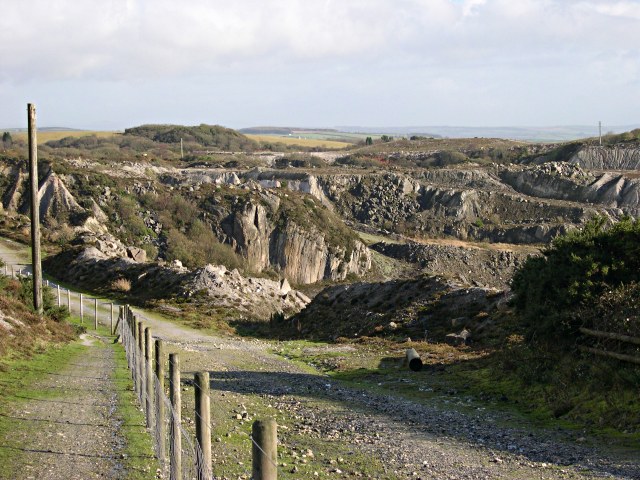
The Old Tin Pit and the later Great Carclaze china clay workings survive as a large, flooded, overgrown pit, visible from the surrounding roads and footpaths and still owned by Imerys. A 2013 exploration report documents the flooded pit and its surrounding sky tips in detail.
The flooded pit itself, encircling spoil tips, and the wider china-clay landscape of paths and worked ground around St Austell.
Redevelopment
None — the pit remains flooded ground in Imerys ownership, now mainly serving as a water source for neighbouring workings.
Nearby mines
- Wheal Martyn China Clay Works — 1.4 miles (2.3 km) NW
- West Crinnis Mine — 1.9 miles (3.0 km) SE
- Cuddra Mine — 1.9 miles (3.1 km) SE
- Wheal Regent — 2.1 miles (3.4 km) SE
- Great Crinnis Mine — 2.3 miles (3.7 km) SE
Straight-line distance, within 9 miles (15 km). Show on the map.
Recorded claims
Individual factual claims, each attached to the source(s) that support it below. Where sources disagree, both are kept.
- M. Jars, visiting for the Académie Royale des Sciences de Paris in 1764, gave one of the earliest scientific accounts of the pit, which remained a standard stop for geological visitors into the early 19th century. 1
- The pit exposed a stockwork of tin-bearing, greisen-bordered quartz-tourmaline veins rather than a single lode, worked as an open pit rather than by shafts and levels. 1
- China clay was first quarried alongside tin from 1851; after the tin price collapsed in the 1860s, Carclaze proved to hold large reserves of china clay and continued to be worked for it. 2
- By 1873 the pit measured over a mile in circumference and about 150 ft deep, covering some 12 acres. 2
- In 1913 Elias Meyer's Great Treverbyn China Clay Co. Ltd began working china clay, china stone and tin at Great Carluddon, the operation that became known as Great Carclaze. 2
- Clay extraction continued under Imerys until around 2002, after which the flooded pit has served mainly as a water source for neighbouring workings. 2
Sources
- (primary) Late 18th and early 19th Century forays into economic geology: Carclaze — Ussher Society
- (secondary) Carclaze — Wikipedia
- (observational) Great Carclaze China Clay Works Quarry, Cornwall (Imerys), August 2013 — 28DaysLater
Record created: 24 August 2026 · Last researched: 24 August 2026