 MineArchive
Tilly Whim Caves
| Location | Durlston Head, near Swanage, Dorset — 50.5925, -1.9575 (exact) |
|---|---|
| Commodity | Freestone |
| Type | Stone |
| Worked | 18th century–Around 1812 |
| Maximum depth | Shallow horizontal galleries driven into the cliff face; no significant vertical depth |
| Operators | George Burt (1887–1976) |
Overview
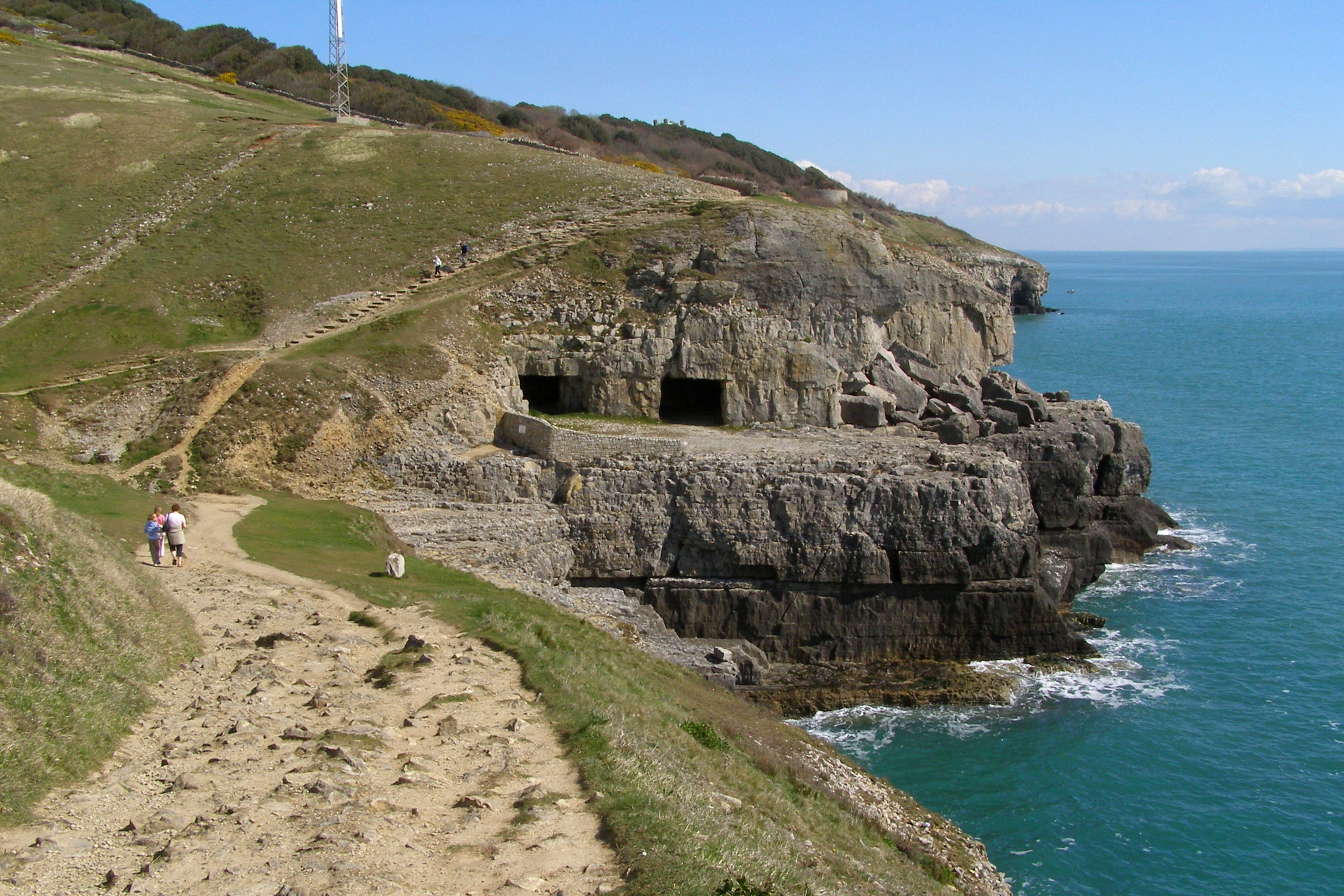
Three small stone quarries driven horizontally into the Purbeck coastal cliffs near Swanage, worked chiefly through the 18th century until Napoleonic-era demand for fortification stone collapsed in 1812 — later reinvented as a Victorian tourist attraction, and closed to the public since 1976 after repeated rockfalls, leaving the caves today as a protected bat roost.
History
Tilly Whim was worked predominantly during the 18th century, its quarrymen — who also worked as stonemasons, finishing stone on site — extracting Purbeck limestone horizontally from the cliff face using metal punches, wedges and hammers. Finished blocks were lowered from the quarry ledges to waiting boats below using a special wooden crane known as a whim, for onward transport to Swanage Quay or directly to offshore sailing ships. Demand surged during the Napoleonic Wars, when Purbeck stone was used extensively for coastal fortifications along the south coast of England, but collapsed once the wars ended, and quarrying at Tilly Whim ceased around 1812. The caves lay unused until 1887, when the Victorian businessman George Burt, developer of the neighbouring Durlston estate, opened them as a tourist attraction, blasting a new entrance and adding inscriptions and seating across the wider park. Regular rockfalls eventually made the galleries too dangerous, and Tilly Whim was closed to the public completely in 1976.
Geology
The caves are cut into the Portland Stone beds of the Purbeck cliffs, the same Jurassic limestone sequence — laid down in a warm shallow sea around 145 million years ago — that produced Portland's own famous building freestone and forms much of the wider Jurassic Coast.
Workings
Quarrymen drove shallow horizontal galleries directly into the cliff face at roughly ledge height above the sea, working and finishing the stone into shape on site before lowering it by whim crane onto boats waiting below — a method suited to a coastal site with no easy road access, but entirely unlike the deep vertical shafts used elsewhere in British quarrying and mining.
Closure
Quarrying itself ended around 1812 as Napoleonic-era demand collapsed; the caves' later life as a public tourist attraction ended in 1976, when safety concerns over ongoing rockfalls forced their closure to visitors.
What remains
Closed behind locked gates since 1976, the caves are now an undisturbed roost for a protected bat colony, with the surrounding cliffs providing nesting habitat for seabirds. A 2022 restoration project at Durlston Country Park installed handcrafted viewing gates at the cave entrance, allowing visitors to look inside without entering and disturbing the resident bats and adders.
The quarried cave mouths remain clearly visible from the South West Coast Path, along with Victorian-era inscriptions, seating and waymarks added by George Burt across the wider Durlston estate.
Redevelopment
Opened as a tourist attraction in 1887 by George Burt; a 2022 restoration project restored limited viewing access via new gates without reopening the galleries themselves to entry.
Nearby mines
- Norman's Quarry — 2.7 miles (4.4 km) NW
- Purbeck Marble Quarries — 2.8 miles (4.5 km) W
- Winspit — 3.4 miles (5.5 km) W
- Furzebrook and Norden Ball Clay Pits — 6.8 miles (10.9 km) NW
- Kimmeridge Oil Shale Workings — 7.6 miles (12.3 km) W
Straight-line distance, within 9 miles (15 km). Show on the map.
Recorded claims
Individual factual claims, each attached to the source(s) that support it below. Where sources disagree, both are kept.
- Quarrying at Tilly Whim was worked predominantly through the 18th century, ending around 1812 as demand collapsed once the Napoleonic Wars, which had driven strong demand for coastal fortification stone, came to an end. 1
- Stone was extracted horizontally from the cliff face using metal punches, wedges and hammers, and finished by the same quarrymen acting as stonemasons before being lowered to waiting boats by a wooden crane known as a whim. 1,2
- The caves were opened as a tourist attraction in 1887 by the Victorian businessman George Burt, developer of the adjoining Durlston estate, before being closed to the public completely in 1976 due to the danger of rockfalls. 1
- The closed caves are now an undisturbed roost for a protected bat colony, and in 2022 a restoration project installed handcrafted viewing gates at the entrance allowing visitors to look inside without entering and disturbing them. 3
- Located at about 50.593 N, 1.958 W. 1
Sources
- (secondary) Tilly Whim Caves — Wikipedia
- (secondary) Tilly Whim Caves - Stone Quarry in Durlston Country Park — Virtual Swanage
- (secondary) New access to Tilly Whim caves as part of Durlston project — Swanage News
- (secondary) Purbeck Marble — Wikipedia
Record created: 22 August 2026 · Last researched: 22 August 2026