 MineArchive
Tunstead Quarry
| Also known as | Tunstead and Old Moor Quarries |
|---|---|
| Location | Great Rocks Dale, between Wormhill and Fairfield, near Buxton, Derbyshire — 53.2717, -1.8517 (approximate) |
| Commodity | Limestone |
| Type | Quarry |
| Worked | 1929–Still active |
| Maximum depth | Unknown. |
| Operators | Buxton Lime Firms Ltd. (1891–1919), Brunner, Mond and Company Ltd (1919–1926), Imperial Chemical Industries (1926–1992), Tarmac (1992–2015), CRH plc (2015–?) |
Overview
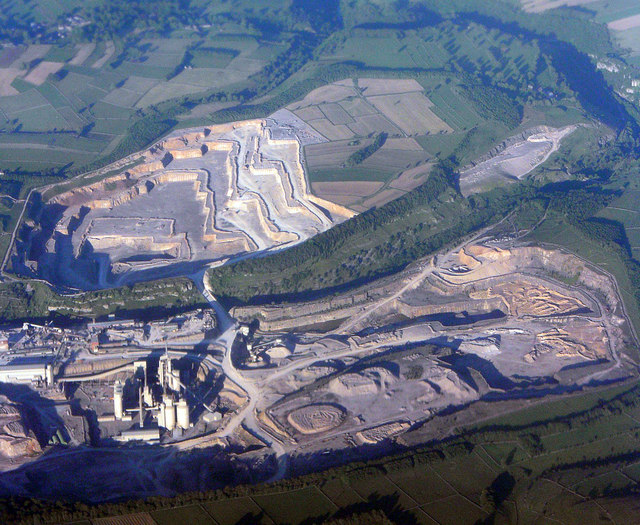
Tunstead is the largest limestone quarry in the United Kingdom, covering some 840 acres either side of Great Rocks Dale east of Buxton and producing around five and a half million tonnes of stone a year. It was opened in 1929 by Imperial Chemical Industries, which had come into the Buxton limestone trade through the amalgamations of the previous forty years, and it exists because the rock here is unusually pure — clean enough for chemical-grade lime rather than merely for roadstone. It is also the clearest case in the archive of a quarry shaping a landscape designation rather than the other way round: the boundary of the Peak District National Park was drawn to exclude the dale.
History
Quarries in this area were worked from the nineteenth century to supply limestone and lime to the chemical industries of the Mersey Valley. A large number of firms operated around Buxton, and in 1891 a group of them combined as Buxton Lime Firms Ltd, whose main business was supplying chemical-grade lime to Brunner, Mond and Company's Solvay soda plant at Northwich. Sources differ on how many companies went into that amalgamation — thirteen or fourteen — and on the detail of what followed, but the direction is clear enough: between 1895 and 1915 a further nine quarries were started or bought, cementing the company's position in the market. Brunner, Mond and Company took Buxton Lime Firms over in 1919, and was itself merged into Imperial Chemical Industries in 1926.
The Tunstead quarries were opened in 1929. The land around them had been farmed since about 1250 by people connected with the nearby hamlet of Tunstead, within the bounds of the mediaeval Forest of High Peak, and before the quarrying the southern part of the valley was described as narrow and flat-bottomed and rocky, with almost perpendicular cliffs of limestone on either side, while the northern part was broader and grassy. The site had been made accessible in 1867, when an extension of the Manchester, Buxton, Matlock and Midlands Junction Railway was opened through the valley between Peak Forest and Millers Dale; that line is still open for freight and is now called the Great Rocks Line after this ground.
In 1932 quarrying opened a fissure containing the remains of bison, Irish elk and deer, washed down from the surface in the distant past. In 1957 the painter Peter Lanyon visited the valley to study the quarry faces, seeing in them both the geological and the human history of the area.
The quarry's economic weight has repeatedly told against the landscape around it. When the Peak District National Park was created in 1951 the boundary was drawn carefully to exclude the dale, which is why Buxton itself lies outside the Park and is known as its gateway. By 1973 Tunstead was the largest quarry in Europe, and permission to extend it into the National Park was refused on the ground that there was enough stone to last until at least 2000. After a public inquiry and a case in the High Court, the Secretary of State ultimately overrode the National Park Authority and granted permission for an extension of 148.57 hectares inside the Park.
A second problem produced a second industry. By the 1960s the waste from the washing plant had become unmanageable: besides fine limestone it contained some 50,000 tonnes a year of mainly interstitial clay, and planning restrictions blocked landfilling it. A cement plant was built to consume the clay instead, and a wet kiln installed north of the lime plant in 1966 ran for thirty-eight years. A larger and more efficient plant replaced it in 2004, built in worked-out ground south of the lime plant. Ownership has passed from ICI to Anglo American in 1992, trading as Buxton Lime Industries and then as Tarmac, to Lafarge Tarmac in 2013 and to CRH in 2015; in 2024 SigmaRoc bought the Buxton manufacturing plants.
Geology
Tunstead works Carboniferous limestone of the Bee Low Limestone Formation, laid down between about 334 and 337 million years ago, with the older Woo Dale Limestone Formation beneath it. What makes the site exceptional is purity rather than quantity: the limestone carries less than three per cent dolomite and less than one per cent chert, and selective crushing and washing can bring the clay and iron contents down far enough to make chemical-grade lime — the quality the whole Buxton trade was built on. The limestone of the dale extends to a depth of about 380 metres, and boreholes here have allowed significant quantities of water to be drawn for local industry. Great Rocks Dale contains the only dikes in the White Peak. The 1932 fissure, filled with the bones of bison, Irish elk and deer washed down from the surface, is a reminder that this limestone is well jointed and that those joints have been open to the surface for a very long time — the same interstitial clay that later forced the cement plant into existence arrived by much the same route.
Geological setting: Sedimentary Beds and Seams (well documented example)
Workings
An opencast limestone quarry in two parts either side of Great Rocks Dale: Tunstead itself to the west, opened in 1929, and Old Moor to the east, opened in the mid-1980s. The Great Rocks Line railway runs between the two, taking stone and cement south to Buxton or north through Peak Forest towards Sheffield and Manchester. On the site are the largest lime plant in Britain and a cement works, built to consume the clay in the washing-plant waste; even now the cement plant absorbs only about a quarter of the quarries' output, and gives an outlet for lower-quality and undersized stone. The rest is sold as aggregate and industrial limestone.
Closure
Still worked. Tunstead remains the largest producer of limestone in the Peak District, with about 5.5 million tonnes extracted a year, and the cement plant on the site continues in operation.
What remains
A fully operational industrial site. A public footpath crosses the northern end of the quarry, within walking distance of the Monsal Trail and crossing the Great Rocks Line between the two workings; a walker's account and photographs from it show how vast the site is, with Tunstead on one side and Old Moor on the other. The wet kiln site was cleared and landscaped within two years of its shutdown in 2004.
Not applicable in the usual sense: this is a working quarry, lime plant and cement works, not a site of remains. The most conspicuous piece of the older landscape still legible is Great Rocks Dale itself, surviving as a strip between the two workings that have eaten in from either side.
Related mines
- Dowlow Works — Two of the great Buxton-area limestone quarries working the same Derbyshire Carboniferous limestone for the same lime and aggregate trades, Tunstead from 1929 and Dowlow from 1899, and between them a large part of the reason the Peak District National Park boundary was drawn to leave this ground outside it.
- Harpur Hill Quarry — Both Buxton limestone quarries worked by the same succession of owners: Buxton Lime Firms Ltd., formed in the 1891 amalgamation, and then Imperial Chemical Industries, which absorbed that company through Brunner, Mond and Company in 1926 and opened Tunstead three years later.
Nearby mines
- Cowdale Quarry — 2.0 miles (3.2 km) SW
- Hill's Venture Lead Mine — 3.1 miles (4.9 km) NE
- Maury Mine and Sough — 3.1 miles (5.0 km) SE
- Harpur Hill Quarry — 3.4 miles (5.5 km) SW
- Gautries Rake — 3.6 miles (5.8 km) N
Straight-line distance, within 9 miles (15 km). Show on the map.
What's uncertain
Points where sources disagree or the record could not be settled; both accounts are kept. All open questions in the archive.
- Buxton Lime Firms was formed in 1891 following the amalgamation of 14 lime and limestone companies operating in the Buxton area. (disputed) 1
- Thirteen firms combined in 1891 to form Buxton Lime Firms Ltd, whose main occupation was to supply chemical-grade lime to Brunner-Mond's Solvay soda plant in Northwich. (disputed) 2
Recorded claims
Individual factual claims, each attached to the source(s) that support it below. Where sources disagree, both are kept.
- Buxton Lime Firms was formed in 1891 following the amalgamation of 14 lime and limestone companies operating in the Buxton area. (disputed) 1
- Thirteen firms combined in 1891 to form Buxton Lime Firms Ltd, whose main occupation was to supply chemical-grade lime to Brunner-Mond's Solvay soda plant in Northwich. (disputed) 2
- The Tunstead quarries were opened in 1929, under ICI, which had absorbed Buxton Lime Firms through Brunner, Mond and Company in 1926. 2,1
- Tunstead is the UK's largest limestone quarry, covering some 840 acres, and comprises two quarries either side of Great Rocks Dale: Tunstead to the west, opened in 1929, and Old Moor to the east, opened in the mid 1980s. 3
- The limestone quarries are the largest in the UK, producing 5.5 million tonnes per year, of which the cement plant absorbs only about a quarter. 4,2
- The limestone is of unusually high quality, with dolomite less than 3% and chert less than 1%; with selective crushing and washing the clay and iron contents can be reduced low enough to make it suitable for chemical-grade lime. 2
- The site was so important to the local economy that when the Peak District National Park was created in 1951 the planners excluded a wide area around it, which is why Buxton lies outside its borders. 3
- By 1973 Tunstead was the largest quarry in Europe, and permission to extend it into the National Park was rejected on the grounds that there was sufficient stone to last until at least 2000; following a public inquiry and a High Court case the Secretary of State overrode the National Park Authority and granted permission for a 148.57-hectare extension within the Park. 4
- By the 1960s the wash-plant waste contained about 50,000 tonnes a year of mainly interstitial clay; faced with planning restrictions on land-filling, the cement plant was built to consume it, a wet kiln operating from 1966 for 38 years and a new plant being constructed in worked-out quarry in 2004. 2
- In 1932 quarrying opened a fissure containing remains of bison, Irish elk and deer, washed down from the surface in the distant past. 4
- The quarry works Carboniferous limestone of the Bee Low Limestone Formation (334-337 Ma) with the Woo Dale Limestone Formation (337-339 Ma) below. 2
Photographs & further reading
A technical history of the works on the site — ownership from 1929 to the present, the composition of the limestone, and the kiln-by-kiln detail of the cement plant built to consume the quarry's own washing waste.
View sourceA walker's account with photographs taken from the public footpath that crosses the northern end of the quarry, giving a sense of the scale of the two workings and the railway between them.
View sourceSources
- (primary) History — Buxton Lime — Buxton Lime Limited
- (secondary) Cement Kilns: Tunstead — Cement Kilns
- (observational) Tunstead Quarry (site visit and photographs from the public footpath) — Monsal Trail
- (secondary) Great Rocks Dale — Wikipedia
Record created: 4 September 2026 · Last researched: 5 September 2026