 MineArchive
Rescue Brigade
| Also known as | Rescue Team, Rescue Man, Brigadesman (A member of a permanent station brigade), Mines Rescue Brigade |
|---|---|
| Category | Labour & Roles |
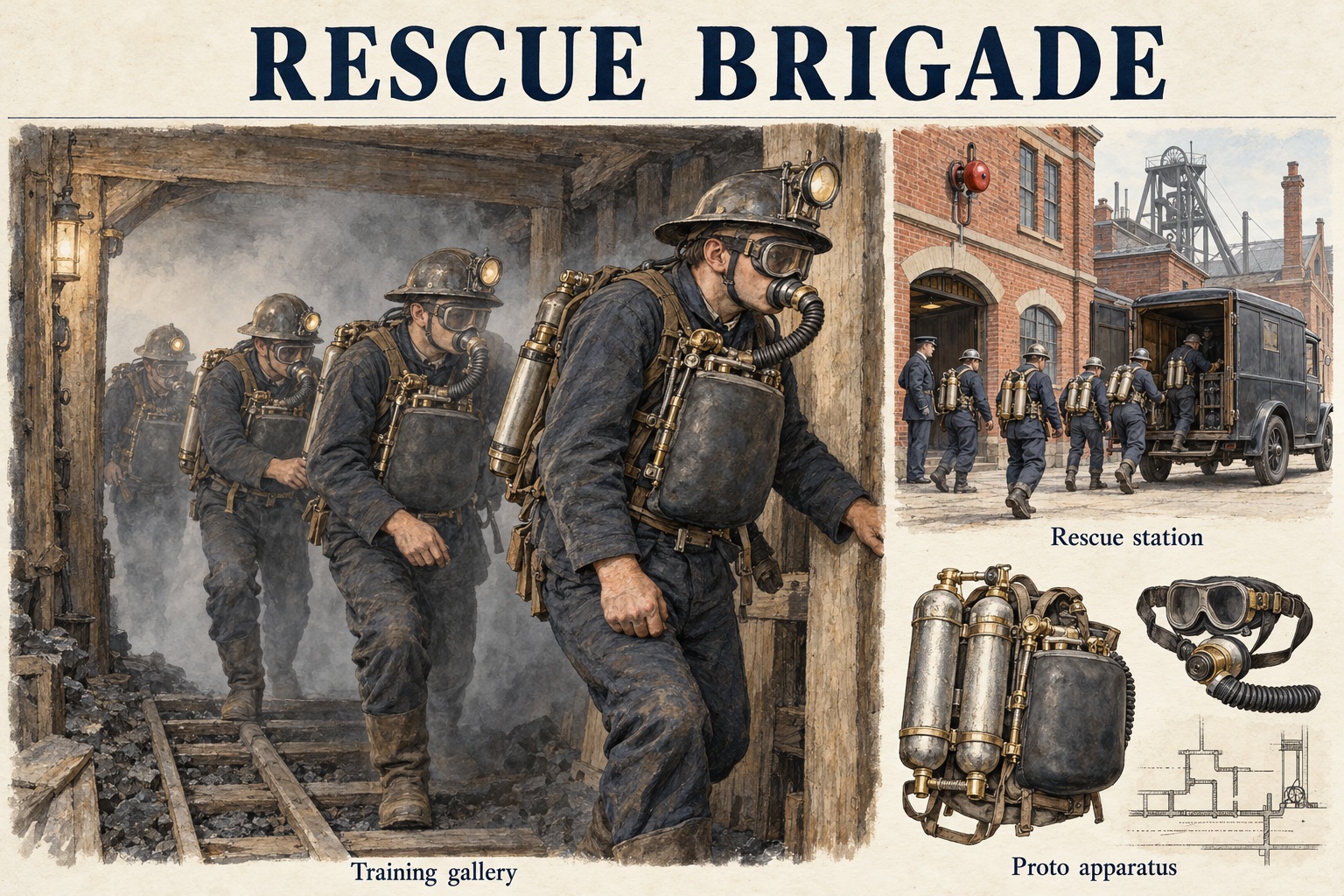
A team of trained men with breathing apparatus who went into a mine after an explosion, fire or inrush to search for the living, recover the dead and make the pit safe: part-time brigades of colliery men trained at a rescue station, and full-time brigadesmen kept at the station itself.
Historical usage
The first mines rescuers were the colliery managers and the volunteer workmates of the victims, who went in with nothing but safety lamps to tell them where the gas was. Fleuss's self-contained breathing apparatus was used after the Seaham explosion of 1881 and Siebe Gorman developed it into the Proto. W. E. Garforth of Altofts built a gallery to train rescuers in 1899 and proposed a network of stations; the first opened at Tankersley in 1902, funded by the West Yorkshire owners, and Howe Bridge, the first central station serving a whole coalfield, opened in 1908 under the Lancashire and Cheshire Coal Owners, where a competition among makers in gas-filled galleries chose the Proto. Its six trained men were called to Maypole Colliery near Wigan that August, where seventy-six died, and each received a medal struck by the owners. The Royal Commission appointed in 1906 recommended central stations manned by full-time brigades in every coalfield and a part-time brigade of trained men at every colliery; stations opened at Aberaman, Crumlin, Mansfield, Altofts, Elswick and Cowdenbeath in 1909 and at New Tredegar and Stoke-on-Trent in 1910, and Elswick, built by the Durham and Northumberland owners, was the first with permanent brigadesmen living on the premises, the Durham and Northumberland Fire and Rescue Brigade, with a Merryweather fire engine. At Pretoria Pit in 1910, where 344 died, several hundred trained men took part. The Coal Mines Act 1911 made stations compulsory: a mine of a hundred men or more had to have one within ten miles.
How it worked
Brigadesmen were colliery miners who volunteered and were trained at the station in the Proto apparatus, in first aid and in working through a gallery built to imitate underground roads in an irrespirable atmosphere. Each colliery kept a rescue and fire-fighting plan, updated by the surveyor, showing the air courses, doors, water pipes and hydrants, the underground fire station and the ambulance tubes with stretchers and splints, with a copy at the rescue station. When a call came the station's permanent men and the part-time teams from neighbouring pits mobilised, and on a large disaster brigades from several stations worked in relays. Rescue men once had to retire at forty-five; they may now continue as long as they pass the yearly medical as A1 fit.
Why it was used
Afterdamp killed more men than the blast, and the men who went in after them had died too often. A trained brigade with oxygen could travel roads no one else could, seal fires so a pit could be reopened, and bring out survivors, as the apparatus made possible for the first time in the Lancashire pits of 1908 and 1910.
Risks & limitations
Rescue work is done in the dark, in gas, under roofs the explosion has loosened, and the apparatus itself has limits of time and endurance. Brigades could not always reach the entombed: at Creswell in the 1950s it took over a year to recover all the bodies, and the lesson drawn was that every man should carry a self-rescuer. The stations followed the industry down, forty-three by 1919, forty-six at the peak, six by 2013, and in 2015 the regulations that had required every coal mine to use the service were revoked.
Regional variation
Every coalfield had its stations and brigades; the Durham and Northumberland owners alone combined fire and rescue in one permanent brigade at Elswick. Proto team, from the apparatus, is the South African name for the same men.
Related terminology
Afterdamp, Coal Mines Act 1911, Mines Rescue Station, Royal Commission, Self-Rescuer
Mines associated with this term
5 examples chosen from 12 linked records — the term page is not an index.
- Harpur Hill Quarry — Derbyshire (well documented example)
Named in this record’s history: “…as vapour and killed much of the nearby vegetation. An RAF mountain rescue team was also based here, attending air crashes across Derbyshire. The…” - Lassodie Colliery — Fife (well documented example)
Named twice in this record, first in the history: “…a corrugated-iron hall, a working farm at its centre, a mines rescue team and a competition-winning ambulance team. Annie Reid served for…” - Astley Green Colliery — Greater Manchester (well documented example)
Named in this record’s history: “…leading the firefighting effort, and four more were injured. Mines rescue teams from Boothstown Mines Rescue Station responded but were themselves…” - Beynon Colliery — Blaenau Gwent (well documented example)
Named in this record’s closure notes: “…2 April 1975. Production stopped at once and everyone was withdrawn; rescue teams sealed the face with sandbags. Within days the National Coal Board…” - Brookhill Colliery — Derbyshire (well documented example)
Named in this record’s history: “…motor sent smoke through the workings and brought out the Pinxton rescue team for the first time. Brookhill became the main coal-winding and…”
Disasters associated with this term
5 examples chosen from 59 linked records, most direct relationship first.
- Annesley Colliery fire and afterdamp (contextual relationship)
Named in this record’s rescue and recovery: “…death in a nineteenth-century pit, and one of the reasons trained rescue brigades were eventually made a statutory requirement.” - Astley Green Colliery explosion, 1939 (contextual relationship)
Named twice in this record, first in the summary: “…five men including the pit manager and injuring four more; mines rescue teams were themselves driven back by further explosions.” - Auchengeich Colliery explosion, 1931 (contextual relationship)
Named in this record’s rescue and recovery: “The Lanarkshire Rescue Brigade were descending the pit in gas helmets within twenty-five minutes,…” - Auchengeich Colliery fire, 1959 (contextual relationship)
Named in this record’s rescue and recovery: “Rescue teams could do little against a fire in the return airway with the…” - Auchinraith Colliery explosion (contextual relationship)
Named in this record’s rescue and recovery: “…that the explosion would be serious and telephoned the Lanarkshire Rescue Brigade at Coatbridge, who were underground with their respirators a little…”
Sources
- (secondary) Mine rescue — Wikipedia
- (secondary) Our heritage — MRS Training & Rescue
- (secondary) Pit Terminology — Healey Hero
- (secondary) The beginning of Rescue Stations (Part 2) — Nottinghamshire Mining Museum
- (secondary) The beginning of the Rescue stations (part 1) — Nottinghamshire Mining Museum
Record created: 18 October 2026 · Last researched: 18 October 2026