 MineArchive
Auchengeich Colliery fire, 1959
A fire in an underground booster fan filled the return airway of Auchengeich Colliery with carbon monoxide, and a man-riding train carrying 48 miners was sent into it. Forty-seven died; one man walked out. It remains the worst mining disaster in 20th-century Scotland.
| Date | 18 September 1959 |
|---|---|
| Mine | Auchengeich Colliery |
| Region | North Lanarkshire |
| Primary type | Fire |
| Associated types | Gas / Asphyxiation, Machinery |
| Fatalities | 47 (The dead were aged between 20 and 65, and were mostly strippers, shot-firers and coal cuttermen. Forty-one women were widowed and 76 children lost their fathers.) |
| Injuries | One survivor, Thomas Green, who escaped when the train stopped near the exit. |
| Context | During active mining (A fire in the ventilation machinery of a working pit, on the morning shift.) |
Cause
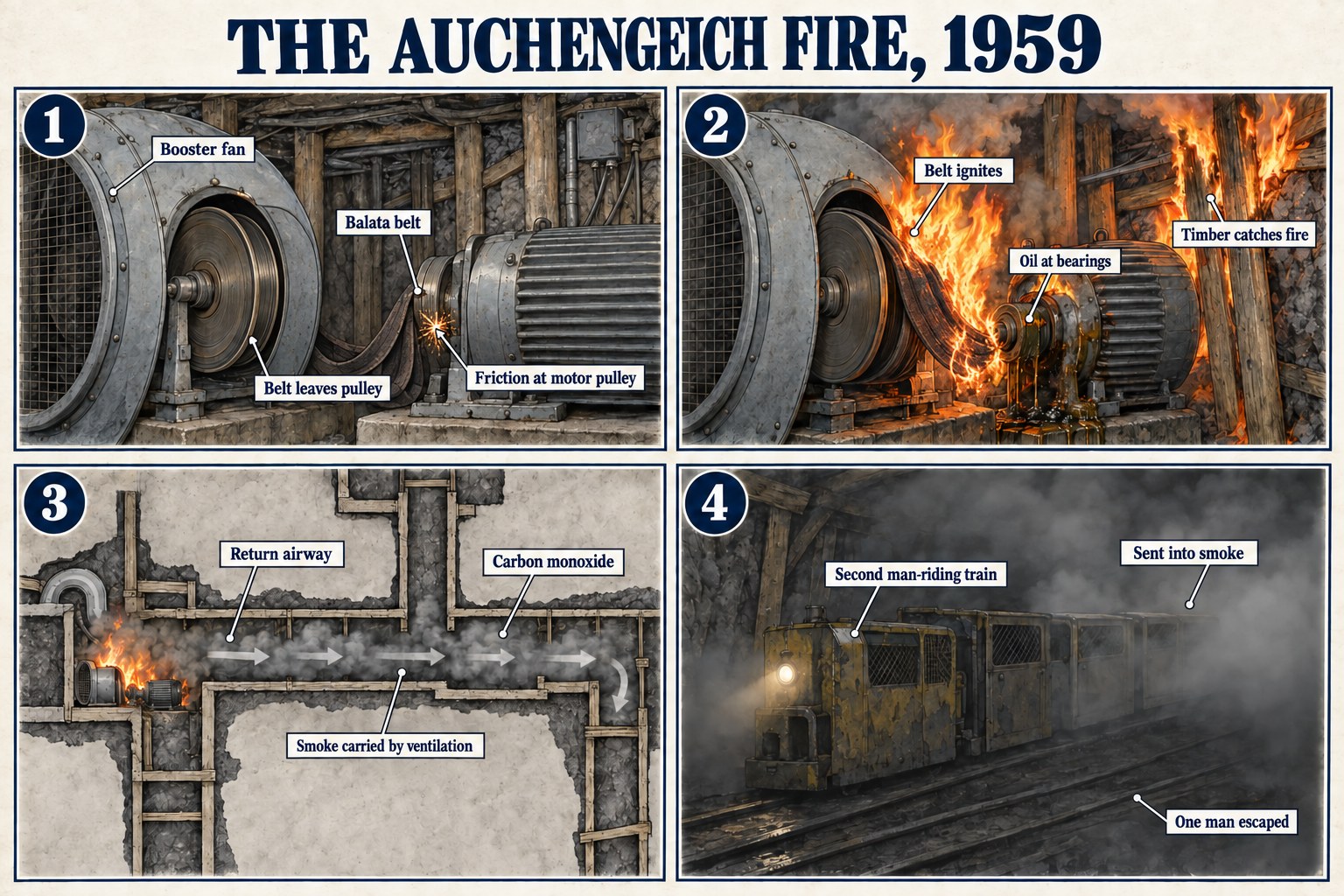
Frictional heat between a rotating motor pulley and a balata transmission belt that had come off the booster fan pulley and jammed against it. The belt ignited, setting fire to the oil around the fan bearings and then to the wooden timbers of the roadway.
Contributing factors
The fan was not continuously supervised. The belt had been running badly for several days without adequate attention, and inflammable material — oil deposits and timber — had been allowed to remain in the roadway close to it.
What happened
At about 6:25 on the morning of Friday 18 September 1959, men underground at Auchengeich noticed a slight haze and a smell of burning. The source was a booster fan in the No. 2 Pit workings, where a transmission belt had jumped its pulley and jammed; the friction had set it alight and the fire had spread to the oil around the bearings and to the timber of the roadway. Smoke carrying carbon monoxide at around 0.4 per cent — a lethal concentration — was already moving through the return airway. At 7:00 a second man-riding train carrying 48 miners was sent into that airway. It ran into the smoke and was engulfed. Only Thomas Green got out, escaping when the train stopped near the exit. The other 47 men died of asphyxia from carbon monoxide poisoning, in the space of a few minutes.
Rescue & recovery
Rescue teams could do little against a fire in the return airway with the ventilation carrying smoke towards the men. The recovery of the bodies, rather than any rescue, was what the effort amounted to.
Investigation & inquiry
The official inquiry found that the fire began in frictional heat between the motor pulley and the jammed belt, and was critical on two counts: the fan had not been kept under continuous supervision, and the belt's poor performance in the preceding days had not been given enough attention. It also held that inflammable material should not have been present in the roadway near the fan.
Changes to practice & legislation
The inquiry's recommendations pushed the industry towards fire-resistant transmission belts, constant attendance on underground fans, non-inflammable lubricants for fan bearings, and a general review of fire-fighting arrangements at collieries.
Memorials & commemoration
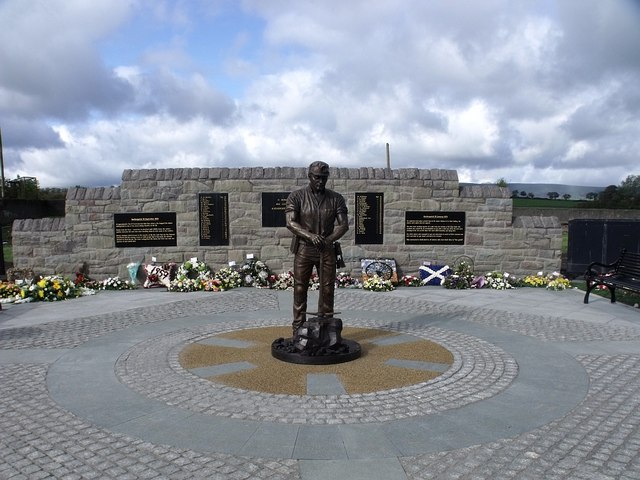
A memorial garden at Bridgend, Moodiesburn, and a bronze statue of a miner by John McKenna, unveiled by the First Minister of Scotland on 18 September 2009 for the fiftieth anniversary. The anniversary continues to be marked, including in the UK Parliament.
Recorded claims
Individual factual claims, each attached to the source(s) that support it below. Where sources disagree, both are kept.
- The inquiry attributed the fire to frictional heat between the rotating motor pulley and a balata transmission belt that had left the fan pulley and jammed near it, igniting oil around the fan bearings and then the roadway timbers. 1
- A slight haze and a smell of burning were noticed at about 6:25 a.m.; a second man-riding train carrying 48 miners was sent into the return airway at 7:00 a.m., by which time the smoke contained about 0.4 per cent carbon monoxide. 1
- Forty-seven men died of asphyxia from carbon monoxide poisoning; the dead were aged between 20 and 65. Thomas Green was the only survivor, escaping when the train stopped near the exit. 1
- The disaster widowed 41 women and left 76 children without a father. 1
- The inquiry found that the fan had not been continuously supervised, that the belt's poor performance over preceding days had received insufficient attention, and that inflammable material should have been excluded from the roadway near the fan. 1
- Recommendations covered fire-resistant transmission belts, constant fan attendance, non-inflammable bearing lubricants and a review of colliery fire-fighting arrangements. 1
Related terminology
Mining terms this disaster is structurally linked to, with the nature of the relationship.
- Colliery (contextual relationship)
Named in this record’s summary: “…an underground booster fan filled the return airway of Auchengeich Colliery with carbon monoxide, and a man-riding train carrying 48 miners was…” - Man-riding (direct cause)
A man-riding train carrying 48 men was sent into a return airway already full of carbon monoxide; 47 of them died. - Mines Rescue Station (rescue/recovery concept)
Rescue teams could do almost nothing against a fire seated in the return airway, and the effort became a recovery of bodies rather than a rescue. - Return Airway (contextual relationship)
The return airway is what turned a fan fire into a mass fatality: it carried the carbon monoxide, and the man-riding train with 48 men aboard was sent straight into it. - Whitedamp (direct cause)
The men died of carbon monoxide poisoning: smoke from the burning fan belt carried whitedamp at around 0.4 per cent through the return airway the train was sent into.
Photographs & further reading
This page doesn't try to reproduce everything — these are the best original sources found for this disaster.
A memorial page for the disaster including the names of the men who died.
View sourceSources
- (primary) Auchengeich Colliery Fire, Chryston, 1959 — Northern Mine Research Society
- (secondary) Auchengeich Colliery — site record — Scottish Cave and Mine Database
Record created: 24 August 2026 · Last researched: 24 August 2026