 MineArchive
Whitedamp
| Category | Ventilation & Mine Gases |
|---|
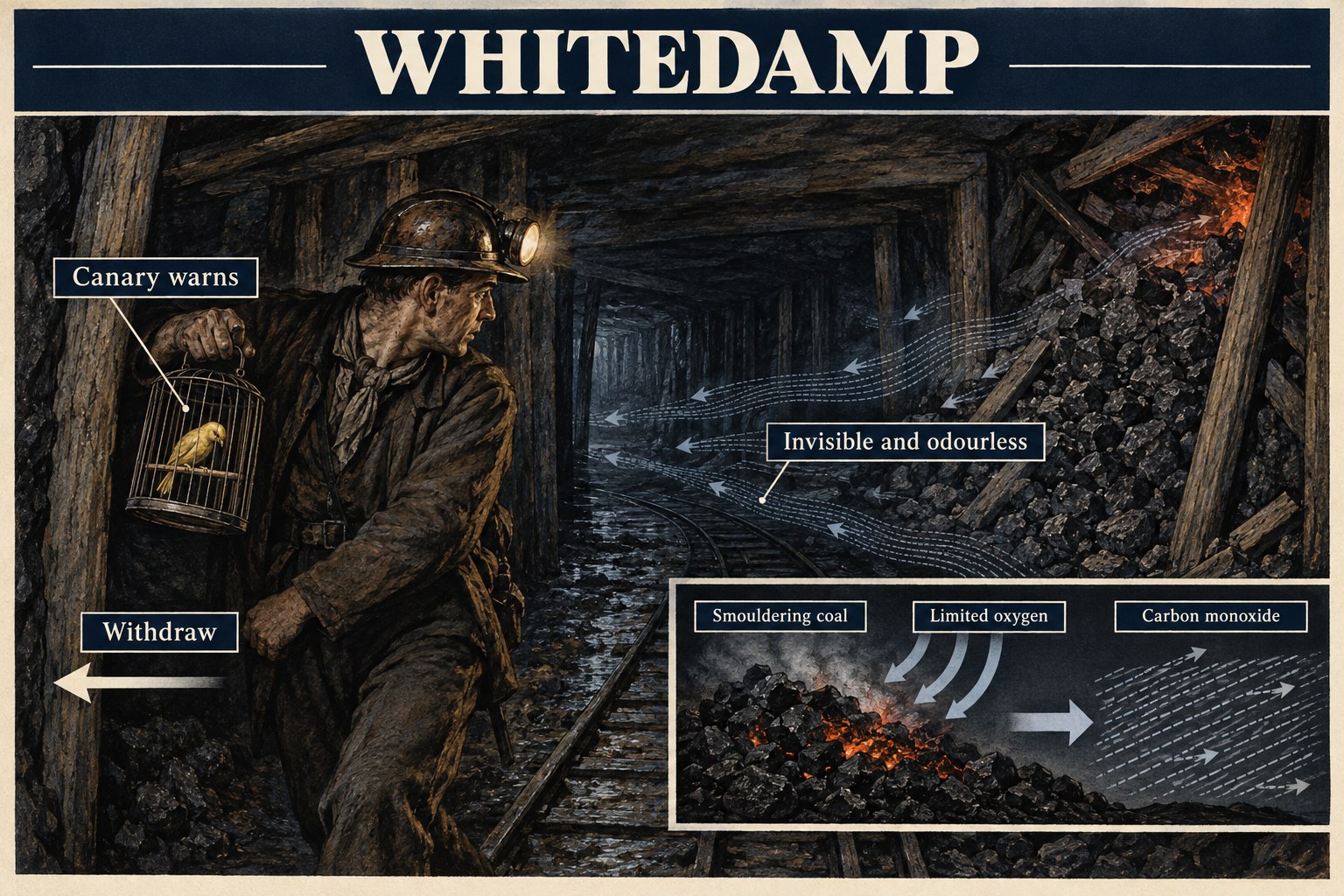
A toxic mixture of gases formed by coal burning slowly in a confined space, whose dangerous constituent is carbon monoxide — colourless, odourless and tasteless, and lethal even at very low concentration.
Historical usage
The word is recorded in English from around the 1810s-1820s, as Britain's coal boom and a run of serious colliery disasters brought early parliamentary safety inquiries; by the 1830s it appears regularly in official colliery-safety reports, as one of the named 'damp' family alongside firedamp, blackdamp/chokedamp and afterdamp (all covered on this site's own term pages).
How it worked
Coal exposed to air in a mine can begin to smoulder and burn slowly, especially where old workings or a fire are starved of enough oxygen for full combustion; this incomplete burning produces carbon monoxide rather than the harmless carbon dioxide full combustion would give. As little as 0.1% carbon monoxide in the air can kill a person within minutes.
Why it was used
Because whitedamp gives no warning to human senses at all, miners relied on canaries, far more sensitive to carbon monoxide than people, carried into suspect workings as a living early-warning system — a bird overcome or falling from its perch told miners to withdraw immediately, well before the gas became dangerous to them.
Risks & limitations
Whitedamp's total undetectability by taste, smell or sight made it one of the most insidious mine gases, since a miner could be overcome with no warning whatsoever beyond an animal detector's reaction.
Regional variation
Whitedamp is closely related to, and often overlaps with, afterdamp — the gas mixture left behind after a mine fire or explosion — since carbon monoxide is a major component of both. The glossaries treat it simply as the name for carbon monoxide in the pit: the Durham Mining Museum's Geordie glossary gives whitedamp as a carbon monoxide and air mixture, and Healey Hero the same, setting it against blackdamp for carbon dioxide and afterdamp for the mixture left after an explosion. Unlike stythe for chokedamp or wildfire for weak firedamp, whitedamp seems to have acquired no separate dialect word of its own.
Related terminology
Canary, Spontaneous Combustion
Mines associated with this term
Included only where MineArchive's own research gives a reasonable evidential basis — not every mine where this might plausibly apply.
- Lochhead Colliery — Fife (well documented example)
Named in this record’s history: “…where spontaneous combustion had long troubled the colliery, and whitedamp killed three men: the fireman John Kilpatrick, and Andrew Morris and…”
Disasters associated with this term
Included only where MineArchive's own research gives a reasonable evidential basis, with the nature of the relationship stated — not every disaster where this term might plausibly apply.
- Auchengeich Colliery fire, 1959 (direct cause)
The men died of carbon monoxide poisoning: smoke from the burning fan belt carried whitedamp at around 0.4 per cent through the return airway the train was sent into.
Sources
- (primary) Definition of white damp — Mindat
- (primary) Glossary of Mining and Geordie Words — Durham Mining Museum
- (primary) Glossary of Scotch Mining Terms — James Barrowman (1886), via Scottish Mining Website
- (secondary) Pit Terminology — Healey Hero
- (secondary) The Most Dangerous Gases In Mining — Chart Industries
- (secondary) Whitedamp — Wikipedia
Record created: 21 August 2026 · Last researched: 11 September 2026