 MineArchive
Auchengeich Colliery
| Also known as | The Geich, Auchengeich No. 2 Pit |
|---|---|
| Location | Bridgend, Moodiesburn, near Chryston, North Lanarkshire — 55.9154, -4.1036 (exact) |
| Commodity | Coal |
| Type | Coal |
| Worked | 1908–1965 |
| Maximum depth | Two shafts, each about 320 m (350 yards) deep |
| Operators | James Nimmo and Company (1908–1947), National Coal Board (1947–1965) |
Overview
A gassy Lanarkshire pit seven miles from Glasgow, remembered for the worst mining disaster in 20th-century Scotland: a jammed fan belt set alight in September 1959, and a train carrying 48 men was sent straight into the smoke. Forty-seven of them died.
History
Auchengeich was sunk and brought into production in 1908 by James Nimmo and Company, and worked the Limestone Coal Formation for gas, house, steam and coking coal. Locally it was simply the Geich. It was a substantial pit rather than an exceptional one — 880 tons a day and 797 employees in 1948, an average workforce of around 650, and a peak of 860 in 1956 — and it passed to the National Coal Board on nationalisation in 1947. It was also known to be gassy, and it killed twice over: an explosion in No. 2 Pit on 22 January 1931 killed six men, and an underground fire on 18 September 1959 killed forty-seven. The 1959 disaster is the worst to have happened in a Scottish mine in the 20th century, and it left 41 women widowed and 76 children without a father in a village of a few thousand people. The colliery closed six years later.
Geology
The workings were in the Limestone Coal Formation and the Upper Limestone Formation of the Scottish Carboniferous — the coal-bearing sequence that underlies most of the central belt, laid down as repeated cycles of swamp, delta and shallow sea so that workable seams alternate with limestones and mudstones. Coals of this kind release methane freely as they are worked, which is why Auchengeich's reputation as a gassy pit mattered so much to how it had to be ventilated — and why the ventilation machinery itself became the thing that killed.
Geological setting: Sedimentary Beds and Seams (well documented example)
Workings
Two shafts served the pit, both about 320 m deep and unusually mismatched: No. 1 was rectangular and timber-lined, No. 2 round and brick-lined. The No. 2 Pit workings, where the 1959 fire occurred, were reached along a return airway travelled by man-riding trains, and ventilation was assisted by an underground booster fan driven by a belt from an electric motor.
Closure
Auchengeich closed in 1965, six years after the disaster; the abandonment plans are dated to that year, and the spoil tip was formally abandoned in 1982.
What remains
Nothing of the colliery survives above ground. The treated shafts lie buried under grassland in a woodland clearing west of the Chryston aggregate works.
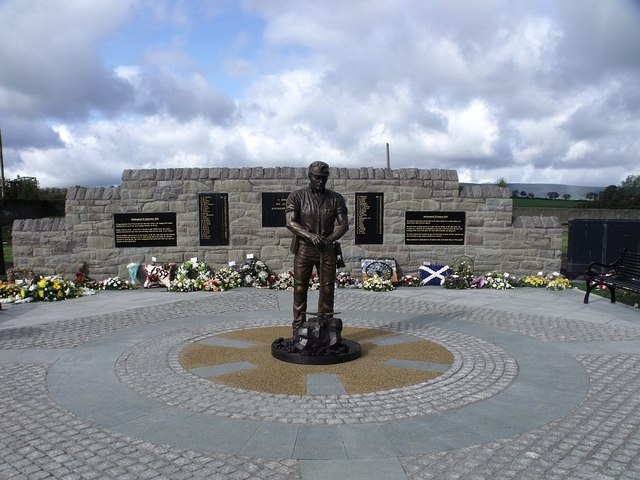
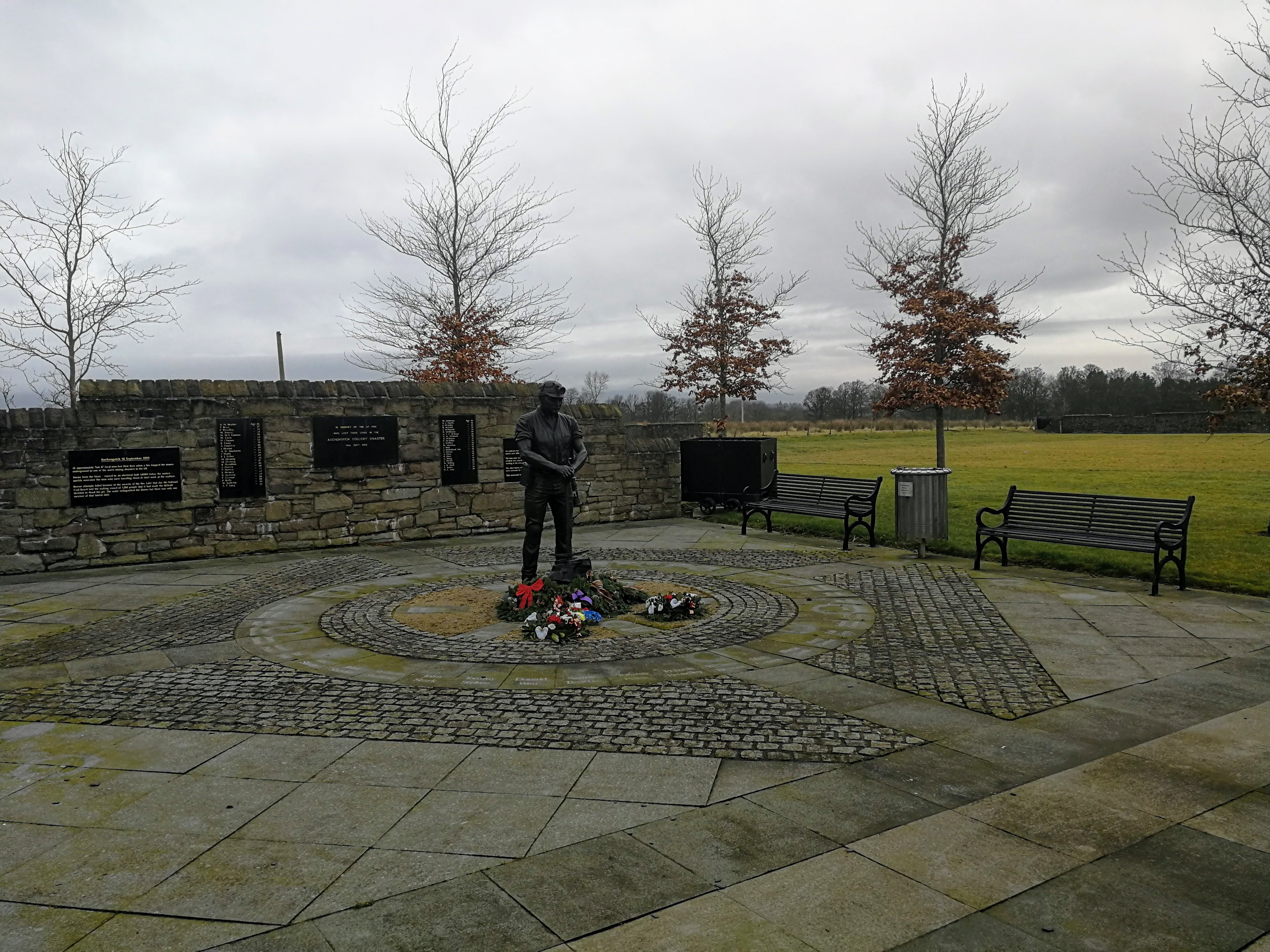
None. What stands instead is the memorial at Bridgend — a bronze miner by John McKenna, unveiled by the First Minister of Scotland on 18 September 2009, the fiftieth anniversary of the fire — and a memorial garden.
Redevelopment
The site has reverted to grass and woodland alongside the M80 corridor.
Related mines
- Canderrigg Colliery — Both worked by James Nimmo and Co.
Nearby mines
- Woodilee Colliery — 1.8 miles (2.8 km) NW, East Dunbartonshire
- Meiklehill Colliery — 2.1 miles (3.3 km) NW, East Dunbartonshire
- Bedlay Colliery — 2.2 miles (3.5 km) E
- Cardowan Colliery — 2.2 miles (3.5 km) SW
- Glenboig Fireclay Mines — 2.8 miles (4.5 km) SE
Straight-line distance, within 9 miles (15 km). Show on the map.
Disasters & major incidents
-
Auchengeich Colliery explosion, 1931
22 January 1931 · Explosion · 6 fatalities
An explosion tore through the night shift in No. 2 Pit — the Round Pit — at Auchengeich Colliery in the early hours of 22 January 1931. Five men were killed outright and a sixth died the next day. Five others who had escaped unhurt went straight back in to look for them and were themselves overcome by gas. -
Auchengeich Colliery fire, 1959
18 September 1959 · Fire · 47 fatalities
A fire in an underground booster fan filled the return airway of Auchengeich Colliery with carbon monoxide, and a man-riding train carrying 48 miners was sent into it. Forty-seven died; one man walked out. It remains the worst mining disaster in 20th-century Scotland.
What's uncertain
Points where sources disagree or the record could not be settled; both accounts are kept. All open questions in the archive.
- The colliery is recorded as having been owned by James Nimmo and Company before nationalisation. (uncertain) 1
Recorded claims
Individual factual claims, each attached to the source(s) that support it below. Where sources disagree, both are kept.
- Auchengeich was sunk and came into production in 1908. 1
- The colliery is recorded as having been owned by James Nimmo and Company before nationalisation. (uncertain) 1
- The pit had two shafts, each about 320 m deep — No. 1 rectangular and timber-lined, No. 2 round and brick-lined. 1
- In 1948 the colliery produced 880 tons a day, 237,600 tons a year, and employed 797 people. 1
- The average workforce was around 650, peaking at 860 in 1956. 1
- The workings were in the Limestone Coal Formation and Upper Limestone Formation, producing gas, house, steam and coking coal. 1
- An explosion killed six men on 22 January 1931 and an underground fire killed forty-seven on 18 September 1959, the latter being the worst mining disaster in Scotland in the 20th century. 1,2
- The colliery closed in 1965; Coal Authority abandonment plans are dated to that year, and the spoil tip was abandoned in 1982. 1,3
- Nothing survives above ground; the treated shafts are buried under grassland in a woodland opening west of the Chryston aggregate works. 1
Photographs & further reading
A page dedicated to the disaster, including the names of the men who died. (The site's certificate blocks automated access; open it directly in a browser.)
View sourceSources
- (secondary) Auchengeich Colliery — site record — Scottish Cave and Mine Database
- (primary) Auchengeich Colliery Fire, Chryston, 1959 — Northern Mine Research Society
- (primary) Mine plans S533 and SP2322: Auchengeich — British Geological Survey / Mining Remediation Authority mine plans catalogue
Record created: 24 August 2026 · Last researched: 24 August 2026