 MineArchive
Canderrigg Colliery
| Also known as | Canderside Colliery, Canderrigg Nos. 4 and 5 |
|---|---|
| Location | Stonehouse, South Lanarkshire — 55.7039, -3.9613 (approximate) |
| Commodity | Coal |
| Type | Coal |
| Worked | By 1905–January 1954 (some accounts 1958) |
| Maximum depth | About 276 feet (84 m), No. 5 Pit |
| Operators | James Nimmo and Company (?–1947), National Coal Board (1947–1954) |
Overview
James Nimmo and Co.'s colliery outside Stonehouse, Lanarkshire, with Nos. 2 and 3 Pits by Canderside and Nos. 4 and 5, sunk from 1902, south of Broomfield farm. The village's largest employer after weaving, it had over 600 men between the wars and closed in the 1950s.
History
Canderrigg Colliery lay just outside Stonehouse, Lanarkshire. Its Nos. 2 and 3 Pits stood south-east of the Canderside bridge, served by a siding on the Stonehouse railway branch, and the sinking of Nos. 4 and 5 began in 1902 just south of Broomfield farm, reached from a yard at Canderside. James Nimmo and Co. worked it. It employed 368 people in 1905 and 678 in 1920, working the Kiltongue, Upper and Lower Drumgray and Virtuewell coals for household use, and became the largest employer in Stonehouse after the weaving trade declined.
In the late 1930s, when it still belonged to James Nimmo and Co. Ltd, the coal was cut by machine, two machinemen to each Anderson Boyes or Mavor and Coulson cutter, in sections as low as 18 inches. Nos. 4 and 5 were 62 and 84 metres deep, with a third shaft, the Draffan, of 59 metres. The National Coal Board took over in 1947, when the colliery raised 135,000 tons with 610 people. In 1948 Nos. 4 and 5 produced 190 tons a day with 267 employees, with three picking belts, a bash-tank washer made by Inglis of Airdrie and a canteen for pieces, but no baths.
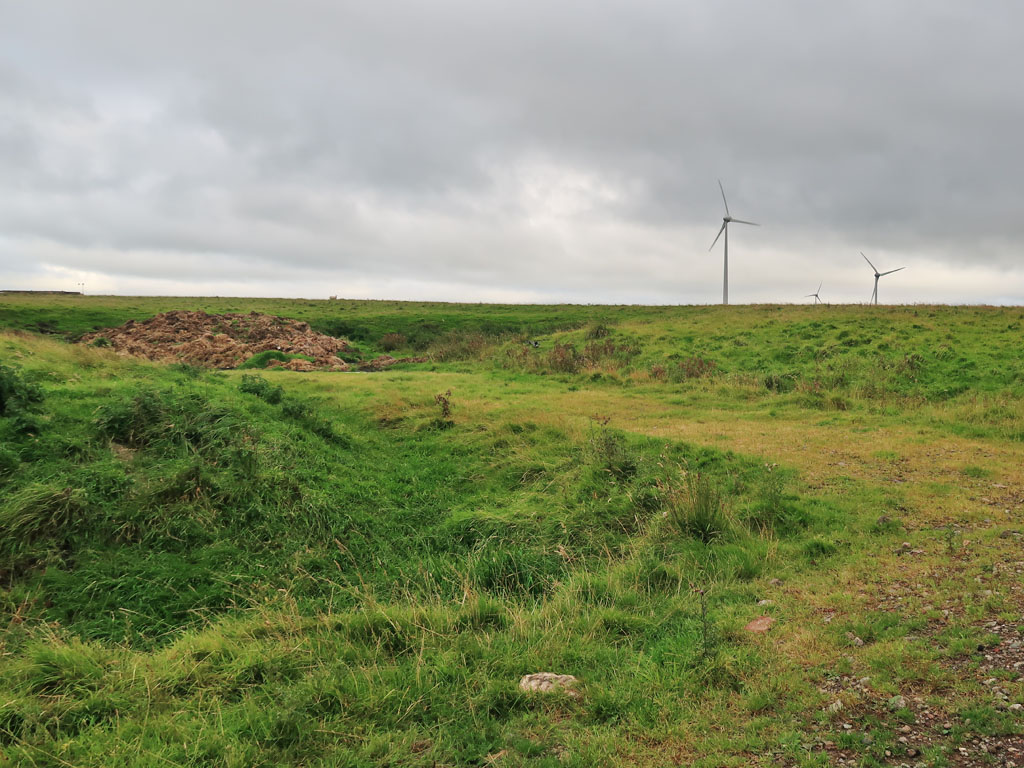
Nos. 4 and 5 are dated as closing in January 1954, though a local account has the pit, owned by then by John McLean, closing in September 1958. Only some groundworks remain on the site of Nos. 4 and 5, among rough grazing, and a derelict building stands on the site of Nos. 2 and 3.
Geology
Lanarkshire coalfield: the Kiltongue, Lower Kiltongue, Upper and Lower Drumgray and Virtuewell seams.
Workings
Nos. 2 and 3 Pits by Canderside; Nos. 4 (62 m) and 5 (84 m) from 1902, with the Draffan shaft (59 m); machine-cut faces; picking belts and a bash-tank washer; sidings on the Stonehouse branch railway.
Closure
Nos. 4 and 5 closed in January 1954 by one account; a local history has the pit closing in September 1958. The separate Canderrigg Nos. 6 and 7 at Larkhall worked on to 1964.
What remains
Only some groundworks remain on the site of Nos. 4 and 5, now rough grazing; a derelict building stands on the site of Nos. 2 and 3 by the Candermill Road.
Groundworks and a derelict building.
Redevelopment
Unknown.
Related mines
- Auchengeich Colliery — Both worked by James Nimmo and Co.
- Redding Colliery — Both worked by James Nimmo and Co.
- Southrigg Colliery — Both worked by James Nimmo and Co.
Nearby mines
- Quarter Colliery — 3.9 miles (6.3 km) NW
- Home Farm Colliery, Hamilton — 4.1 miles (6.5 km) N
- Ferniegair Colliery — 4.4 miles (7.0 km) N
- Eddlewood Colliery — 4.9 miles (7.9 km) NW
- Broomside Colliery — 5.0 miles (8.1 km) N, North Lanarkshire
Straight-line distance, within 9 miles (15 km). Show on the map.
What's uncertain
Points where sources disagree or the record could not be settled; both accounts are kept. All open questions in the archive.
- Canderrigg Nos. 4 and 5 closed in January 1954. (disputed) 5,1
- Owned by John McLean in the 1950s, the pit closed in September 1958. (disputed) 3
Recorded claims
Individual factual claims, each attached to the source(s) that support it below. Where sources disagree, both are kept.
- Nos. 4 and 5 at Canderrigg, owned by James Nimmo and Co., were sunk from 1902 just south of Broomfield farm. 1,2
- Canderrigg was the largest employer in Stonehouse after the decline of the weaving industry. 3
- The colliery employed 368 people in 1905, 678 in 1920 and 610 in 1947, when it raised 135,000 tons. 4
- In 1936-39 two machinemen worked each coal-cutting machine, Anderson Boyes or Mavor and Coulson, in sections about 18 inches high. 3
- No. 4 was 62 m and No. 5 84 m deep, with the Draffan shaft of 59 m. 1
- Canderrigg Nos. 4 and 5 closed in January 1954. (disputed) 5,1
- Owned by John McLean in the 1950s, the pit closed in September 1958. (disputed) 3
- Only some groundworks remain on the site of Pits Nos. 4 and 5. 6
Photographs & further reading
The village's pits, Canderrigg's shafts and its 1948 details.
View sourceCanderrigg's place in Stonehouse and a pre-war account of the jobs and wages there.
View sourceEmployment, output, seams and those killed at the colliery.
View sourceSources
- (secondary) Mining — Stonehouse Heritage
- (secondary) Swinehill Junction — RAILSCOT
- (secondary) Coal Mining — Stonehouse Online
- (primary) Canderrigg/Canderside Colliery — Durham Mining Museum
- (secondary) NCB Collieries - Scotland (Northern Mine Research Society) — Northern Mine Research Society
- (observational) Site of Canderrigg Colliery Pits Nos 4 & 5 (Commons, from Geograph 6602111) — Wikimedia Commons

Record created: 4 October 2026 · Last researched: 4 October 2026