 MineArchive
Cardowan Colliery
| Location | Stepps, North Lanarkshire — 55.8892, -4.1340 (exact) |
|---|---|
| Commodity | Coal |
| Type | Coal |
| Worked | From 1924 (sinking)–1983 |
| Maximum depth | 614 metres (Nos.1 and 2 shafts, to the Kilsyth Coking Coal seam) |
| Operators | National Coal Board (1947–1983) |
Overview
A notoriously gassy pit at Stepps on Glasgow's north-eastern edge, struck by three separate explosions across fifty years, the last of which — though it killed no one — prompted a review of mine ventilation practice before Cardowan closed the following year as the last deep mine working in Lanarkshire.
History
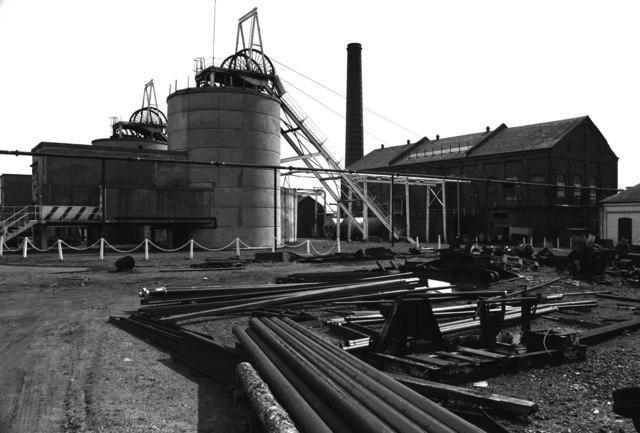
Sinking of Cardowan's No.1 and No.2 shafts began in 1924, reaching the Kilsyth Coking Coal seam at 614 metres by 1928; production of coking coal for Nimmo & Dunlop began in 1929. The colliery grew quickly, employing over 1,000 men by the mid-1930s and around 2,000 by the mid-1950s. A third shaft, No.3 (downcast), was sunk in 1958, its 23-metre steel-framed tower, built by Redpath & Brown, housing an overhead electric winder. By the 1947 nationalisation of the coal industry, Cardowan was one of only a handful of Lanarkshire collieries still working, alongside Garscube, Blantyreferme, Bardykes and Coatspark.
Cardowan's coal was notoriously gassy, and the colliery was struck by explosions three times across roughly fifty years. The worst, on 16 November 1932, killed 11 men (see Disasters, below). A further explosion on 25 July 1960, during work to reopen a district sealed off after an underground fire, killed four men (see Disasters, below). A third explosion, on 27 January 1982 in the Cloven Seam's V52 District, injured 25 men, seven of them seriously, though caused no deaths; the colliery was closed while the cause was investigated, and the accident fed directly into a wider review of mine ventilation and safety practice. Cardowan closed in 1983, the last deep mine working anywhere in Lanarkshire.
Geology
Cardowan reached the Kilsyth Coking Coal seam at 614 metres, and later worked the Cloven seam, recorded at 0.94 metres thick with a sandstone roof and hard floor; the colliery's coal was notoriously high in firedamp, a persistent hazard across its working life.
Workings
Nos.1 and 2 shafts, sunk from 1924, reached 614 metres by 1928; a third shaft, No.3 (downcast), was sunk in 1958 with a 23-metre steel-framed tower built by Redpath & Brown to house an overhead electric winder.
Closure
Cardowan closed in 1983, the last deep coal mine working anywhere in Lanarkshire, in the aftermath of a 1982 explosion that, while causing no deaths, led directly to closer scrutiny of the colliery's notoriously gassy conditions.
What remains
Unknown.
Nearby mines
- Auchengeich Colliery — 2.2 miles (3.5 km) NE
- Woodilee Colliery — 2.8 miles (4.5 km) N, East Dunbartonshire
- Glenboig Fireclay Mines — 3.5 miles (5.7 km) E
- Meiklehill Colliery — 3.6 miles (5.7 km) N, East Dunbartonshire
- Bedlay Colliery — 3.6 miles (5.9 km) NE
Straight-line distance, within 9 miles (15 km). Show on the map.
Disasters & major incidents
-
Cardowan Colliery explosion, 1932
16 November 1932 · Explosion · 11 fatalities
A firedamp explosion, triggered when a shot was fired into coal already loosened by an earlier shot, killed 11 men at Cardowan Colliery's dip side face on 16 November 1932. -
Cardowan Colliery explosion, 1960
25 July 1960 · Explosion · 4 fatalities
Shortly before 7 p.m. on 25 July 1960, as a party led by the Group Manager and the District Inspector came away from clearing an airway over a roof fall on No. 4 East face at Cardowan, firedamp exploded behind them and flame swept the intake. The district had been sealed for six months after a fire. Three men working on the gas drainage pipes in the return were killed and seven were burned, one of whom died a week later. The Deputy Chief Inspector concluded that half-burned coal had reheated once fresh air reached it. -
Cardowan Colliery explosion, 1982
27 January 1982 · Explosion · 0 fatalities
A firedamp explosion on a longwall coal face in the Cloven Seam's V52 District at Cardowan Colliery injured 40 men on 27 January 1982, none fatally. The accident forced the colliery's closure while it was investigated, fed into a national review of ventilation and gas-monitoring practice, and became a landmark case study in mass burns treatment.
Recorded claims
Individual factual claims, each attached to the source(s) that support it below. Where sources disagree, both are kept.
- Sinking of Cardowan's No.1 and No.2 shafts began in 1924, reaching the Kilsyth Coking Coal seam at 614 metres by 1928; production of coking coal for Nimmo & Dunlop began in 1929, and employment grew from over 1,000 by the mid-1930s to around 2,000 by the mid-1950s. 1
- A third shaft, No.3 (downcast), was sunk in 1958, its 23-metre steel-framed tower built by Redpath & Brown to house an overhead electric winder. 1
- An explosion in the Cloven Seam's V52 District on 27 January 1982 injured 25 men, seven of them seriously enough to need intensive hospital care for burns, but caused no fatalities; the colliery was closed pending investigation. 2
- Cardowan closed in 1983, the last deep coal mine working anywhere in Lanarkshire. 1
Sources
- (secondary) 1914 to 1950s: Industry and Technology: Mines — TheGlasgowStory
- (primary) Cardowan Colliery (Accident) (Hansard, 27 January 1982) — UK Parliament, House of Commons (Historic Hansard)
- (primary) Cardowan Colliery, Steppes (Explosion) (Hansard, 26 July 1960) — UK Parliament, House of Commons (Historic Hansard)
Record created: 27 August 2026 · Last researched: 27 August 2026