 MineArchive
Cardowan Colliery explosion, 1932
A firedamp explosion, triggered when a shot was fired into coal already loosened by an earlier shot, killed 11 men at Cardowan Colliery's dip side face on 16 November 1932.
| Date | 16 November 1932 |
|---|---|
| Mine | Cardowan Colliery |
| Region | North Lanarkshire |
| Type | Explosion |
| Fatalities | 11 (Killed immediately: Richard Maroney, William McAllister, James Reynolds and John McNab. Died the following day, 17 November: John Watt Jr., Peter Fratti, William Bradley, George Mullen and James McVey. Died 18 November: John Whiteford. Died 19 November: Michael Flynn.) |
| Injuries | Peter Lusty, Robert Kirkland and Patrick Johnson survived with injuries. |
| Context | During active mining |
Cause
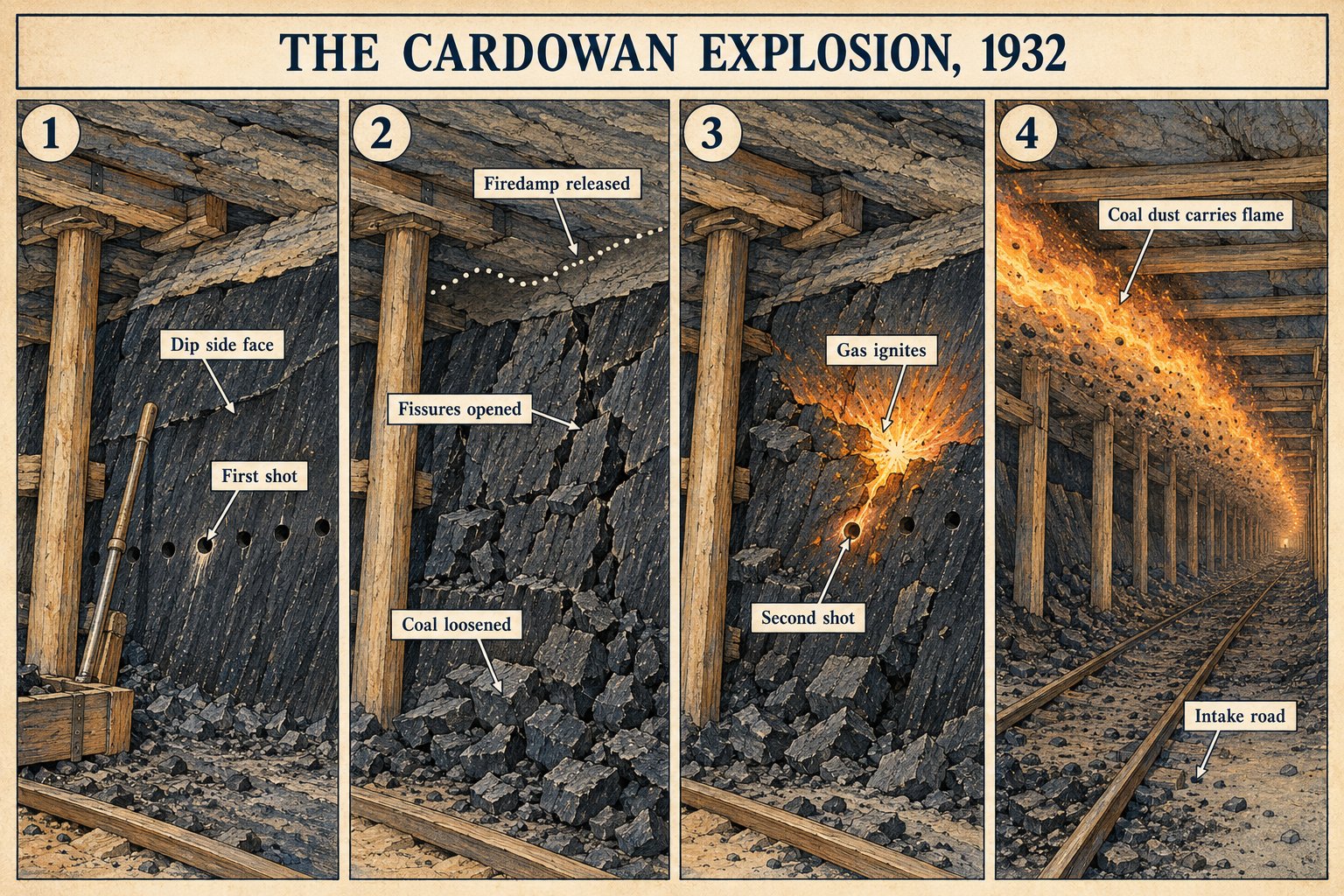
H.M. Chief Inspector of Mines Sir Henry Walker concluded the explosion was caused by the firing of a shot in coal that had already been loosened and broken by a shot fired immediately before it; the first shot opened fissures that released firedamp, and the second shot ignited it, with flame then spreading through coal dust across the face and intake road.
What happened
Around 8:45am, with conveyors briefly stopped for lack of empty tubs, around 12 men were working the dip side face when the explosion struck. Survivor Patrick Johnson described hearing 'a loud report, a sort of dull report', being blown down, and seeing flame in the roof of the full working before dust obscured his view.
Rescue & recovery
Workers on the rise side face discovered the casualties; contractor Robert Kirkland, assisted by rescue personnel, located and recovered bodies along the face and conveyor area, some men needing help to leave the mine.
Investigation & inquiry
Sir Henry Walker's inquiry, held 10-17 January 1933, examined firedamp detection practice, the timing of stone dust application, the frequency of shotfiring, and the practice of firing multiple shots in close succession.
Recorded claims
Individual factual claims, each attached to the source(s) that support it below. Where sources disagree, both are kept.
- Sir Henry Walker concluded the explosion was caused by a shot fired into coal already loosened by a shot fired immediately before it, the first releasing firedamp that the second ignited. 1
- 11 men died: Richard Maroney, William McAllister, James Reynolds, John McNab, John Watt Jr., Peter Fratti, William Bradley, George Mullen, James McVey, John Whiteford and Michael Flynn. 1
Related terminology
Mining terms this disaster is structurally linked to, with the nature of the relationship.
- Coal (contextual relationship)
Named 3 times in this record, first in the summary: “A firedamp explosion, triggered when a shot was fired into coal already loosened by an earlier shot, killed 11 men at Cardowan…” - Firedamp (contextual relationship)
Named 3 times in this record, first in the summary: “A firedamp explosion, triggered when a shot was fired into coal already…” - HM Chief Inspector of Mines (contextual relationship)
Named in this record’s cause: “H.M. Chief Inspector of Mines Sir Henry Walker concluded the explosion was caused by the firing of…” - Return Airway (contextual relationship)
Named in this record’s cause: “…it, with flame then spreading through coal dust across the face and intake road.” - Tub (contextual relationship)
Named in this record’s narrative: “Around 8:45am, with conveyors briefly stopped for lack of empty tubs, around 12 men were working the dip side face when the explosion…”
Sources
- (secondary) Cardowan Colliery Explosion - Stepps - 1932 — Northern Mine Research Society
- (secondary) 1914 to 1950s: Industry and Technology: Mines — TheGlasgowStory
Record created: 27 August 2026 · Last researched: 27 August 2026