 MineArchive
Alum Bay Sand and Copperas Workings
| Also known as | Alum Bay Coloured Sands, Alum Bay alum works |
|---|---|
| Location | Alum Bay, west of the Needles, Isle of Wight — 50.6660, -1.5609 (approximate, low confidence) |
| Commodities | Silica Sand, Pyrite |
| Type | Quarry |
| Worked | from 1561 |
| Operators | Baron Mountjoy (1561–1600) |
Overview
A bay named after a mineral it never produced. Elizabeth I sent a man to find alum here in 1561 and there was none to find — but the cliffs did give up pyrite for copperas, and white sand so pure that London and Bristol used it for their finest glass and porcelain.
History
In 1561 Elizabeth I authorised a search for alum ore and sent an official named Bendall to the Isle of Wight. The attempt failed, as did every other: between 1545 and the end of the century there were at least six attempts to make alum in England and Ireland, and none of them worked. The earliest English efforts were here and in Hampshire, and Baron Mountjoy mined supposed alum ores on the Island and near Poole. The bay kept the name anyway. What could actually be got here was pyrite, collected from the 16th century onward and roasted to make copperas, and — more durably — the white sand, which was carried to London and Bristol for the finer sorts of glass and porcelain. In the 19th century the coloured sands found a second life entirely, as souvenirs: visitors dug them from the cliff foot themselves, and a vogue grew for marmotinto, pictures made by gluing coloured sand to board with gum arabic.
Geology
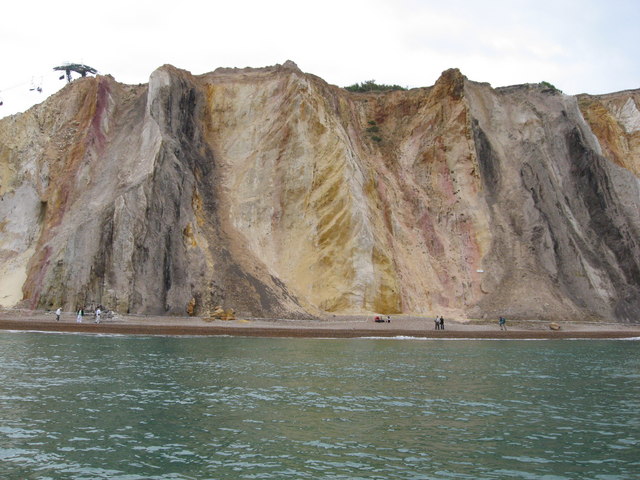
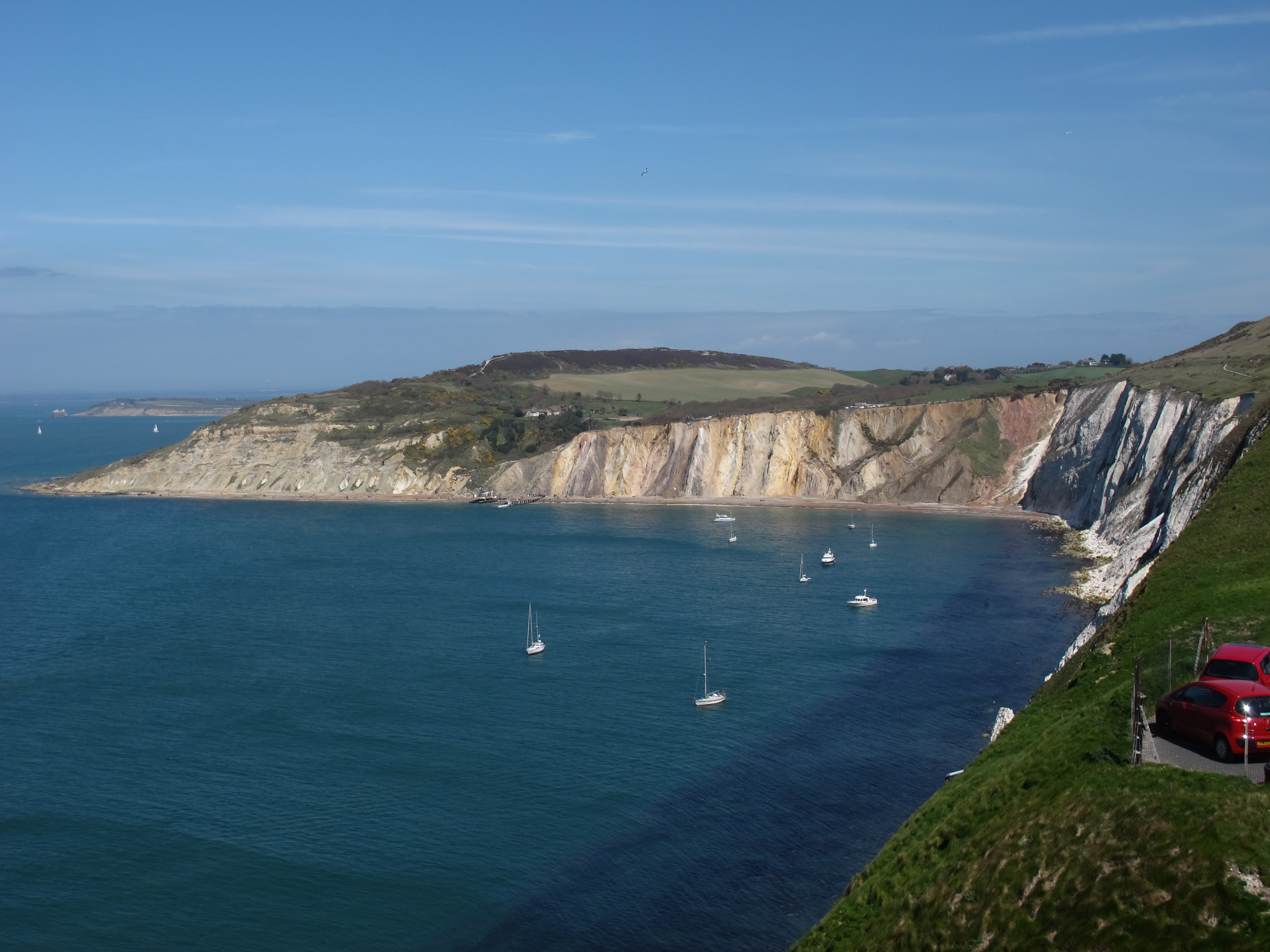
The reason for both the failure and the fame is the same geology. The strata at Alum Bay stand almost vertical, tilted by the Alpine folding that raised the Isle of Wight monocline, so that a long sequence of Palaeocene and Eocene beds is exposed side by side across a short stretch of cliff; their colours come from iron compounds oxidised under different conditions. True alum is a complex sulphate of aluminium and iron and does not normally occur naturally in Britain at all — it is found in Italy. What is here instead are sulphates produced by pyrite oxidising in the beds: melanterite, a green ferrous sulphate, and jarosite, a bright yellow one. Melanterite has some alum-like properties and will fix black dyes, which is precisely why people kept believing there was alum here and kept being wrong.
Geological setting: Faults and Fractures (well documented example)
Workings
Never an organised mine. Pyrite nodules were picked from the cliffs and beach and roasted to make copperas; the white sand was dug from the cliff face and carried away by sea. The workings were shallow, intermittent and small in scale, which is why the bay reads today as a natural feature rather than an industrial one.
Closure
Commercial extraction has ceased and removing minerals from the site is now prohibited by law under the notices attached to the Headon Warren and West High Down SSSI. The sand sold to visitors today comes from rockfalls rather than from the cliff.
What remains
A protected site and a major tourist attraction, reached by chairlift from the Needles Park above. The coloured sands are the draw, and the industrial history behind the name is largely forgotten.
Nothing industrial survives. The cliff section itself is the monument, and is protected as a Site of Special Scientific Interest.
Redevelopment
Tourism. The bay has been a visitor attraction since the 19th century and the sand trade continues in miniature as souvenir bottles.
Recorded claims
Individual factual claims, each attached to the source(s) that support it below. Where sources disagree, both are kept.
- In 1561 Elizabeth I authorised a search for alum ore and sent an official named Bendall to the Isle of Wight; the attempt failed. 1
- Between 1545 and the end of the 16th century there were at least six attempts to produce alum in England and Ireland, including on the Isle of Wight, in Cornwall and in Dorset, and all failed; Baron Mountjoy mined supposed alum ores on the Island and near Poole. 2
- True alum is a complex sulphate of aluminium and iron and is not normally found in natural conditions in Britain; what occurs at Alum Bay is melanterite and jarosite, sulphates produced by the oxidation of pyrite. Melanterite has some alum-like properties and will fix black dyes, which is the source of the long confusion. 1
- Pyrite nodules were collected from Alum Bay from the 16th century onward to make artificial melanterite, known as copperas. 1
- The bay's extremely pure white silica sand was extracted for glass and pottery manufacture and used at London and Bristol in the finer sorts of glass and porcelain. 3
- The strata stand near vertical as a result of Alpine folding, exposing a sequence of Palaeocene and Eocene beds whose colours come from oxidised iron compounds formed under different conditions. 3
- Removal of minerals from the site is now prohibited by law under the notices attached to the Headon Warren and West High Down SSSI; souvenir sand comes from rockfalls. 3
Photographs & further reading
Local newspaper history of the bay and its sands.
View sourceSources
- (primary) Geology of Alum Bay, Isle of Wight — Ian West, Wessex Coast Geology (University of Southampton)
- (secondary) The history of alum in England — wovepaper.co.uk
- (secondary) Alum Bay — Wikipedia
Record created: 24 August 2026 · Last researched: 24 August 2026