 MineArchive
Aplite
| Category | Commodities |
|---|---|
| Commodity page | Aplite → |
A fine-to-medium-grained igneous rock of granitic composition, valued not for any single mineral it contains but for its unusually pure, glass-ready mix of potassium, aluminium, sodium and silica.
Historical usage
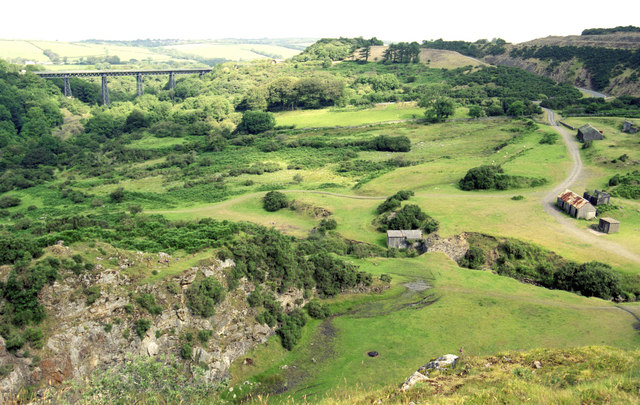
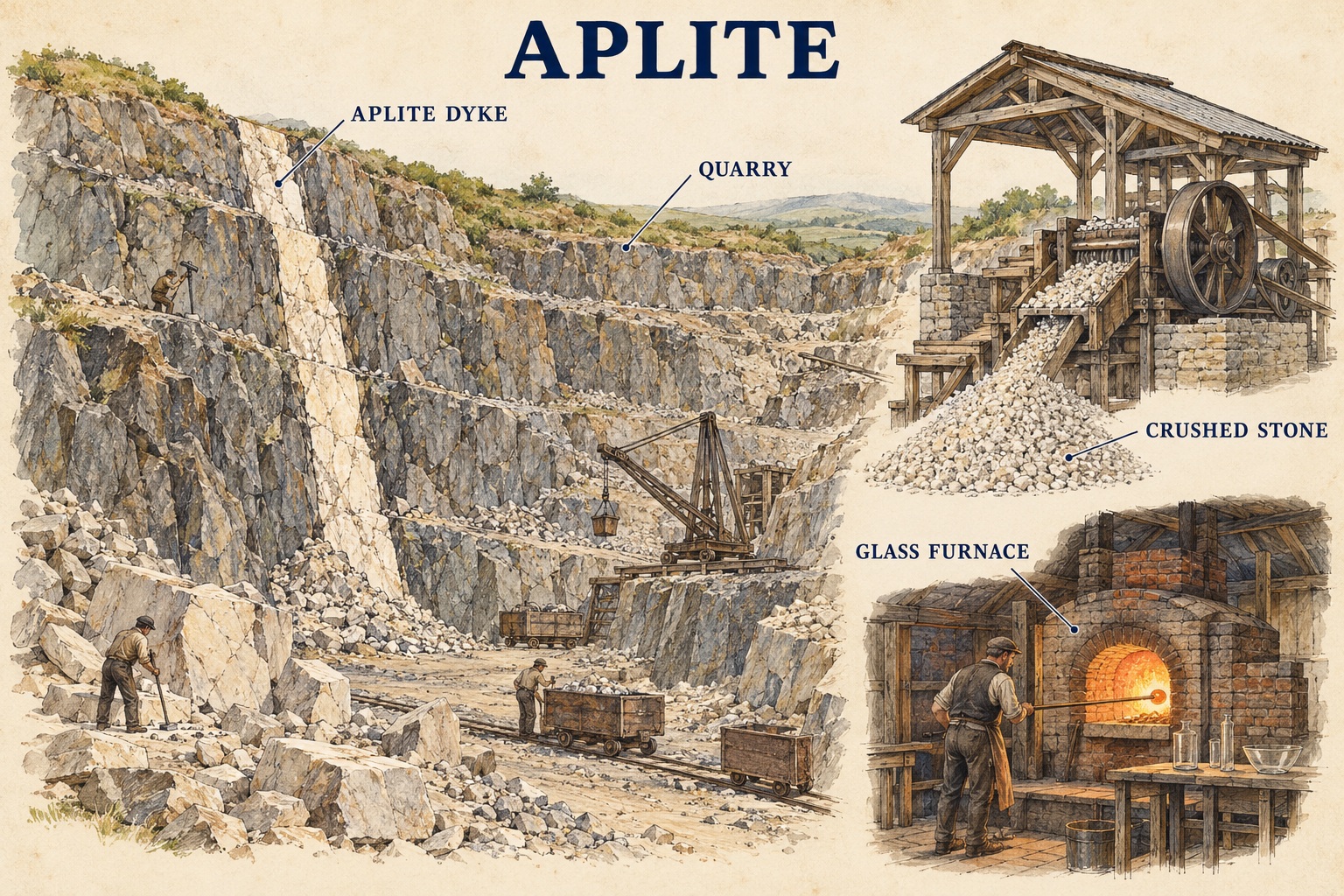
Britain's only significant aplite deposit is a dyke at Meldon, on the northern edge of Dartmoor, discovered either side of the Red-a-Ven Brook and first quarried from 1889. Its main use was as roadstone and railway ballast, but its unusual chemistry also drew a short-lived attempt at glass manufacture: a syndicate erected furnaces at the quarry around 1920, importing German and Dutch glassblowers to produce light-green medicine and cosmetic bottles from a mix of calcined aplite, marble, soda and manganese. Persistent difficulty producing clear glass forced the venture to lay off around 100 workers by February 1921, and it closed soon after; ordinary quarrying for aggregate and other uses continued at Meldon into the 1970s. The aplite is a dyke, unique in south-west England, intruded into the Lower Carboniferous rocks on the north-west flank of Dartmoor rather than into the granite: an unusual lepidolite-soda microgranite rich in plagioclase and lithium mica, with abundant topaz and fluorite and an enrichment in rubidium, caesium, fluorine, boron and beryllium, and almost no tin or tungsten. The 'Granulite Quarry' that worked it on both banks of the Red-a-Ven Brook is now a Geological Conservation Review site and part of the Meldon SSSI. The stone that made Meldon a great quarry was not the aplite but the hornfels beside it: a small quarry opened for the London and South Western Railway's Okehampton–Lydford line in 1874, and in 1897 the company developed it to supply most of its track ballast, about 100,000 tons a year, extending it again in 1902 until it covered 200 acres. By 1932 four trains of hopper wagons a week left the quarry, mostly worked at night, and by 1953 it was producing 340,000 tons. After nationalisation the ballast was thought better than the nearer limestones but the haul from Devon counted against it; from the 1980s Scottish stone came by sea to Tilbury instead, the quarry was privatised in 1994 and mothballed in May 2011.
How it worked
A dyke some tens of feet thick, quarried from both sides of the brook, the workings moving from the east bank to the west as the first deposits were exhausted; the waste that had nowhere to go in the narrow valley was itself later sold as railway ballast. The glass venture ground the aplite as its base and fired it in furnaces built beside the quarry.
Why it was used
For glass, because its chemistry came ready-mixed — potassium, aluminium, sodium and silica in the proportions a glass-maker wants, at a fraction of the cost of a prepared sand batch; for the railway, because Meldon's stone is harder and longer-lasting than anything available further east on the system.
Value over time
Meldon's aplite needed almost no preparation to act as a glass-making base, costing as little as 15 shillings a ton against roughly £2 a ton for a conventional prepared glass-sand mixture -- on paper, a compelling cost advantage. In practice the venture could not turn that into a viable business: the glass it produced was persistently unclear, isolated Dartmoor offered no local pool of skilled glassworkers, and the factory folded within a year of production starting. Quarrying the rock itself for aggregate, however, remained commercially viable for decades after the glass venture failed.
Hazards & challenges
No hazard specific to aplite itself is well documented; as with any hard-rock quarrying, the generic risk is airborne silica dust and the resulting risk of silicosis for anyone cutting, crushing or calcining it without proper dust control.
Risks & limitations
A single dyke of a rock with no second use: when the glass would not come out clear the aplite had no market, and the quarry lived on the hornfels ballast beside it, whose own market depended on the railway's willingness to haul it from the far end of the system.
Regional variation
Meldon is the only aplite of consequence in Britain; the name is otherwise a petrologist's term for any fine-grained granitic vein.
Related terminology
Mines associated with this term
Included only where MineArchive's own research gives a reasonable evidential basis — not every mine where this might plausibly apply.
- Meldon Quarry — Devon (well documented example)
Named 8 times in this record, first in the summary: “…out to sit beside one of the rarest rock exposures in Britain — an aplite dyke whose unusual chemistry produces minerals found nowhere else in…”
See every mine that worked aplite →
Sources
- (secondary) Meldon Aplite Quarries, Devon (GCR block 36) — Geological Conservation Review / Scottish Geology Trust GeoGuide
- (secondary) Meldon Glass Factory — Legendary Dartmoor
- (secondary) Meldon Quarry — Wikipedia
- (secondary) Meldon Quarry — Legendary Dartmoor — Legendary Dartmoor
- (secondary) Meldon, Devon — Wikipedia
Record created: 26 August 2026 · Last researched: 8 September 2026