 MineArchive
Marble
| Category | Commodities |
|---|---|
| Commodity page | Marble → |
A stone capable of taking a fine decorative polish — either true metamorphic marble, or, as with most historic English 'marble', a hard, fossil-rich limestone that polishes just as well.
Historical usage
Purbeck Marble has been quarried on the Isle of Purbeck, Dorset, since Roman times, when it was used for architectural mouldings, inscriptions and decorative veneers across Roman Britain. Demand peaked between the 12th and 14th centuries, when it was used extensively for columns, slab panels and flooring in the great Gothic cathedrals of southern England, including Exeter, Salisbury, Canterbury and Westminster Abbey; underground workings known as 'quarrs' developed from the 17th century, with at least 100 believed to have been operating by the late 19th century, and the last recorded extraction of true Purbeck Marble was in 1993. Ireland's Connemara Marble, a true metamorphic stone quarried in County Galway since at least the 18th century, was exported across Europe and North America for columns, floors and decorative work, including the Senate Chamber of the Pennsylvania State Capitol in 1901.
How it worked
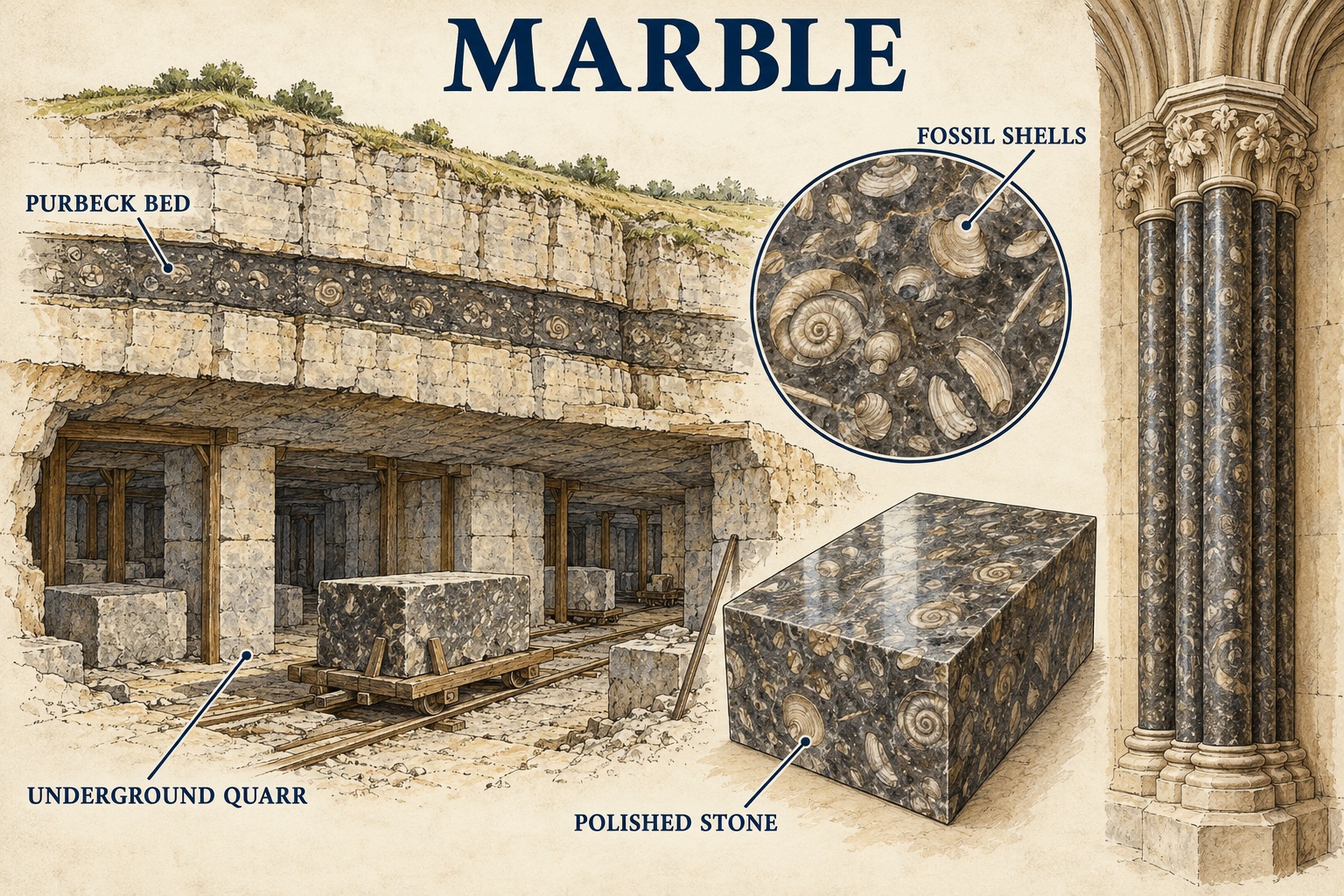
Purbeck Marble beds are thin, never exceeding about 1.2 metres, and were worked from narrow underground 'quarrs' following the seam; blocks were cut out, then ground and polished to bring out the dense pattern of freshwater snail shells that gives the stone its marble-like appearance.
Why it was used
Both Purbeck and Connemara stone take a fine, durable polish, letting them substitute for scarce true marble in columns, monuments, flooring and church fittings; Purbeck's dark, shell-flecked appearance and Connemara's distinctive green colouring, from serpentine formed by later hydrothermal alteration, each became fashionable in their own right.
Value over time
Purbeck Marble commanded its highest value during the 12th-to-14th-century boom in Gothic cathedral building, when ecclesiastical demand for polished dark stone was at its height; demand fell away as fashions changed and true imported marble became more available, leaving a much smaller, specialist market for restoration and heritage work that persisted, on and off, into the 1990s.
Hazards & challenges
As with other stone-cutting, sawing and polishing generates fine dust; the general hard-rock risk of silicosis applies, with no additional hazard specific to Purbeck or Connemara marble well documented.
Risks & limitations
True marble is comparatively rare in Britain: Purbeck Marble is not a metamorphic rock at all but a polishable limestone, and its workable beds are thin and geologically limited to a narrow strip of the Dorset coast, which constrained the industry's scale even at its medieval peak.
Regional variation
Purbeck Marble (Isle of Purbeck, Dorset) is a fossiliferous limestone; Connemara Marble (County Galway) is genuine metamorphic marble, formed from Ordovician-age limestone recrystallised during the Grampian Orogeny and later coloured green by serpentine from hydrothermal fluids.
Related terminology
Limestone, Purbeck Marblers, Serpentine
Mines associated with this term
Included only where MineArchive's own research gives a reasonable evidential basis — not every mine where this might plausibly apply.
- Skye Marble Quarry — Highland (well documented example)
Named 12 times in this record, first in the summary: “Britain's only true marble deposit, at Torrin in Strath Suardal, Skye — limestone metamorphosed…”
See every mine that worked marble →
Sources
- (secondary) Connemara marble — Wikipedia
- (secondary) Purbeck Marble — Wikipedia
Record created: 27 August 2026 · Last researched: 27 August 2026