 MineArchive
Serpentine
| Also known as | Serpentinite (The petrologically correct name for the rock; 'serpentine' properly names the mineral group) |
|---|---|
| Category | Commodities |
| Commodity page | Serpentine → |
A metamorphic rock — properly serpentinite — made largely of serpentine-group minerals, formed when mafic or ultramafic rock is hydrated deep beneath the ocean floor at mid-ocean ridges and in subduction zones. It is soft enough to carve at 2.5 to 3.5 on Mohs, takes a high polish, and its mottled green colouring gives it both its name and its whole commercial value: it was never worked for a mineral it contained, but for how it looked when cut.
Historical usage
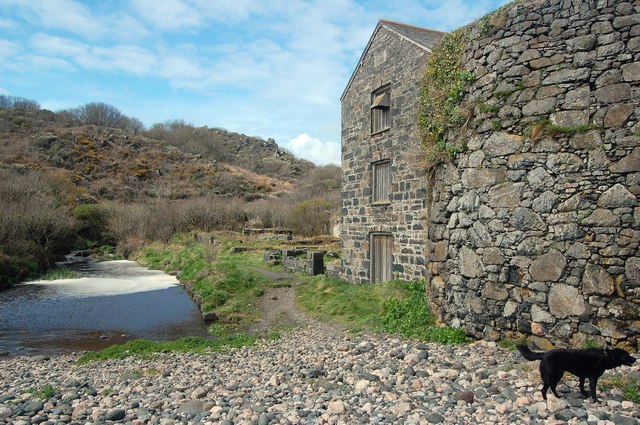
In Britain the material means the Lizard peninsula in Cornwall, the country's principal serpentinite outcrop. Small coastal workings dug soapstone and later talc there from at least the early 18th century, and serpentine ornaments were being made by 1838, but the trade was made by royal patronage: a royal visit to the Penzance serpentine works in 1846 produced an order for Osborne House, and Prince Albert's display of Cornish serpentine at the Great Exhibition of 1851 turned it into a fashionable material almost overnight. The Lizard Serpentine Company followed in 1853, and its Poltesco factory was cutting mantelpieces, pillars, shop fronts, pulpits and church fonts by 1855. Elsewhere the rock has been carved for oil lamps by Inuit peoples, used for ovenstone bases in Switzerland, and — because it is hydrous and dense — as neutron shielding in nuclear reactors.
How it worked
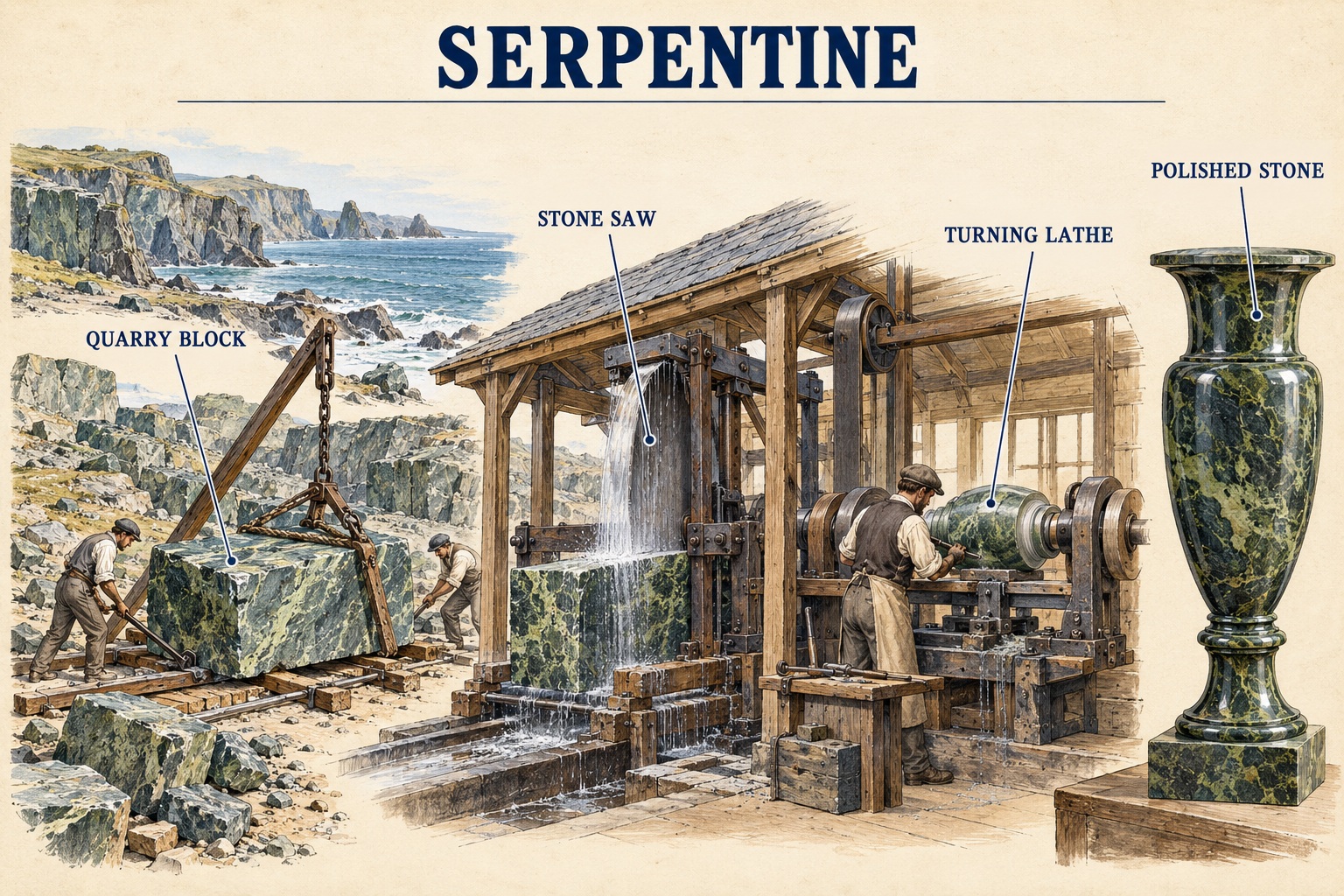
Serpentine is quarried in blocks rather than crushed, then sawn, turned, ground and polished. Poltesco worked it in a purpose-built factory from 1866 with 23 people, shipping finished work out through Penryn and Falmouth. The rock's softness is the whole point of the process: it can be worked with comparatively simple lathes and saws, which is why an ornamental industry could be built on it in a remote coastal parish.
Why it was used
Because it looked like something far more expensive. Higher-grade serpentinite carrying calcite passes convincingly for marble, and the Lizard's green mottling is distinctive enough to be recognisable as Cornish. For a Victorian market furnishing public buildings and prosperous houses, a native British decorative stone with royal approval attached to it was worth a great deal more than the rock itself.
Value over time
The Cornish serpentine trade is an unusually clean example of a value created and destroyed by fashion rather than by geology or engineering. Before 1846 it supported a handful of small coastal workings making ornaments. The Osborne House order, and then the Great Exhibition of 1851, created a national market where none had existed, and within two years a company had been formed and a factory built to serve it. The demand did not last: Victorian taste moved on, cheaper imported marbles competed, and by the end of the century the industry had contracted back to the small-scale ornamental turning that survives on the Lizard today. Serpentinite has no bulk industrial value to fall back on, so the collapse was close to total.
Hazards & challenges
The serious hazard is not in the quarry face but in the rock's mineralogy: serpentinite commonly contains chrysotile, the fibrous serpentine mineral that is white asbestos. California debated removing serpentinite as its state rock in 2010 for exactly this reason. The qualification matters — chrysotile in solid rock is not dangerous unless it is mobilised into the air as dust, which is precisely what sawing, grinding and polishing do. A Victorian serpentine works had no way of knowing that, and no dust control worth the name.
Risks & limitations
It is a fashion material, and fashion is the risk. The trade rose on a royal endorsement and fell when taste moved on, leaving works with no other product to turn to — serpentine cannot be redirected into construction or industry the way a bulk mineral can. The rock is also soft enough to weather and scratch in exterior use, which limited it to interiors and sheltered work.
Regional variation
In Britain, serpentine effectively means the Lizard. Cornish usage distinguishes the ornamental stone from soapstone (steatite), the softer talc-rich material dug from the same coast and sent to the Worcester and Bristol porcelain factories. Britain has serpentinite elsewhere without having had a serpentine trade elsewhere. The British Geological Survey's account of Shetland describes shear-bounded blocks of serpentinite on Unst and Fetlar — peridotite-serpentinite, dunite-serpentinite and antigorite-serpentinite along the thrusts — where what was actually worked was the chromite in pockets within it rather than the stone itself. The Lizard's distinction is not that it has the rock but that its rock was turned into an ornamental industry.
Related terminology
Mines associated with this term
Included only where MineArchive's own research gives a reasonable evidential basis — not every mine where this might plausibly apply.
- Poltesco Serpentine Works — Cornwall (well documented example)
The Lizard workings and the Poltesco factory are the archive's record of serpentine worked as an ornamental stone rather than for any mineral it contains.
See every mine that worked serpentine →
Sources
- (observational) The Ruins at Poltesco — The Cornish Bird
- (primary) Metamorphic rocks of Shetland: Yell, Unst and Fetlar — British Geological Survey
- (secondary) Poltesco — Wikipedia
- (secondary) Serpentine — Museum of Cornish Life
Record created: 25 August 2026 · Last researched: 11 September 2026