 MineArchive
Talc
| Also known as | Soapstone (The massive, carvable form; 'steatite' in older Cornish records), Steatite (The older technical name for soapstone), Kleber (Shetland) |
|---|---|
| Category | Commodities |
| Commodity page | Talc → |
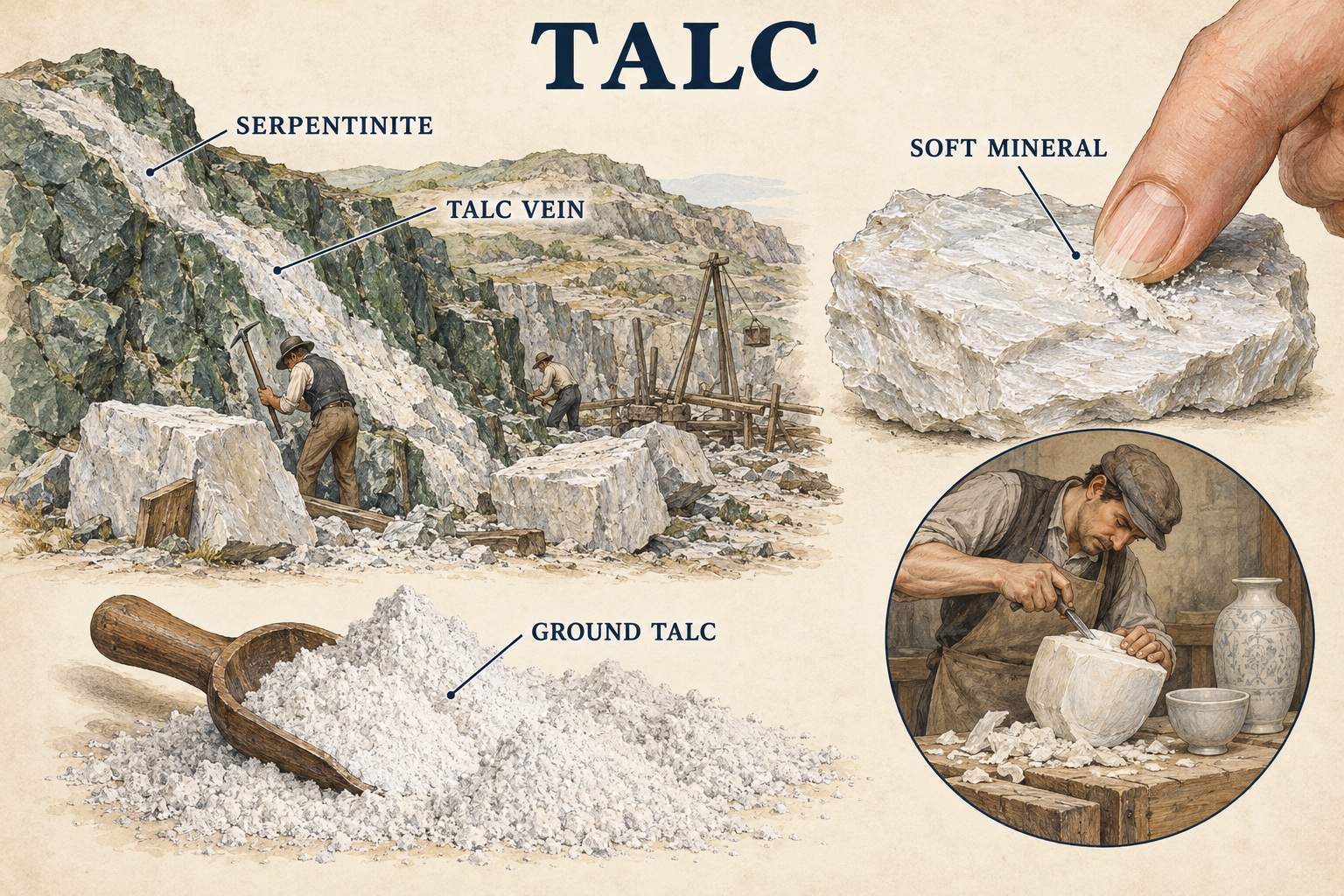
A hydrated magnesium silicate, Mg3Si4O10(OH)2, and the softest mineral there is — 1 on the Mohs scale, soft enough to mark with a fingernail. Its massive carvable form is soapstone, or steatite. It has perfect basal cleavage, splits into thin sheets, and its low shear strength makes it a solid lubricant.
Historical usage
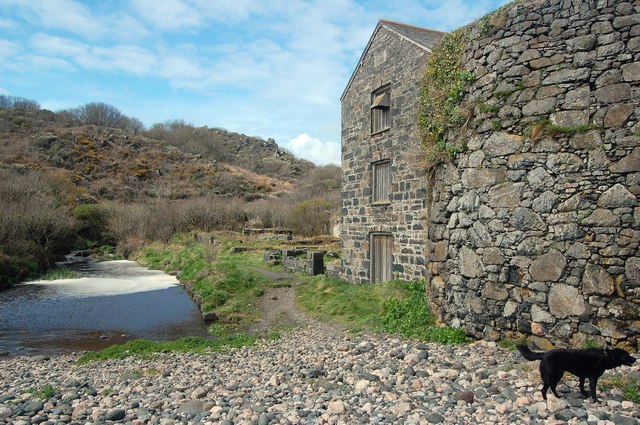
Britain has never been a talc producer of any consequence, and the mineral appears in the archive only as a by-product of the Lizard serpentine coast, where soapstone and later talc were dug from at least the early 18th century. That soapstone mattered more than its tonnage suggests: it went to the Worcester and Bristol porcelain works as a body ingredient before English porcelain recipes settled on china clay and china stone. Industrially, talc is now a filler and a functional mineral rather than a material in its own right — in paper, paint, ceramics, roofing, rubber and plastics — with the cosmetic and pharmaceutical grades a small but conspicuous fraction of output. Britain's other talc working is a small, intermittently-worked quarry at Cross Geo on Clibberswick bay, Unst, Shetland -- a Norse-period steatite (soapstone) source, carved into bowls and loom-weights over a thousand years ago, that has also seen small-scale modern talc quarrying distinct from a separate, larger, now-abandoned operation at Queyhouse elsewhere on Unst (worked continuously from 1945, producing around 9,000 tons a year for uses including roofing felt). Talc at both Shetland sites forms where hydrothermal fluids alter the serpentine of the Shetland Ophiolite Complex -- a slice of ancient oceanic crust and mantle rock entirely unlike the Lizard's own serpentine geology, despite both sites yielding the same commodity.
How it worked
Talc forms by the alteration of magnesian minerals: serpentine, pyroxene, amphibole and olivine react in the presence of carbon dioxide and water, a process called talc carbonation or steatization — serpentine plus carbon dioxide yields talc, magnesite and water. That is why British talc occurs where it does, on an ultramafic coast that had already been serpentinised. Working it is a matter of quarrying and grinding rather than any complex separation; the difficulty is not extraction but purity.
Why it was used
Because softness, chemical inertness and platy crystal habit are a useful combination. Talc will not react with what it is mixed into, it lubricates, it fills, it resists heat, and it can be ground to very fine particle sizes without becoming abrasive — the same property that makes it feel smooth is what makes it valuable as a filler.
Value over time
Talc's market has moved decisively away from the uses most people associate with it. Global output is dominated by China at about 2.2 million tonnes in 2016, roughly 30% of world production, followed by Brazil at 12%, India 11%, the United States 9%, France 6% and Finland 4%; the largest single mine, at Luzenac in southern France, produces around 400,000 tonnes a year. Against that, the cosmetic grades are a small share — but they carried the reputational risk, and the litigation that followed asbestos contamination claims led Johnson & Johnson to withdraw talc-based baby powder in the United States and Canada in 2020. Britain's own contribution was always marginal: the Lizard soapstone trade was worth something to 18th-century porcelain makers and effectively nothing thereafter.
Hazards & challenges
Talc and asbestos form under related conditions and frequently occur in the same ground, which is the central problem: talc contaminated with asbestos is classified by IARC as a group 1 agent, carcinogenic to humans. Stringent quality control since 1976, including separating cosmetic and food-grade talc from industrial material, has largely dealt with this, but the classification of asbestos-free talc itself was raised to group 2A — probably carcinogenic — in July 2024, and perineal use sits at 2B. Occupational exposure is limited in the United States to 2 mg/m³ over an eight-hour day. Inhaled talc also causes pulmonary talcosis, a granulomatous inflammation of the lung, most often seen where talc-adulterated drugs are injected.
Risks & limitations
Purity governs everything. Talc's value depends on the grade achievable, and a deposit carrying iron-bearing or fibrous impurities is worth far less — or, in the case of asbestiform contamination, worth nothing for cosmetic or food use. The British occurrences were never large or pure enough to compete, which is why the Lizard workings supplied local porcelain rather than a national industry.
Regional variation
In Cornwall the material is soapstone or steatite rather than talc, and the distinction is practical rather than mineralogical: soapstone names the block you can carve, talc the powder you can grind.
Related terminology
Mines associated with this term
Included only where MineArchive's own research gives a reasonable evidential basis — not every mine where this might plausibly apply.
- Catpund Quarries — Shetland Islands (well documented example)
Named 9 times in this record, first in the summary: “The largest soapstone quarry in Britain and one of the largest in the world, strung for…” - Cross Geo Talc Quarry — Shetland Islands (well documented example)
Cross Geo Talc Quarry is Britain's other talc working alongside the Lizard coast, worked for steatite in the Norse period and intermittently for talc in modern times. - Poltesco Serpentine Works — Cornwall (well documented example)
The Lizard coastal workings dug soapstone and later talc alongside the serpentine, and it is the archive's only record of talc being worked in Britain.
See every mine that worked talc →
Sources
- (primary) Economic geology of Orkney and Shetland — British Geological Survey (BGS Earthwise)
- (secondary) Poltesco — Wikipedia
- (secondary) Serpentine — Museum of Cornish Life
Record created: 25 August 2026 · Last researched: 26 August 2026