 MineArchive
Poltesco Serpentine Works
| Also known as | Lizard Serpentine Works |
|---|---|
| Location | Poltesco, Lizard Peninsula, Cornwall — 49.9977, -5.1729 (exact) |
| Commodities | Serpentine, Talc |
| Type | Mineral |
| Worked | From early 18th century–1893 |
| Operators | Lizard Serpentine Company (1853–1893) |
Overview
Small coastal workings on the Lizard Peninsula for soapstone and serpentine, growing into a Victorian factory at Poltesco that cut and polished the distinctive green Lizard serpentine into mantelpieces, pillars and ornaments for a market created almost overnight by royal patronage.
History
Small workings along the Lizard coast dug soapstone, and later talc, from at least the early 18th century, and small serpentine ornaments were being made by 1838. Cornish serpentine's popularity as a decorative building material took off after the Great Exhibition of 1851, when Prince Albert ordered pieces to be displayed, following an 1846 royal visit to the Penzance serpentine works that had already resulted in an order for Osborne House. The Lizard Serpentine Company, founded in 1853, built a factory at Poltesco that was operating by 1855 and, in its own purpose-built building from 1866, employed 23 people cutting and polishing serpentine into mantelpieces, pillars, shop fronts, pulpits, church fonts and ornaments. Finished work was shipped out through Penryn and Falmouth; slabs went into Duchy of Cornwall buildings in London, and the company kept showrooms near the Strand.
Geology
Serpentine and its associated talc/soapstone (steatite) both derive from the Lizard Complex's serpentinite, itself formed by the alteration of magnesium-rich igneous rock — a geological formation essentially unique in Britain to this small peninsula.
Geological setting: Podiform Deposits (historical documentary reference)
Workings
Raw serpentine blocks were brought by cart from local quarries to the Poltesco works, cut into slabs and polished, then shipped out by flat-bottomed barge to schooners waiting offshore. The works were driven by a large water wheel fed from a dam by a wooden launder, with a boiler house and engine room added in 1866 to bring in steam power alongside it.
Closure
A brief revival under the Poltesco Marble Company ended when the loss of an uninsured cargo at sea, combined with changing taste, forced the business to wind up in 1893.
What remains
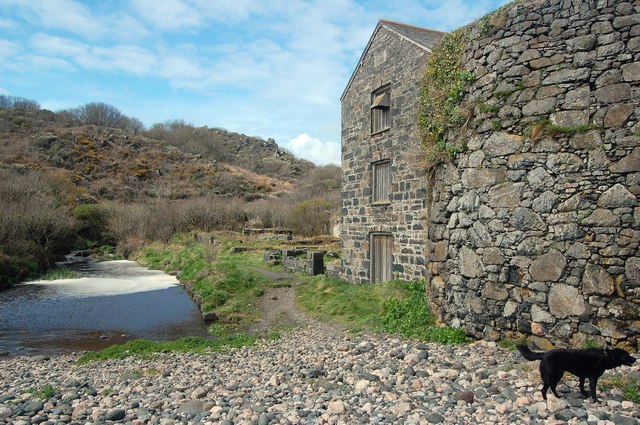
The works survive as ruins in the Poltesco valley, a well-known coastal landmark on the South West Coast Path near Carleon Cove, now in the care of the National Trust. Most of the buildings were demolished in the 1930s by a Mr Ironside, following a Council for the Preservation of Rural England survey that had recommended converting them to holiday accommodation.
The most complete survival is the three-storey gabled warehouse dated 1866; the wheel pit and a saw block also remain visible, along with footings of the machine shops, offices and showroom, storage buildings and forge that made up the rest of the complex.
What's uncertain
Points where sources disagree or the record could not be settled; both accounts are kept. All open questions in the archive.
- The business wound up in 1893 after the loss of an uninsured cargo at sea, combined with a decline in the fashion for serpentine ornament. (uncertain) 1
- Most of the works were demolished in the 1930s by a Mr Ironside, after a Council for the Preservation of Rural England survey recommended converting the buildings to holiday accommodation. (uncertain) 2
- Serpentine slabs from the works were used in Duchy of Cornwall buildings in London, with company showrooms near the Strand; finished goods were shipped through Penryn and Falmouth. (uncertain) 2
Recorded claims
Individual factual claims, each attached to the source(s) that support it below. Where sources disagree, both are kept.
- The Lizard Serpentine Company, founded in 1853, had a factory operating at Poltesco by 1855, employing 23 people in its purpose-built 1866 works. 1
- The business wound up in 1893 after the loss of an uninsured cargo at sea, combined with a decline in the fashion for serpentine ornament. (uncertain) 1
- The factory was water-powered by a wheel fed from a dam via a wooden launder, with a boiler house and engine room added in 1866 to supplement it with steam. 2
- The three-storey warehouse dated 1866 is the most complete surviving building; the wheel pit and a saw block also survive. 2
- Most of the works were demolished in the 1930s by a Mr Ironside, after a Council for the Preservation of Rural England survey recommended converting the buildings to holiday accommodation. (uncertain) 2
- Serpentine slabs from the works were used in Duchy of Cornwall buildings in London, with company showrooms near the Strand; finished goods were shipped through Penryn and Falmouth. (uncertain) 2
Photographs & further reading
Building-by-building record of the factory complex and what survives of it.
View sourceSources
- (secondary) Poltesco — Wikipedia
- (primary) Serpentine Factory at Carleon, Cadgwith & Poltesco (MNA101940) — National Trust Heritage Records
- (observational) The Ruins at Poltesco — The Cornish Bird
- (primary) Mine plan search: LIZARD / POLTESCO / SERPENTINE — BGS / Mining Remediation Authority mine plans catalogue
- (secondary) Serpentine — Museum of Cornish Life
Record created: 25 August 2026 · Last researched: 25 August 2026