 MineArchive
Launder
| Also known as | Launders |
|---|---|
| Category | Ore Processing |
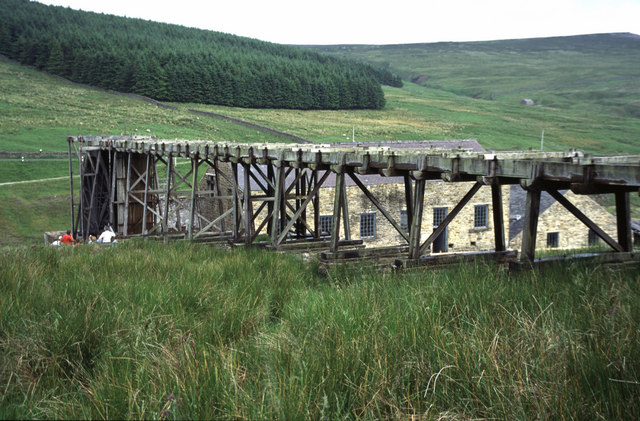
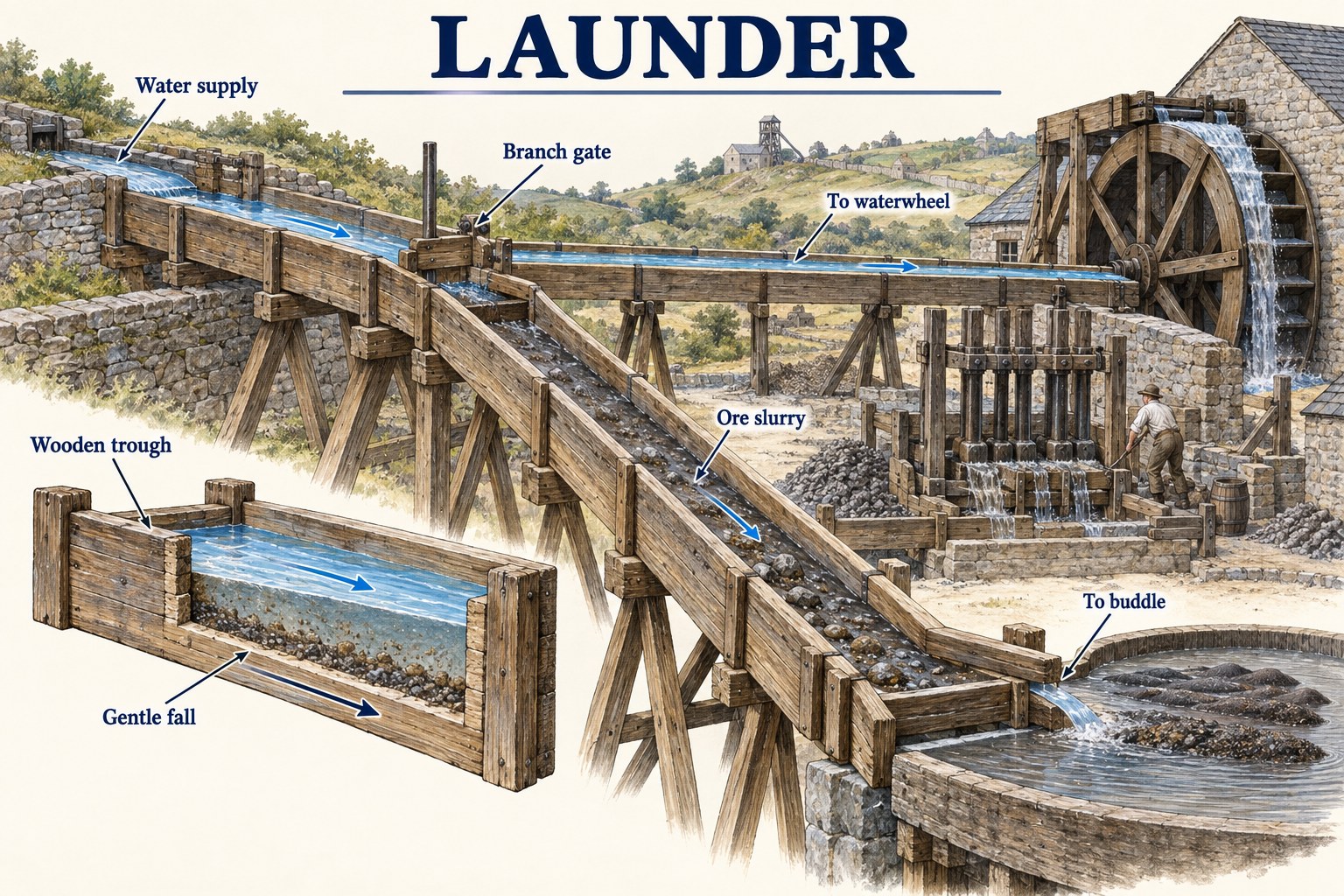
A trough or channel — usually of wood, though sometimes canvas, hide or later iron — used to carry a controlled flow of water, or of crushed ore in water suspension, around a mine's surface dressing floor.
Historical usage
Launders were everyday infrastructure wherever water-powered ore dressing was used, carrying water to and between buddles, stamps and other processing machinery, and sometimes raised on trestles to feed an overshot waterwheel from above.
How it worked
A launder works by gravity alone, carrying water or a water-and-crushed-ore slurry along a gently sloping, open-topped channel from one point to the next — from a supply leat or reservoir to a wheel, from a set of stamps to a buddle, or carrying waste water away from the dressing floor.
Why it was used
A launder was the cheapest and simplest way to move water or slurry exactly where it was needed across a dressing floor, needing no power of its own beyond the natural fall of the ground, and could be extended, branched or repositioned relatively easily as a mine's surface layout changed.
Risks & limitations
Being open-topped and usually built of wood, launders needed regular maintenance against rot, leaks and blockage by settled ore particles, and their fixed, gravity-fed slope meant a dressing floor's whole layout was often designed around getting water to fall the right way through them.
Regional variation
The term and the basic technique are common across British hard-rock mining districts; overshot-wheel feed launders in particular are a recurring feature of Cornish, Welsh and Pennine mine sites wherever a natural fall of water could be captured above the wheel.
Related terminology
Mines associated with this term
5 examples chosen from 9 linked records — the term page is not an index.
- Killhope Lead Mine — County Durham (surviving physical example)
Killhope's restored site includes a surviving launder feeding the Killhope waterwheel, among its other preserved ore-dressing structures. - Broadmeadow Lead Mine — Derbyshire (well documented example)
Named in this record’s history: “…shaft; the drift itself carried water from the river, via raised launders, to the Broadmeadow engine shaft, where a hydraulic engine chamber…” - Green Hurth Mine — County Durham (well documented example)
Named 3 times in this record, first in the workings: “…400 m downhill from the shaft to the dressing floors, where timber launders and a trunk buddle survive among the waste heaps.” - Greenhead Gill Mine — Cumbria (well documented example)
Named in this record’s history: “…square box buddles sunk into the ground, three supports for the launder that fed the waterwheel, and a 'rowle wagon servinge for within the…” - Grinton Smelt Mill — North Yorkshire (well documented example)
Named in this record’s workings: “…behind driven by an overshot waterwheel of about 20 ft fed by a launder from a dammed reservoir. An arched flue 1.8 m high runs 290-300 m…”
Sources
- (secondary) Definition of launder — Mindat.org Glossary
- (secondary) Glossary of Mining Terms — Open University Geological Society (South West Branch)
Record created: 20 August 2026 · Last researched: 20 August 2026