 MineArchive
Water Garland
| Also known as | Garland, Water Curb |
|---|---|
| Category | Structures & Machinery |
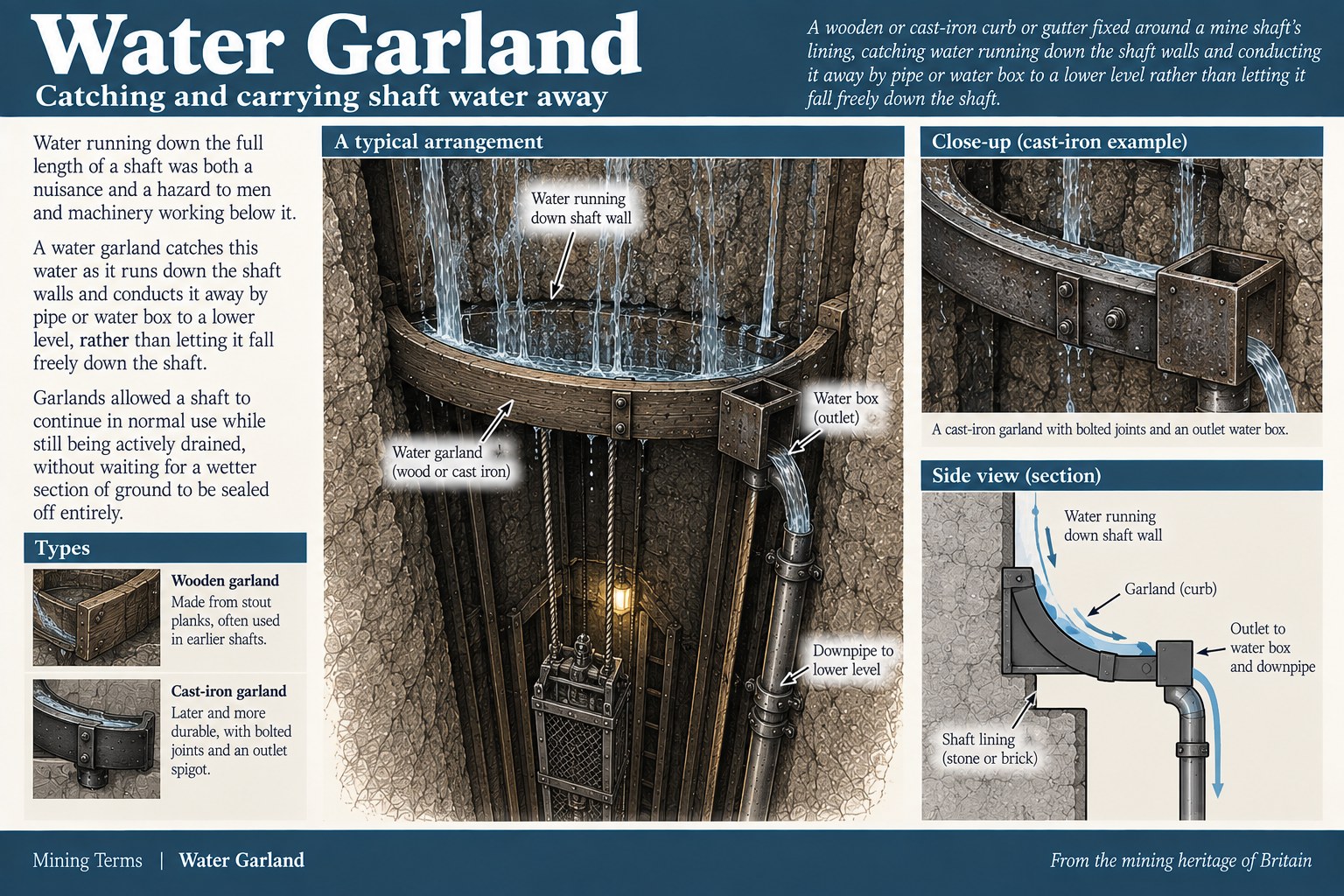
A wooden or cast-iron curb or gutter fixed around a mine shaft's lining, catching water running down the shaft walls and conducting it away by pipe or water box to a lower level rather than letting it fall freely down the shaft.
How it worked
Fitted at intervals up a shaft's lining, a garland formed a continuous ring or channel that intercepted water seeping through the surrounding rock and running down the shaft sides, carrying it sideways into a pipe or launder rather than allowing it to cascade down onto men, cages and machinery working below. The same word was also applied, in a quite different sense, to a rectangular wooden frame with iron corner-plates used to keep coal piled high on a tram from spilling.
Why it was used
Water running freely down the full length of a shaft was both a nuisance and a hazard to men and machinery working below it; a garland let a shaft continue in normal use while still being actively drained, without waiting for a wetter section of ground to be sealed off entirely.
Risks & limitations
Cleaning and maintaining garlands meant working from a scaffold rigged on top of a cage as it moved up and down the shaft -- itself a hazardous task: on 6 June 1943, three men engaged in exactly this work were killed at the already-published Blidworth Colliery when the shaft's two cages collided.
Related terminology
Mines associated with this term
Included only where MineArchive's own research gives a reasonable evidential basis — not every mine where this might plausibly apply.
- Blidworth Colliery — Nottinghamshire (well documented example)
Named twice in this record, first in the history: “…the night of Sunday 6 June 1943, three men were engaged in cleaning water garlands in one of the shafts, working from a scaffold mounted on top of a…” - Gentlewoman's Pipe — Derbyshire (well documented example)
Named in this record’s history: “…the surface, fine examples of hand-pick work including decorative 'garlands', various miners' inscriptions, a wooden hotching trough (used to…” - Ting Tang Mine — Cornwall (well documented example)
Named in this record’s history: “…district. Its principal shafts were known as Eldon's, Taylor's and Garland's; the site produced approximately 40,000 tons of copper ore during…” - United Mines — Cornwall (well documented example)
Named 3 times in this record, first in the history: “…built around a 30-inch cylinder, and the pumping engine house at Garlands Shaft, built for an 85-inch engine. A stamps engine house was added…”
Disasters associated with this term
Included only where MineArchive's own research gives a reasonable evidential basis, with the nature of the relationship stated — not every disaster where this term might plausibly apply.
- Blidworth Colliery Cage Collision (1943) (contextual relationship)
Named in this record’s narrative: “…mounted on top of a descending cage, and while being moved from one garland to another, the shaft's two cages collided for a reason that…” - Glamorgan Colliery cage accident, 1903 (contextual relationship)
Named 3 times in this record, first in the summary: “…on 22 January 1903 when the crowded double-deck cage struck a water garland in the shaft and tipped; three more clung to the frame all the way…” - Maindy Colliery cage accident, 1909 (contextual relationship)
Named 3 times in this record, first in the summary: “…men down the Maindy Colliery shaft at Ton Pentre swung, struck a garland curb and canted, throwing two men some 200 yards to their deaths.”
Sources
- (secondary) Glossary of coal mining terminology — Wikipedia
- (secondary) Glossary of mining terms (G) — Apedale (National Stoke Mining Group)
Record created: 31 August 2026 · Last researched: 31 August 2026