 MineArchive
Ting Tang Mine
| Location | Carharrack, Cornwall — 50.2300, -5.1820 (approximate) |
|---|---|
| Commodity | Copper |
| Type | Metal |
| Worked | By 1816–By 1870 |
| Operators | Clifford Amalgamated Mines (1861–1870) |
Overview
Ting Tang Mine was a copper mine worked in the northern part of the West Clifford United sett at Carharrack, in the Gwennap mining district of Cornwall, one of the richest copper-producing areas in the world during the early nineteenth century. It was drawn into the Clifford Amalgamated Mines combine in 1861 and closed with that operation by 1870 as the district's copper industry collapsed.
History
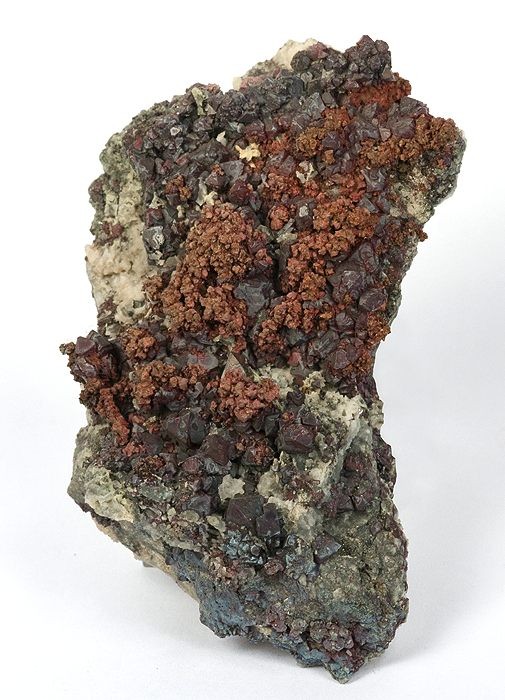
Ting Tang Mine worked copper lodes in the northern part of the West Clifford United sett, in the parish of Gwennap near Carharrack, in the heart of Cornwall's most productive nineteenth-century copper district. Its principal shafts were known as Eldon's, Taylor's and Garland's; the site produced approximately 40,000 tons of copper ore during its working life, with chief produce recorded as copper alongside pyrites and malachite. A Wikimedia Commons specimen record independently describes the mine as active from 1816 to 1865, consistent with the wider run of activity recorded for it.
In 1861 Ting Tang was drawn into a large combination with the neighbouring Consolidated Mines, United Mines, Wheal Clifford and Wheal Squire, known collectively as the Clifford Amalgamated Mines. That combine had itself been formed in 1857 from the merger of Consolidated Mines and United Mines as falling ore grades and cheap foreign competition forced local operations together; Ting Tang's 1861 inclusion appears to represent a later expansion of that same amalgamation rather than a separate event. The combined operation struggled on unprofitably until 1870, by which point the wider Cornish copper industry was in terminal decline against cheaper imported ore, and Ting Tang's workings closed with it.
Carharrack, the mine's home village, is itself the type locality for the copper-arsenate mineral olivenite, which along with azurite, chalcophyllite and cuprite has been recorded from Ting Tang's dumps and remains of interest to mineral collectors.
Geology
Copper lodes in the northern part of the West Clifford United sett at Gwennap, with pyrite alongside the copper.
Workings
Worked from three principal shafts, Eldon's, Taylor's and Garland's.
Closure
The combined operation struggled on unprofitably until 1870, by which time the Cornish copper industry was in terminal decline.
What remains
No detailed current-condition survey specific to Ting Tang's own workings is recorded; most of the mine's numerous shafts are not thought to survive as identifiable features today. The site lies within the wider Carharrack and Gwennap mining landscape, part of the Cornwall and West Devon Mining Landscape World Heritage Site, where engine houses and spoil survive elsewhere in the parish.
Related mines
- United Mines — Drawn into the 1861 combination with United Mines, Consolidated Mines and Wheal Clifford that formed Clifford Amalgamated Mines.
Nearby mines
- Wheal Damsel — 0.2 miles (0.4 km) NE
- Ale and Cakes Mine — 0.5 miles (0.7 km) E
- Wheal Andrew — 0.5 miles (0.9 km) E
- Wheal Cupboard — 0.5 miles (0.9 km) SE
- Copper Hill Mine — 0.6 miles (1.0 km) E
Straight-line distance, within 9 miles (15 km). Show on the map.
What's uncertain
Points where sources disagree or the record could not be settled; both accounts are kept. All open questions in the archive.
- The mine's principal shafts were Eldon's, Taylor's and Garland's shafts. (uncertain) 3
- Ting Tang was one of the important copper-producing concerns in the Gwennap district, with production of approximately 40,000 tons of ore recorded during its operational period; chief produce was copper, alongside pyrites and malachite. (uncertain) 3
- A Wikimedia Commons specimen description independently records Ting Tang as 'an active mine from 1816-1865' — consistent with, though not identical to, the c.1816-1847 copper production window commonly attributed to H.G. Dines in third-party summaries. (uncertain) 4
- In 1861 Ting Tang was drawn into a large combination with the Consolidated Mines, United Mines, Wheal Clifford and Wheal Squire, known as the Clifford Amalgamated Mines — a name and grouping already recorded on this site's Clifford Amalgamated Mines operator page, whose own account dates the underlying merger of Consolidated Mines and United Mines to 1857. The two accounts are not necessarily contradictory: read together they suggest an initial 1857 merger of the two largest setts, expanded in 1861 to formally bring in Ting Tang and the others. (uncertain) 2
Recorded claims
Individual factual claims, each attached to the source(s) that support it below. Where sources disagree, both are kept.
- Ting Tang Mine worked copper lodes in the northern part of the West Clifford United sett, straddling the Carharrack, Gwennap and Lanner parish boundaries near Carharrack. 1,2
- The mine's principal shafts were Eldon's, Taylor's and Garland's shafts. (uncertain) 3
- Ting Tang was one of the important copper-producing concerns in the Gwennap district, with production of approximately 40,000 tons of ore recorded during its operational period; chief produce was copper, alongside pyrites and malachite. (uncertain) 3
- A Wikimedia Commons specimen description independently records Ting Tang as 'an active mine from 1816-1865' — consistent with, though not identical to, the c.1816-1847 copper production window commonly attributed to H.G. Dines in third-party summaries. (uncertain) 4
- In 1861 Ting Tang was drawn into a large combination with the Consolidated Mines, United Mines, Wheal Clifford and Wheal Squire, known as the Clifford Amalgamated Mines — a name and grouping already recorded on this site's Clifford Amalgamated Mines operator page, whose own account dates the underlying merger of Consolidated Mines and United Mines to 1857. The two accounts are not necessarily contradictory: read together they suggest an initial 1857 merger of the two largest setts, expanded in 1861 to formally bring in Ting Tang and the others. (uncertain) 2
- Carharrack, Ting Tang's home village, is the type locality for the copper-arsenate mineral olivenite; azurite, chalcophyllite and cuprite have also been recorded from the mine's dumps. 5,4
Photographs & further reading
Three catalogued abandonment-plan sheets (custodian: The Coal Authority) for Clifford United West Moyle Ting Tang, seam recorded as copper ore — the primary catalogue record for the mine's surviving plans, though the scans themselves are not publicly viewable.
View sourceAditNow's dedicated page for the mine; the site was returning a server error throughout this research pass (2026-08-29) so its content could not be checked, but the page itself is a known-good observational-tier lead for a future refresh.
View sourceSources
- (primary) Mine plan catalogue: Clifford United West Moyle Ting Tang (OMR140D) — British Geological Survey / Mining Remediation Authority
- (secondary) Wheal Clifford Mine, Cornwall — Cornwall Calling
- (secondary) Gwennap Mining District, Cornwall — Cornwall Calling
- (secondary) File:Cuprite-Copper-213114.jpg (image description page) — Wikimedia Commons
- (secondary) Carharrack — Wikipedia

Record created: 29 August 2026 · Last researched: 29 August 2026