 MineArchive
Wheal Pool
| Location | Eastern bank of the Loe valley, south of Helston, Cornwall — 50.0902, -5.2827 (approximate) |
|---|---|
| Commodities | Lead, Silver, Tin |
| Type | Metal |
| Worked | 16th century–1914 |
| Maximum depth | Unknown. |
| Operators | Helston Valley Tin Company (1912–1914) |
Overview
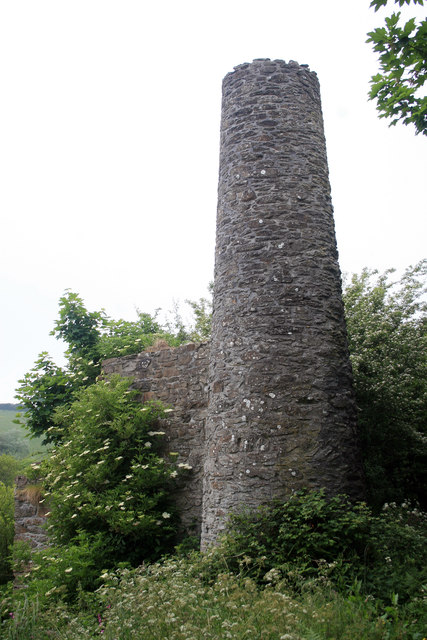
An ancient lead, silver and tin mine on the eastern bank of the Loe valley below Helston, worked opencast and then underground, protected from the Loe Pool by a drainage adit cut through the cliffs; its round-stacked engine house survives.
History
Wheal Pool lies on the eastern side of the Loe valley, south of Helston, beside the Loe Pool. Mining here is ancient, probably from the sixteenth century: the lead and silver ore near the surface was first worked opencast, and the workings went underground about 1800. To keep the Loe Pool from flooding the mine, a drainage adit was cut through the cliffs on the south side of Loe Bar at the end of the eighteenth century so that the level of the pool could be controlled. Official records begin in 1790, when the mine had its own smelting house and a small steam engine.
The surviving engine house may have held a 30- or 36-inch Hornblower and Winwood compound engine of 1794, which would explain its odd size, then perhaps a 30-inch Boulton and Watt engine about 1800, and a 20- or 24-inch pumping engine from 1855. That year a new lease was granted to work for silver, lead and tin over a much larger area, including the tin-rich mud flats around the engine house, and several companies, among them the Loe Pool Stream Works, worked it into the 1870s. From 1912 to 1914 the Helston Valley Tin Company brought modern processing to the eastern side, with concrete tanks, buddles, Wilfley tables, a narrow-gauge railway and two steam engines, whose concrete remains survive in the undergrowth. The mine had three shafts, Engine or Leed's Engine, Caermarthen and Shop; no output is recorded.
Geology
Lead and silver ore near the surface, with tin in the valley-floor deposits.
Workings
Opencast workings, then underground from about 1800 by Engine (Leed's Engine), Caermarthen and Shop shafts; a drainage adit through the cliffs at Loe Bar; tin-streaming and dressing works of 1912-14.
Closure
Worked by several companies into the 1870s; the Helston Valley Tin Company's reworking ended in 1914.
What remains
The engine house with its round stack stands beside the valley; concrete remains of the 1912-14 dressing works survive in the bushes.
An engine house with a round chimney, and concrete foundations of the 1912-14 processing works.
Redevelopment
Unknown.
Nearby mines
- Wheal Fortune — 2.3 miles (3.7 km) NW
- Wheal Metal — 2.6 miles (4.2 km) NW
- Wheal Vor — 2.7 miles (4.4 km) NW
- Wheal Trewavas — 3.4 miles (5.4 km) W
- Wheal Lovell — 3.4 miles (5.5 km) NE
Straight-line distance, within 9 miles (15 km). Show on the map.
Recorded claims
Individual factual claims, each attached to the source(s) that support it below. Where sources disagree, both are kept.
- Worked since at least the 16th century, first opencast and underground from the start of the 19th century. 1,2
- A drainage adit was cut through the cliffs on the south side of Loe Bar at the end of the 18th century to regulate the level of the Loe Pool. 2
- Official records begin in 1790, when the mine had its own smelting house and a small steam engine. 1
- In 1855 a new lease was granted to work for silver, lead and tin over a larger area. 1
- From 1912 to 1914 the Helston Valley Tin Company added modern processing works on the east side. 1
Sources
- (secondary) Wheal Pool — Explore Cornwall
- (secondary) Wheal Pool — iWalk Cornwall
Record created: 17 October 2026 · Last researched: 17 October 2026