 MineArchive
Wheal Metal
| Location | Breage, Cornwall — 50.1211, -5.3167 (exact) |
|---|---|
| Commodities | Tin, Arsenic |
| Type | Metal |
| Worked | 15th century–1877 |
| Maximum depth | 227 fathoms (Ivey's Shaft) |
| Operators | Great Wheal Vor United (1853–1877) |
Overview
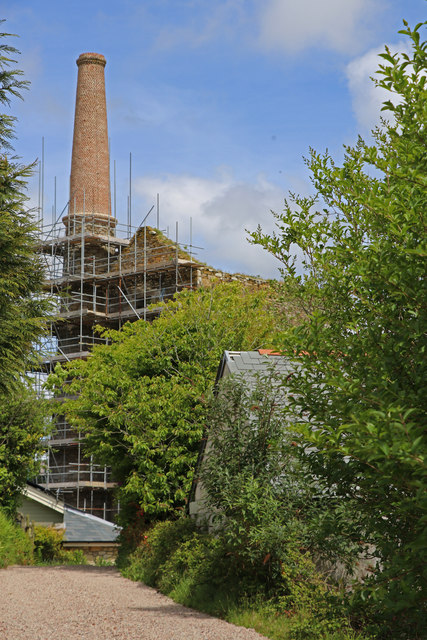
Wheal Metal, part of the wider Wheal Vor group near Breage, hosted a mid-19th-century engine house relocated from Wheal Vor's own Trelawney's Shaft -- today the only large surviving engine house of a mining group that once accounted for a tenth of Cornwall's tin output.
History
Wheal Metal worked on the flanks of Tregonning Hill and Godolphin Hill near Breage from the 15th century, closing around 1877. Four principal shafts were sunk during its 19th-century peak -- Metal Shaft, Old (West) Metal Shaft, Edwards Shaft and Ivey's Shaft, the last reaching the mine's final depth of 227 fathoms -- alongside Trelawney's Shaft, whose 85-inch pumping engine and steam whim were relocated there from the neighbouring Wheal Vor in 1860, the engine house's own stones numbered, dismantled and rebuilt at Ivey's Shaft. Great Wheal Vor United acquired the Wheal Metal sett in 1853, working it alongside its neighbour Flow Mine as part of the wider Wheal Vor mining group -- described by the Mining Journal in July 1885 as 'probably the richest tin mine in the world'. At its mid-1860s peak Wheal Metal alone raised 60-70 tons of black tin a month, some ten per cent of Cornwall's entire annual output by 1867. A 60-inch engine operated alongside the relocated 85-inch engine, and a man-engine with a 12-foot stroke was added in 1868. Work ceased in 1874 and the company was wound up in 1877; the 85-inch engine was sold on to the Wylam pumping station of the Newcastle and Gateshead waterworks, where it survived into the 1940s.
Geology
Worked tin lodes on the eastern flank of Tregonning Hill and Godolphin Hill's granite, part of the same mineralised sett worked at the neighbouring Wheal Vor and Great Wheal Fortune.
Workings
Worked via four principal 19th-century shafts (Metal, Old/West Metal, Edwards and Ivey's) plus the relocated Trelawney's Shaft engine house; an 85-inch pumping engine and steam whim, moved stone-by-stone from Wheal Vor's own Trelawney's Shaft in 1860, operated alongside a 60-inch engine and, from 1868, a 12-foot-stroke man-engine.
Closure
Work ceased in 1874 and the company was wound up in 1877.
What remains
The engine house at Ivey's Shaft survives in good condition and is Grade II listed -- the only large surviving engine house of the whole Wheal Vor group, whose other workings have left little visible trace.
The Ivey's Shaft engine house survives largely intact; a detached chimney and a second engine house associated with the wider Wheal Metal and Flow sett are also separately listed.
Redevelopment
The site of the former sett is now occupied by various private properties.
Related mines
- Wheal Vor — Wheal Metal was acquired in 1853 by Great Wheal Vor United and worked as part of one combined operation with Wheal Vor; the 85-inch pumping engine that came to stand over Wheal Metal's own Ivey's Shaft was physically relocated there, stone by stone, from Wheal Vor's own Trelawney's Shaft in 1860.
Nearby mines
- Wheal Fortune — 0.5 miles (0.8 km) S
- Wheal Vor — 0.5 miles (0.8 km) SW
- Tregonning Hill China Clay Pits — 1.8 miles (2.9 km) W
- Great Work Mine — 2.2 miles (3.6 km) W
- Wheal Grey Mine — 2.2 miles (3.6 km) W
Straight-line distance, within 9 miles (15 km). Show on the map.
Recorded claims
Individual factual claims, each attached to the source(s) that support it below. Where sources disagree, both are kept.
- The 85-inch pumping engine and steam whim that came to stand over Ivey's Shaft were relocated there from Wheal Vor's own Trelawney's Shaft in 1860, the engine house's stones numbered, dismantled and rebuilt on the new site. 1
- At its mid-1860s peak Wheal Metal alone raised 60-70 tons of black tin a month, around ten per cent of Cornwall's entire annual tin output by 1867. 1
- Work at Wheal Metal ceased in 1874 and the operating company was wound up in 1877; the relocated 85-inch engine was sold on to the Wylam pumping station of the Newcastle and Gateshead waterworks, where it survived into the 1940s. 1
- The engine house at Ivey's Shaft is a Grade II listed building on the National Heritage List for England, listed at SW628298. 2
- A combined mine plan record in the BGS/Mining Remediation Authority catalogue (no. OM175) names Wheal Metal alongside Wheal Vor, Great Carleen, Penhale and other setts under one operation, independent corroboration of the combined Wheal Vor United working. 3
Photographs & further reading
The official Grade II listing for the surviving engine house, the only large surviving structure of the wider Wheal Vor mining group.
View sourceSources
- (secondary) Wheal Metal — Wikipedia
- (primary) Engine House at SW628298, Ivey's Shaft, Wheal Metal — Historic England (National Heritage List for England)
- (primary) Wheal Vor Mine Plan (BGS Mine Plans Catalogue) — British Geological Survey / The Coal Authority
Record created: 2 September 2026 · Last researched: 2 September 2026