 MineArchive
Podiform Deposits
| Also known as | Podiform Chromite Deposits (The specific, and in Britain only, form this deposit type takes) |
|---|---|
| Category | Deposit Types |
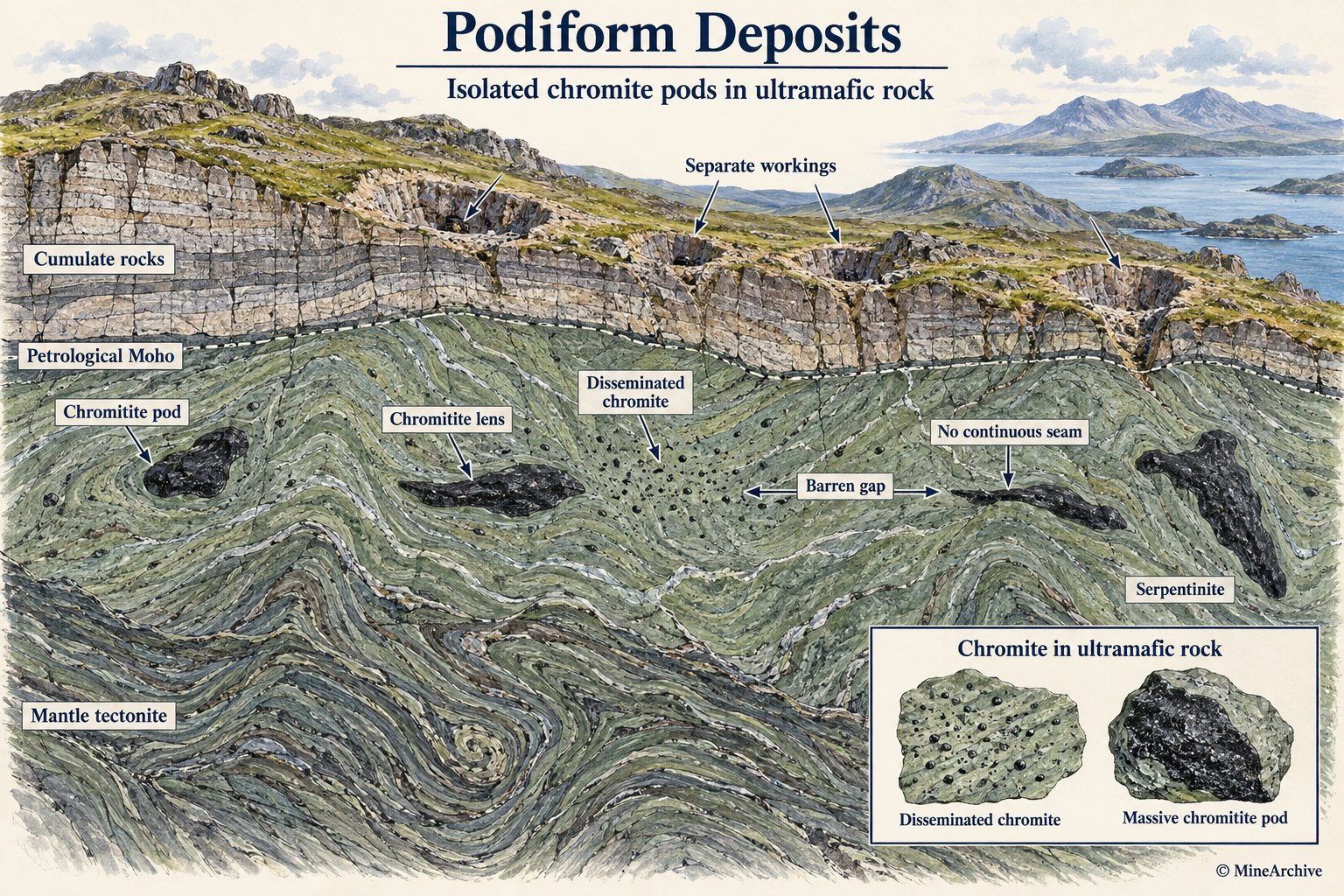
A pod-shaped, isolated concentration of ore — most often chromite — enclosed within a body of serpentinised ultramafic rock, with no continuous vein or seam connecting one pod to the next.
How it forms
Podiform deposits form within slices of ancient oceanic crust and upper mantle, called ophiolites, thrust up onto continental land during mountain-building episodes. As the original ultramafic rock — dense, iron- and magnesium-rich material from deep in the Earth — cools and crystallises, chromite can separate out and collect into isolated pockets within it, shaped by the way the surrounding rock later deforms and folds during and after emplacement, rather than by any single planar fracture the way a vein or lode forms. Chromite itself is not rare in these rocks: the USGS puts it at about 1 per cent of the ultramafic part of an ophiolite sequence, scattered as accessory grains through the whole mass. What makes a deposit is the small proportion of it that gathered. The pods sit in dunite, serpentinite or peridotite, and characteristically near the boundary between the cumulate rocks above and the tectonite below — within about a kilometre of the petrological Moho, the old crust-mantle transition of the ocean floor the ophiolite came from. They form at mid-ocean ridges, off-ridge, and above subduction zones; Shetland's are of the last kind, formed as melt percolated through the mantle of a supra-subduction-zone ophiolite about 492 million years ago.
Why minerals concentrate here
Chromite concentrates in these settings because it crystallises early and at a different point from the surrounding silicate minerals of the parent ultramafic rock, and because the intense deformation an ophiolite undergoes during its uplift and emplacement — folding, shearing and structural disruption — tends to gather these early crystals into discrete pockets rather than leaving them spread evenly through the host rock. The difference in grade between gathered and ungathered chromite is what decides whether there is a mine. Disseminated bands and streaks typically run 10 to 30 per cent chromic oxide; massive podiform ore runs 40 to 60 per cent. Where the process is seen at close range the two occur side by side: at Hagdale on Unst, the largest of the Shetland deposits, a near-vertical vein of solid chromitite swelling to 3.6 metres wide ran along the north side of the pit, and a metre or two away across a barren zone lay a parallel band of low-grade ore in which the chromite content varied from almost nothing to 90 per cent with no regularity of grain distribution at all.
Typical shape of the deposit
Irregular, pod- or lens-shaped bodies, typically small and occurring in clusters rather than as a single continuous body — the shape gives the deposit type its name. They range from nodules the size of a pea to bodies hundreds of metres across, and may be tabular, cylindrical or wholly irregular; massive lenses can run continuously for tens of metres or pinch and swell abruptly, with individual lenses widely separated. Neither vein nor seam is the right mental picture. The Unst memoir's verdict on the deposits worked there is worth quoting for how little order they showed: nowhere did the veins of chromitite, or the grains forming the low-grade ore, 'exhibit any order or regularity, or display any rectilinearity'. Size follows shape. The USGS's world database of 1,124 podiform deposits gives a median tonnage of 11,000 tonnes for the major model and 100 tonnes for the minor one — figures that describe a quarry rather than a colliery.
What this means for mining
Because a podiform deposit has no predictable continuation the way a vein or seam does, mining it means following each pod individually rather than driving a single level or drift along one consistent line: a district with this geology is naturally worked as a scatter of separate small quarries or pits, each exhausted in turn, rather than as one large connected mine. This is exactly the pattern seen at Unst, where chromite workings are spread across several separate sites — Hagdale, Nikka Vord and Wick of Hagdale — rather than following one lode. Exploration is the hard part, and it stays hard. The pods are distributed more or less at random through the ultramafic rock; they occur in dunite, but most dunite has none, and the dunite bodies are themselves scattered unpredictably through the peridotite. Chromite resists erosion, so a deposit at outcrop is easy enough to spot protruding from softer rock — but once the visible ones are gone, drilling around a worked-out pod has a poor record of finding the next. On Unst the method for a century and a half was to find a thin chromitite vein at surface and follow it by hand drilling in the hope that it swelled into one of the pancake-like lenses; more than a hundred such excavations were dug, each leaving its pair of spoil heaps, and in 1870 about a hundred boreholes were put down on the island of Haaf Gruney alone. Only two or three minor economic deposits were found that way. Almost no undisturbed chromitite vein now survives at surface on Unst, however thin — the memoir notes drily that veins of chromitite are extremely rare there 'because they were targeted by the miners'. The economics follow: a deposit is quickly mined out, the shallow ones by open pits and the deeper extensions by underground workings, and the industry lives or dies on finding new pods rather than on deepening old ones. Unst's chromite mining ended in 1877, and again after 1944, for exactly that reason — not because the ground was exhausted in any general sense, but because the high-grade pods that could be found had been found.
Associated commodities
Chromite (Chromite is the commodity of essentially every podiform deposit worked anywhere: the pods are chromitite, and massive podiform ore runs 40 to 60 per cent chromic oxide against 10 to 30 per cent in the disseminated bands around it.)
Related Mining Terms & Methods
Gangue (The silicate minerals enclosing the chromite — olivine, serpentine, chlorite and pyroxenes — are the gangue here, and the proportion of them rises steadily as an orebody grades out from massive to disseminated.), Opencast Working (Podiform pods at or near surface were worked as open pits — the shallow ones by quarrying and only their deeper extensions underground, which is why an ophiolite district reads as a scatter of small pits rather than a mine.)
Diagrams
MineArchive examples
Included only where MineArchive's own research gives a reasonable evidential basis — not every mine where this geology might plausibly apply.
- Unst Chromite Mines — Shetland Islands (well documented example)
Unst's chromite occurs as isolated pods within serpentinised ultramafic rock, part of an ophiolite emplaced during the Caledonian orogeny — the defining example of this deposit type in Britain. - Poltesco Serpentine Works — Cornwall (historical documentary reference)
Poltesco worked the Lizard Complex serpentinite itself, as decorative stone and soapstone — the same serpentinised ultramafic host rock that carries podiform chromite elsewhere, though no chromite was worked here.
See all 2 linked mines.
Sources
- (primary) Geology of Unst and Fetlar in Shetland: Memoir for 1:50 000 geological sheet 131 (Scotland) — D. Flinn, British Geological Survey, 2014
- (primary) Podiform Chromite Deposits — Database and Grade and Tonnage Models (Scientific Investigations Report 2012-5157) — Mosier, Singer, Moring & Galloway, U.S. Geological Survey, 2012
- (primary) Scottish mineral Geological Conservation Review sites — Magmatic Minerals — Geological Conservation Review / ScienceDirect
Record created: 25 August 2026 · Last researched: 5 September 2026