 MineArchive
Unst Chromite Mines
| Also known as | Hagdale Chromite Quarry, Nikka Vord Chromite Quarries |
|---|---|
| Location | Hagdale and Nikka Vord, near Baltasound, Unst, Shetland Islands — 60.7703, -0.8261 (approximate) |
| Commodity | Chromite |
| Type | Mineral |
| Worked | 1817 (discovery)–1944 |
| Maximum depth | Hagdale Quarry nearly 40 m deep at its greatest extent |
Overview
Britain's largest chromite deposit, worked from the edge of a Shetland voe for a mineral found almost nowhere else in the country — and one of the few places in the archive reached by a railway that never carried a single passenger.
History
Chromite was discovered on Unst by the naturalist Samuel Hibbert in 1817, in outcrops of the island's distinctive serpentine rock. Serious quarrying began in 1824 and continued, mainly from Hagdale Quarry opened in 1839, until 1873; at its peak Hagdale was the largest chromite working in Britain. Mining resumed on a smaller scale from 1908 to 1923, when falling freight rates made Unst's comparatively low-grade chromite uncompetitive against richer overseas sources, and again briefly from 1938 to 1944. A narrow-gauge railway, built in 1907, carried ore a mile and a half from the Hagdale quarries down to a pier at Baltasound for shipment.
Geology
Unst's chromite occurs in podiform deposits within a body of serpentinised peridotite — part of an ophiolite, a slice of ancient oceanic crust and upper mantle thrust onto land during the Caledonian mountain-building episode. The chromite formed as isolated, pod-shaped concentrations within the ultramafic rock rather than as a continuous seam, which is why the workings are scattered across several separate quarries — Hagdale, Nikka Vord and Wick of Hagdale — rather than following one lode.
Geological setting: Podiform Deposits (well documented example)
Workings
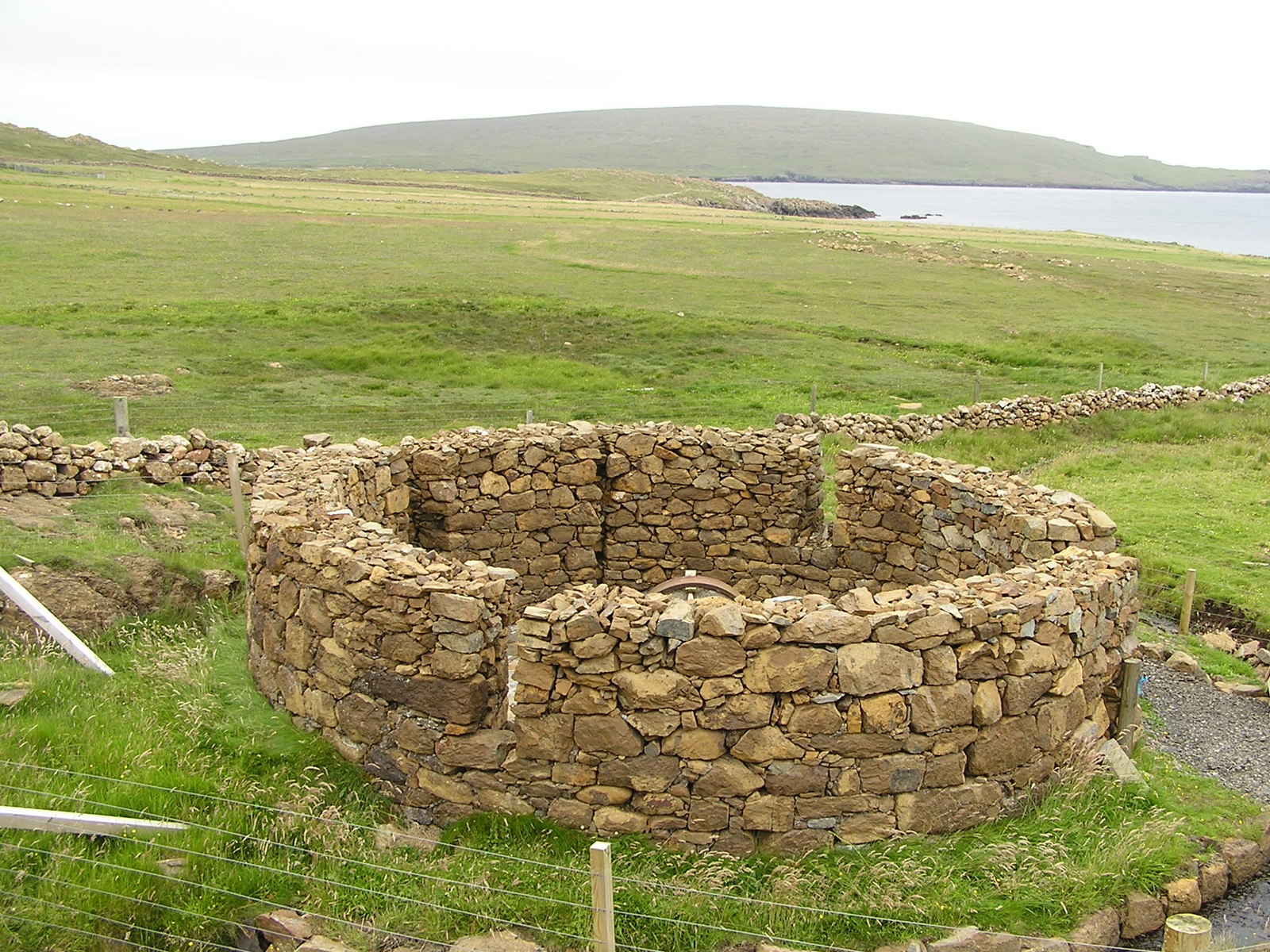
Worked entirely by opencast quarrying rather than underground mining, following the chromite pods as they were exposed. At Hagdale, quarried ore was crushed and washed at a horse-powered mill — a large circular horse-gin, the 'crushing circle' — before onward transport; the mill and its circle survive as the last of their kind in the United Kingdom. From 1907 a narrow-gauge railway of 2 ft 6 in gauge carried ore a mile and a half from Hagdale to a loading pier at Baltasound.
Closure
Chromite quarrying at Unst ended for good in 1944, defeated each time it resumed by the cost of shipping a comparatively low-grade ore such a long way to market against cheaper overseas chromite.
What remains
The main Hagdale Quarry is now largely infilled, but its waste heaps remain prominent on the hillside, along with numerous smaller pits and flattened spoil heaps at Nikka Vord. The horse-powered crushing mill and its surrounding circle at Hagdale have been restored and are the last surviving example of their kind in Britain. No trace of the railway or its rolling stock was preserved when it closed.
The restored Hagdale horse mill and crushing circle, waste heaps at Hagdale and Nikka Vord, and the former railway formation between Hagdale and Baltasound.
Redevelopment
None — the site is preserved as an industrial heritage feature within the Shetland Geopark.
Nearby mines
- Cross Geo Talc Quarry — 2.3 miles (3.6 km) S
Straight-line distance, within 9 miles (15 km). Show on the map.
Recorded claims
Individual factual claims, each attached to the source(s) that support it below. Where sources disagree, both are kept.
- Chromite was discovered on Unst by Samuel Hibbert in 1817; serious quarrying began in 1824, mainly from Hagdale Quarry opened in 1839, which was the largest chromite working in Britain at its peak. 1,2
- The chromite occurs as podiform deposits within serpentinised peridotite, part of an ophiolite emplaced during the Caledonian orogeny, which is why the workings are scattered across several separate quarries rather than following one lode. 2
- Ore was crushed and washed at a horse-powered mill at Hagdale, whose crushing circle survives restored as the last of its kind in the UK; from 1907 a narrow-gauge railway carried ore a mile and a half to a pier at Baltasound. 1,3
- Mining continued intermittently — 1824-73, 1908-23 and 1938-44 — each phase eventually defeated by the cost of shipping comparatively low-grade ore against cheaper overseas chromite. 2
Photographs & further reading
Sources
- (secondary) Metal ores and minerals — Shetland.org (Shetland UNESCO Global Geopark)
- (primary) Scottish mineral Geological Conservation Review sites — Magmatic Minerals — Geological Conservation Review / ScienceDirect
- (secondary) Hagdale Chromate Railway — Wikipedia
Record created: 24 August 2026 · Last researched: 24 August 2026