 MineArchive
Chromite
| Also known as | Chrome Ore (General industrial name), Chrome Ironstone (Older 19th-century name) |
|---|---|
| Category | Commodities |
| Commodity page | Chromite → |
An iron-chromium oxide, the only commercially important ore of chromium, worked in Britain almost nowhere but Unst — a mineral valued first as a pigment and later, once steelmaking demanded it, as the source of metallic chromium itself.
Historical usage
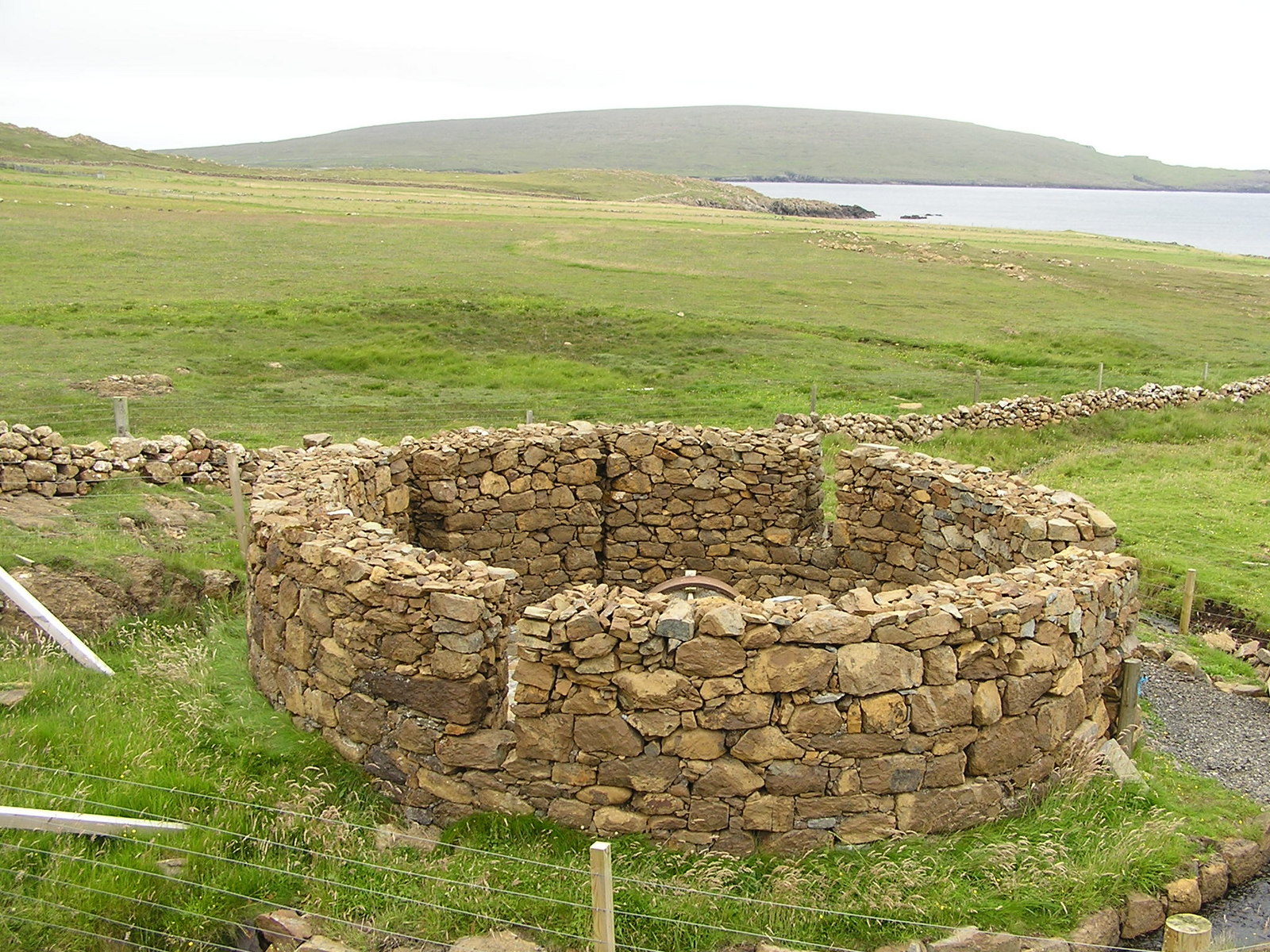
Chromite was discovered on Unst by the naturalist Samuel Hibbert in 1817, and serious quarrying began in 1824, mainly at Hagdale Quarry from 1839, which became the largest chromite working in Britain before closing in 1873. It was reworked on a smaller scale in 1908-23 and again in 1938-44, each revival eventually defeated by the cost of shipping comparatively low-grade Shetland ore against cheaper deposits overseas.
How it worked
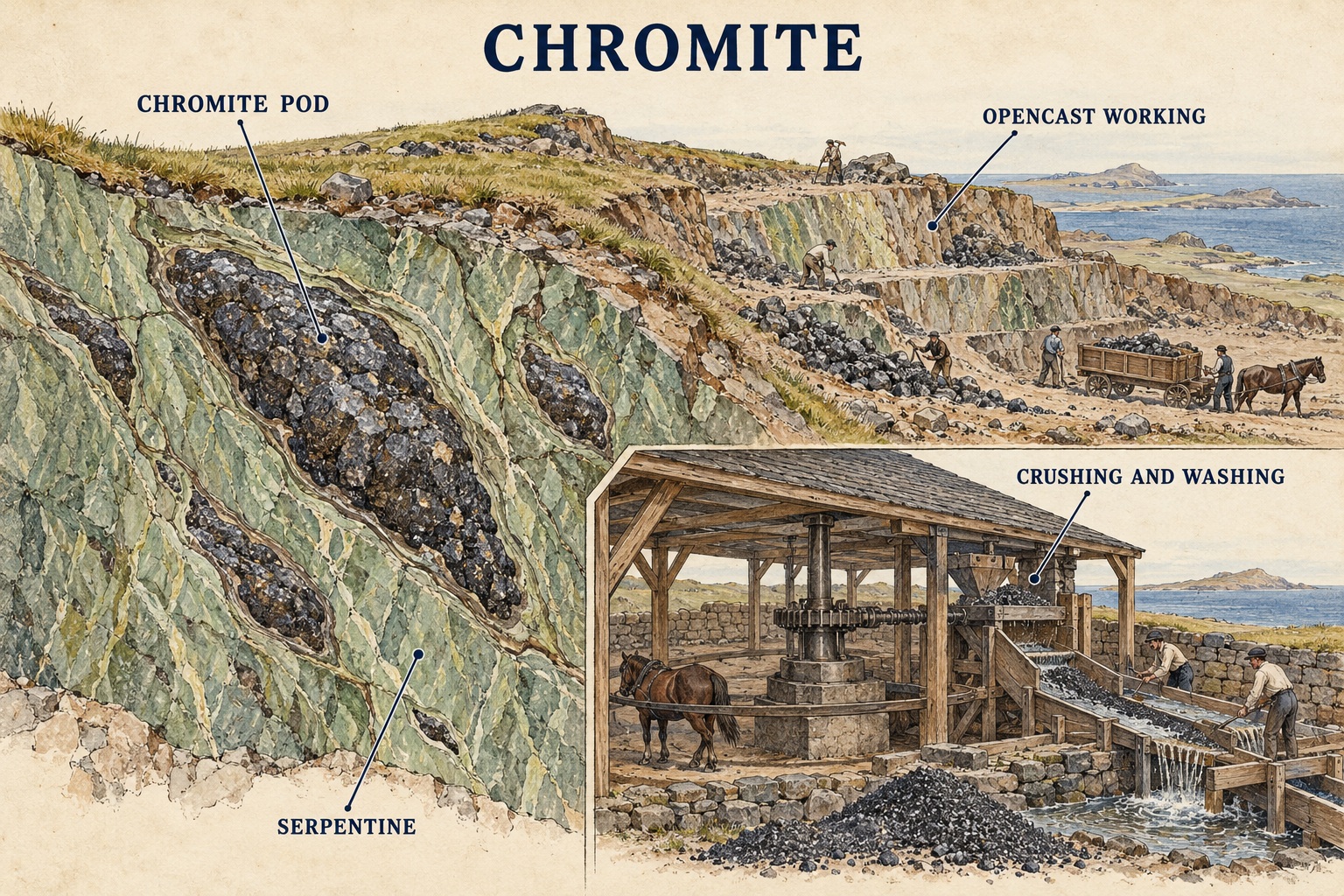
Chromite was quarried entirely by simple opencast working, following the isolated, pod-shaped concentrations of the mineral as they were exposed in the surrounding serpentine rock, rather than by deep mining along a continuous seam. At Unst the quarried ore was crushed and washed at a horse-powered mill before being carried to port for shipment.
Why it was used
Chromite's early value was as a pigment, giving paints and glazes a stable yellow to green colour; as steelmaking grew from the mid-19th century, it became instead the essential raw material for producing metallic chromium and ferrochrome, the alloying element that gives stainless and other specialist steels their hardness and corrosion resistance.
Value over time
Unst's chromite never competed on price with the world's major deposits: its value lay in being the only substantial British source at all, which sustained small-scale, intermittent working through the 19th and into the 20th century whenever transport costs or wartime disruption to imports briefly made it worth reopening. Once cheaper, higher-grade chromite from overseas producers became reliably available, each revival proved short-lived, and the deposit has not been worked since 1944.
Hazards & challenges
Chromite ore itself, and the simple crushing and washing it received at Unst, did not generate the more serious hexavalent chromium hazard associated with chromium manufacture — that specific carcinogenic risk arises mainly from high-temperature processing and fine dry milling of the kind never carried out on the island — so the extraction hazard here was the generic hard-rock dust risk of any opencast quarry rather than a chemical hazard peculiar to the mineral.
Risks & limitations
Because chromite forms as scattered pods within serpentine rock rather than a single continuous lode, workings like Unst's were spread across several separate small quarries rather than one large mine, and reserves at any one site were correspondingly limited.
Regional variation
Chromite is found in Britain almost nowhere outside Unst, whose serpentine geology is itself unusual for the country; most British demand has always been met by imported ore from much larger overseas deposits.
Related terminology
Mines associated with this term
Included only where MineArchive's own research gives a reasonable evidential basis — not every mine where this might plausibly apply.
- Unst Chromite Mines — Shetland Islands (well documented example)
The only chromite deposit worked at any scale in Britain, documented in detail on the mine's own record.
See every mine that worked chromite →
Sources
- (secondary) Human exposure to chromite mining pollution, the toxicity mechanism and health impact — Heliyon / ScienceDirect
- (secondary) Metal ores and minerals — Shetland.org (Shetland UNESCO Global Geopark)
Record created: 24 August 2026 · Last researched: 24 August 2026