 MineArchive
Chrysotile
| Also known as | White Asbestos (The common trade and regulatory name), Serpentine Asbestos (Describes its mineral group) |
|---|---|
| Category | Commodities |
| Commodity page | Chrysotile → |
The fibrous, curly-stranded form of serpentine that gives ordinary asbestos its name — soft, flexible and fire-resistant enough to be spun into cloth, and now understood to be lethal to breathe.
Historical usage
Chrysotile has been recognised and used for over two thousand years, valued in antiquity for cremation cloths, lamp wicks and other fire-resistant textiles woven from its unusually long, flexible fibres. Commercial mining on an industrial scale began in the 19th century in the Urals, Italy and above all Canada, where large-scale extraction started at Thetford, Quebec, in 1878 and continued there, at what became the Jeffrey Mine, until 2011 — for much of the 20th century the largest asbestos mine in the world. In Britain, chrysotile occurs only very rarely: the geologist Edward Greenly recorded it in 1919 in a small quarry at Mynachdy, North Anglesey, worked into a body of serpentinised ultrabasic rock, and it has been tentatively identified only once more, in an unusual occurrence within Coal Measures strata at Cefn Coed Colliery in the Dulais Valley, Neath — the only two locations recorded anywhere in Wales.
How it worked
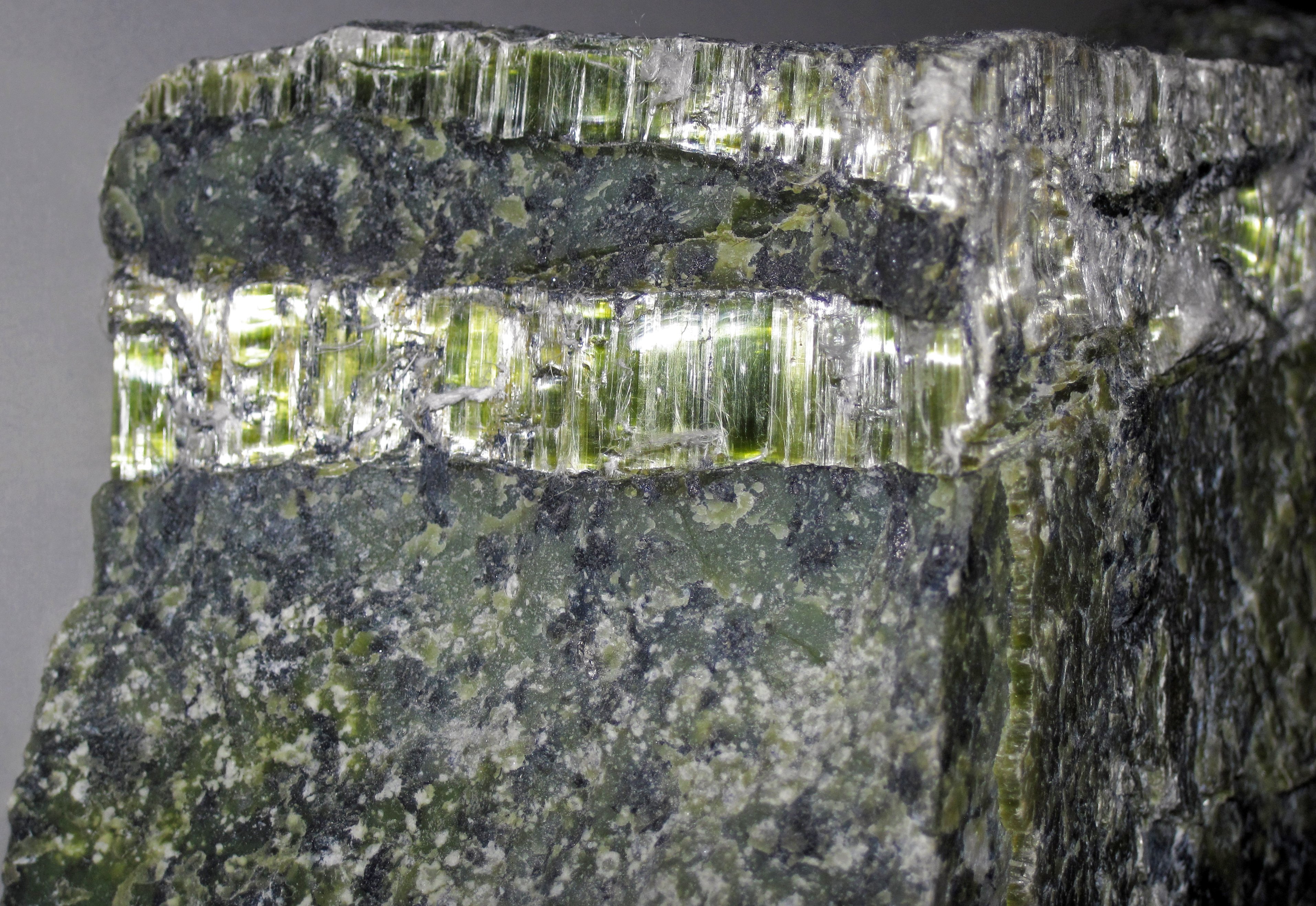
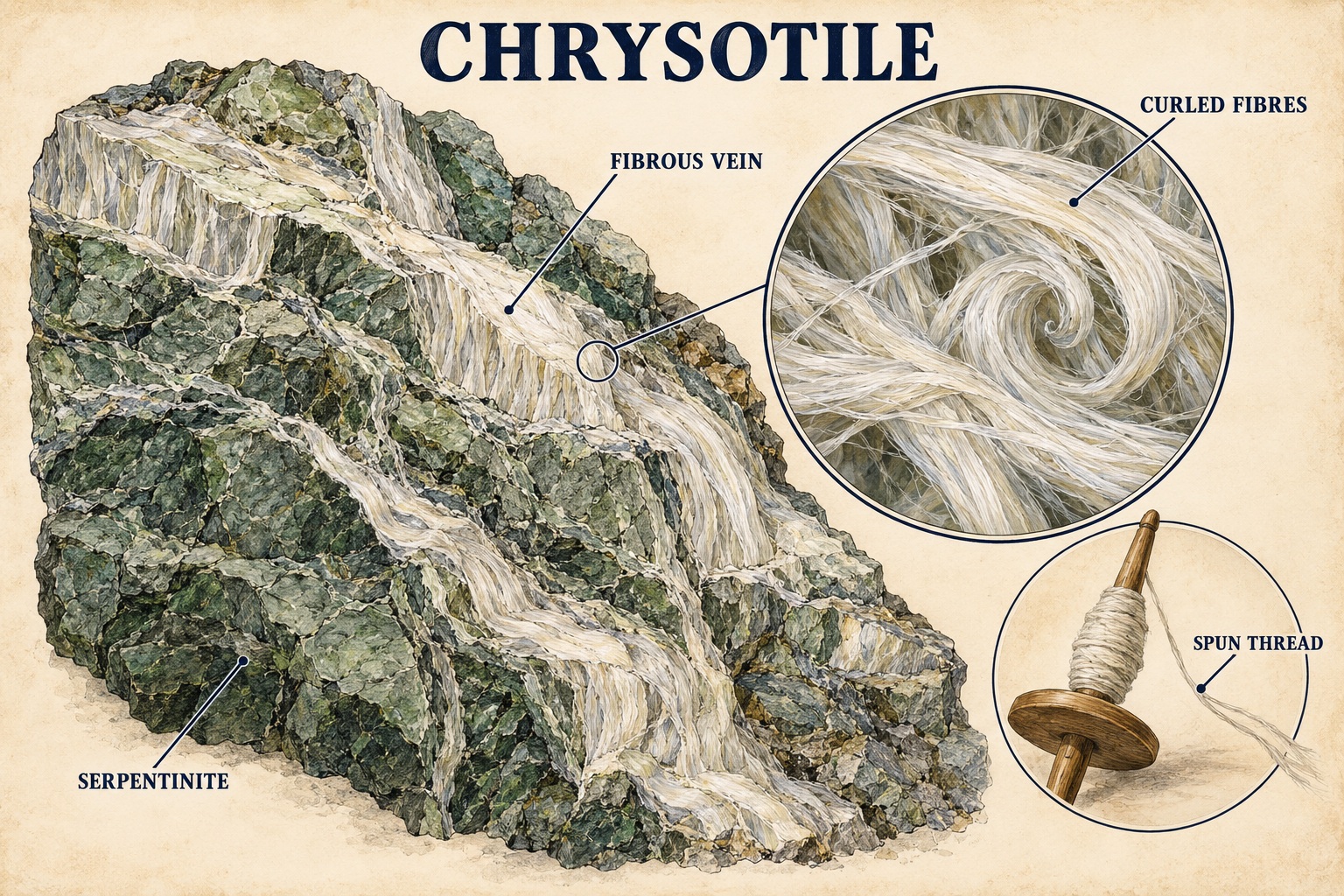
Chrysotile forms where ultrabasic rocks such as peridotite are altered by hot, water-rich fluids in a process called serpentinisation, which converts their original minerals into serpentine-group minerals including chrysotile itself. Rather than growing as compact crystals, chrysotile forms as fine, curling fibres running through veins in the serpentinite, which is what let it be extracted, separated and spun rather than merely crushed for its chemistry the way most mined minerals are.
Why it was used
Chrysotile's long, flexible, heat-resistant fibres made it exceptionally versatile: spun into cloth for fireproof curtains, safety clothing and conveyor belts, woven or bonded into gaskets, brake linings, roof sealants, pipe lagging and high-temperature caulking, and mixed into cement sheet and building board for fireproofing and insulation throughout the 20th century. By volume it became by far the most widely used form of asbestos, accounting for roughly 95 per cent of all asbestos ever produced.
Value over time
Chrysotile never had any real commercial value in Britain — the Mynachdy quarry was a small, short-lived local operation rather than part of any national industry, and nothing suggests the Cefn Coed occurrence was ever worked for the mineral at all, only later identified in colliery material by laboratory analysis. Britain's asbestos economy, such as it was, ran almost entirely on imported fibre from Canada and elsewhere rather than on any domestic mining. Chrysotile's value later inverted entirely: once one of the most useful industrial minerals in the world, it became, once its health effects were understood, a substance whose 'value' lies chiefly in the cost of safely removing it.
Hazards & challenges
Chrysotile is the reason asbestos exposure is one of the best-documented occupational health disasters in industrial history: prolonged inhalation of its fine fibres causes asbestosis, lung cancer, mesothelioma and other cancers, typically after a latency of decades, and it is now classified as a proven human carcinogen with no safe level of exposure. Unlike most hazards recorded in this archive, this is not a hazard of extracting the mineral so much as of the mineral itself, in any form and at any stage of use.
Risks & limitations
Chrysotile in Britain occurs only in small, geologically unusual pockets rather than any deposit worth developing commercially, which is precisely why neither Mynachdy nor Cefn Coed ever became more than a curiosity: there was never enough of it, in a consistent enough body, to compete with imported Canadian or Russian fibre even before the mineral's health effects made that competition moot. The Cefn Coed identification is further complicated by genuine mineralogical uncertainty — the material there has not been conclusively distinguished from amesite, a related but non-fibrous serpentine mineral.
Regional variation
In Britain chrysotile is essentially a Welsh curiosity rather than a worked industry in its own right: the small Mynachdy quarry and the tentative Cefn Coed identification are the only two confirmed or suspected occurrences in the country, in complete contrast to the vast industrial scale chrysotile mining reached in Canada, Russia and elsewhere.
Related terminology
Mines associated with this term
Included only where MineArchive's own research gives a reasonable evidential basis — not every mine where this might plausibly apply.
- Mynachdy (Rhosmynach and Carmel Head Copper Mines) — Anglesey (well documented example)
The confirmed British locality: a small quarry described by Edward Greenly in 1919, worked into serpentinised ultrabasic rock at Mynachdy itself. - Cefn Coed Colliery — Neath Port Talbot (historical documentary reference)
An unresolved, tentative identification only: material from the Dulais Seam here was identified by X-ray diffraction as 'amesite or chrysotile', an unusual and unconfirmed occurrence in Coal Measures strata rather than a worked example.
See every mine that worked chrysotile →
Sources
- (primary) Chrysotile — Mineralogy of Wales database — National Museum Wales
- (secondary) A History Of Asbestos In The UK — Lucion Group
- (secondary) Chrysotile asbestos — the deadly consequences of a retreat from national bans — The Lancet Respiratory Medicine
Record created: 24 August 2026 · Last researched: 24 August 2026